Summary
- The webinar was purpose-built to help Jamaat members prepare holistically for Ramadan, addressing the connection between physical well-being and spiritual readiness through a three-pillared framework of mind, body and soul.
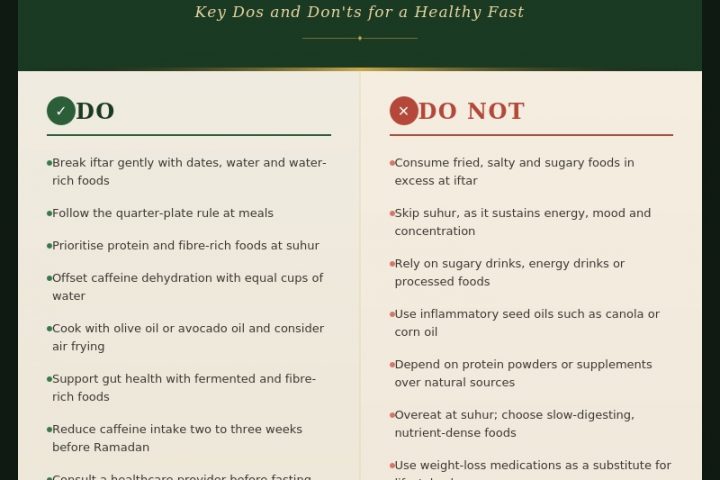
- Practical strategies for suhur and iftar were outlined, including the quarter plate rule, proper hydration and healthier cooking methods, all grounded in Quranic guidance on moderation and lawful consumption.
- The teachings of the Promised Messiah (as) on balance, moderation and the obligation to preserve health during illness and travel were presented as the spiritual foundation for the session.
- Panellists stressed that individuals with chronic conditions such as diabetes or hypertension should seek medical advice before fasting, as medication absorption and metabolic responses change during prolonged fasting.
A pre-Ramadan health webinar titled “From Plate to Pulse: Preparing Mind, Body and Soul for Ramadan” drew 157 participants for an evening of practical guidance on nutrition, hydration and mindful eating ahead of the blessed month. The session was designed to help members move beyond a survival mindset during Ramadan and toward a thriving one, entering the holy month feeling physically capable, mentally sharp and spiritually prepared.
The online session, organized by the Ahmadiyya Muslim Medical Association (AMMAC) Allied Health and Nurses Committee, was hosted by Dr. Noman Hassan, surgeon and committee president. The keynote presentation was delivered by Mubarka Khokhar, a registered nurse and vice president of the Nurses and Allied Health Professionals within AMMAC Canada.
Khokhar connected Quranic teachings on moderation with evidence-based nutritional strategies, outlining a three-pillared approach centred on mind, body and soul. She reminded participants that food choices are acts of faith, citing the verse, “O mankind, eat from whatever is on earth that is lawful and good, and do not follow the footsteps of Satan” [Al-Baqarah, ch.2:v.169]. She further emphasized the principle of moderation through the injunction, “… eat and drink but exceed not the bounds… ” [Al-A’raf, ch.7:v.32].
Drawing on the teachings of the Promised Messiah (as), Khokhar reminded the audience that our physical state deeply impacts our spiritual journey, and that the heights of spiritual excellence cannot be reached if the body is neglected. She cited a clear ruling published in the Akhbar Al-Badr on 17 October 1907 (page 7), in which the Promised Messiah (as) stated that whoever fasts during sickness or travel clearly disobeys the command of God, and that a sick person should fast only after recovering. Reflecting on the Philosophy of the Teachings of Islam, she noted that the Promised Messiah (as) taught that Islam prescribes balance and moderation in all aspects of life, including eating and caring for the body, and that excess causes harm while moderation preserves health.
Khokhar introduced the quarter plate rule for iftar meals, recommending one quarter whole grains, one quarter protein and half vegetables, and urged participants to prioritize hydration, replace sugary drinks with water and use healthier cooking methods such as air frying with olive or avocado oil.
A panel discussion followed, featuring Shumaila Sheikh, certified nutritionist; Dr. Saira Zafar, internal medicine physician and associate professor at Western University; and Naveed-e-Sahar Chatha, pharmacist and entrepreneur.
Sheikh highlighted the importance of gut health during fasting, recommending high-fibre diets, fermented foods and plant diversity to support digestion and immunity. Dr. Zafar addressed the metabolic benefits of fasting for individuals with prediabetes and elevated cholesterol, while cautioning that patients with chronic conditions, particularly insulin-dependent diabetics, should consult their healthcare providers before fasting. Chatha noted that fasting alters how medications are absorbed and urged participants on prescription drugs to seek individualized guidance.
The panellists also addressed audience questions on caffeine withdrawal, protein supplements for youth, the safety of air fryers and the role of GLP-1 medications such as Ozempic in weight management, emphasizing that medication should complement rather than replace lifestyle modifications.
The session concluded by reminding participants that from plate to pulse, mindful daily choices build the foundation for a healthier and more spiritually focused Ramadan.