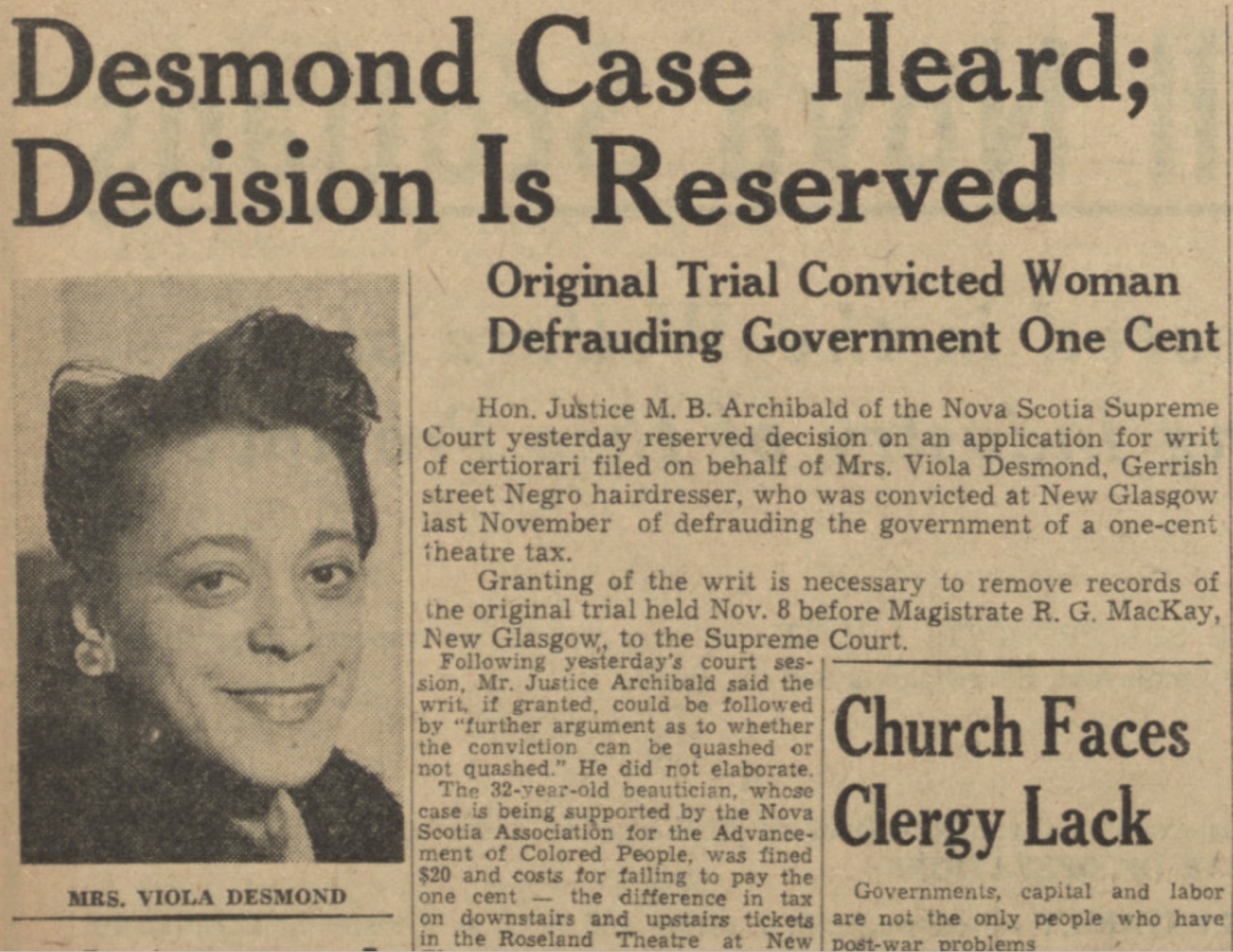
On a November evening in 1946, in the small town of New Glasgow, Nova Scotia, a Black businesswoman named Viola Desmond walked into a movie theatre, purchased a ticket, and sat down. It was, by any measure, an unremarkable act. Yet what followed would reverberate across decades, reshaping the moral landscape of an entire country. For in that theatre, segregation was the unspoken law, and Desmond had, unknowingly, just defied it.
Born on July 6, 1914, in Halifax, Nova Scotia, Viola Desmond was not a political figure. She was an entrepreneur, a woman of formidable energy and quiet ambition who had built something rare and vital for her community. Her beauty parlour, Vi’s Studio of Black Culture, was more than a place of commerce. It was a space of dignity in a society that offered Black Canadians precious little of it. Her Desmond School of Beauty Culture went further still, teaching African Canadians how to build businesses of their own.
It is one of history’s recurring ironies that those who never seek confrontation are sometimes the ones destiny thrusts into its centre. Viola Desmond had purchased a main-floor ticket at the Roseland Theatre. When she took her seat, she was asked to move. Confused, she went to the box office to upgrade to a seat closer to the screen, only to be refused. There were no signs announcing a policy of racial segregation.
She returned to her seat. What happened next stripped away every pretence of civility from a society that considered itself just. She was physically dragged from the theatre. She spent twelve hours in jail. And the charge laid against her was not, as one might expect, anything to do with race or trespass. It was defrauding the Province of Nova Scotia. The offence, the court would later hear, was that she had occupied a seat which was 1 cent more than what she had paid for. The difference of a single cent became the cause for change to Canadian conscience!
At trial, the theatre workers maintained this fiction. Desmond attempted to defend herself, but she had not been informed of her rights, and the theatre’s segregation policy was never once mentioned in court. She was convicted of tax evasion and fined twenty dollars. An appeal in the district court failed on legal technicalities. The law, which ought to have been her shield, became the instrument of her humiliation instead.
Yet something had shifted. The very injustice of the verdict forced Nova Scotians into an uncomfortable reckoning. People began to speak openly about what had long been practised in silence. Viola’s case did not deliver justice to her, but it ignited a conversation about human rights that could no longer be suppressed. It drew attention to the systemic nature of racial segregation in Canada and helped set in motion the civil rights movement that would, in time, transform Canada as a nation.
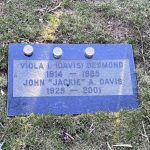
Viola herself, wounded but unbroken, eventually moved to New York for a fresh start. She continued, in her quiet and determined way, to stand up for the rights of herself and others. She died in 1965, at the age of fifty. She was only fifty years old, and the country she had helped to awaken had not yet fully acknowledged what she had done.
But stories of moral courage have a way of outlasting the silence imposed upon them. Her sister, Wanda, took up the work of memory, writing to the mayor of New Glasgow to request a public apology for her sister’s treatment and carrying Viola’s story to a new generation. In time, the recognition came. In 2010, Mayann Francis, Nova Scotia’s first Black lieutenant-governor, issued an official pardon and apology. During the ceremony at Province House in Halifax, Francis remarked on the poetic justice of the moment, famously stating:
“Here I am, a Black woman, giving freedom to another Black woman.”
In addition, the Viola Desmond Chair in Social Justice was established at Cape Breton University in 2010. A monument was unveiled in her honor the Africentric Heritage Park in New Glasgow. Canada Post issued a stamp in her honour in 2012. And in 2018, Viola Desmond was selected to appear on the Canadian ten-dollar bill in 2018, the first Canadian woman other than a monarch to grace the nation’s currency.


There is a lesson in Viola’s life that extends well beyond the history of civil rights. She was a builder, someone who, confronted with a society that excluded her community, responded with civility. Her beauty school, her studio, and her mentorship of aspiring Black entrepreneurs were all acts of resistance as profound as her refusal to leave that theatre seat. She understood, perhaps instinctively, that justice is not only a matter of what is torn down but of what is built up.
Her courage teaches us something else as well, something harder to accept but no less important. Justice does not always arrive on time. The systems that should protect the vulnerable sometimes betray them instead. But the act of standing up, of refusing to accept what is plainly wrong, sets forces in motion that may take years or even decades to bear fruit. Viola Desmond did not live to see her pardon. She did not see her face on the ten-dollar bill. But the Canada that eventually honoured her is a Canada that exists, in no small part, because she refused to move from her seat.
As we mark Canadian Black History Month in February 2026, Viola’s story remains as urgent as ever. Racism did not require a law to operate in 1946, and the structures of exclusion it built do not dismantle themselves with the passage of time alone. They require, in every generation, people willing to do what Viola did: to sit down, to refuse to move, and to insist that justice is not negotiable.
It is here that the guidance of the Holy Qur’an offers a light by which all peoples and nations may navigate toward a more just world. Allah the Almighty states:
“O ye who believe! Be steadfast in the cause of Allah, bearing witness in equity; and let not a people’s enmity incite you to act otherwise than with justice. Be always just, that is nearer to righteousness. And fear Allah. Surely, Allah is aware of what you do.” [Al-Ma’idah, ch.5:v.9]
This is the standard to which the faithful are called. Justice, the verse teaches, is not a sentiment to be felt but a duty to be upheld, even toward those who harbour enmity, even when the cost is great.
Dr. Martin Luther King Jr. once declared that the arc of the moral universe is long, but it bends toward justice. Viola Desmond’s life is proof of that truth. The arc bent slowly, agonizingly so, but it bent. And it bent because she, and those who carried her story forward, refused to let it remain still.
Note: This article is our humble effort to promote Canadian Black Heritage Month. If you would like to contribute, kindly send your contributions to ahmadiyyajournal.ca/contribute