My son came to me the other evening with his phone in his hand. Google says Ramadan starts on February 18th, he said. Al Jazeera, too. So why are we starting on the 19th?
It was a fair question. I sat him down and explained it the simplest way I could.
The Islamic month does not begin with the new moon. It begins with the crescent. These are not the same thing, and the difference between them is the whole reason different communities sometimes start Ramadan on different days.
The new moon is an astronomical event. It is the moment when the sun, moon and earth line up, with the moon sitting directly between the other two. At that instant, the side of the moon facing us receives no sunlight at all. It is completely dark. Invisible. You could point a telescope at the exact spot in the sky and see nothing. This year, that alignment happened on Tuesday, 17 February at 8:01 AM our time. It was so precise that it produced a solar eclipse over Antarctica.
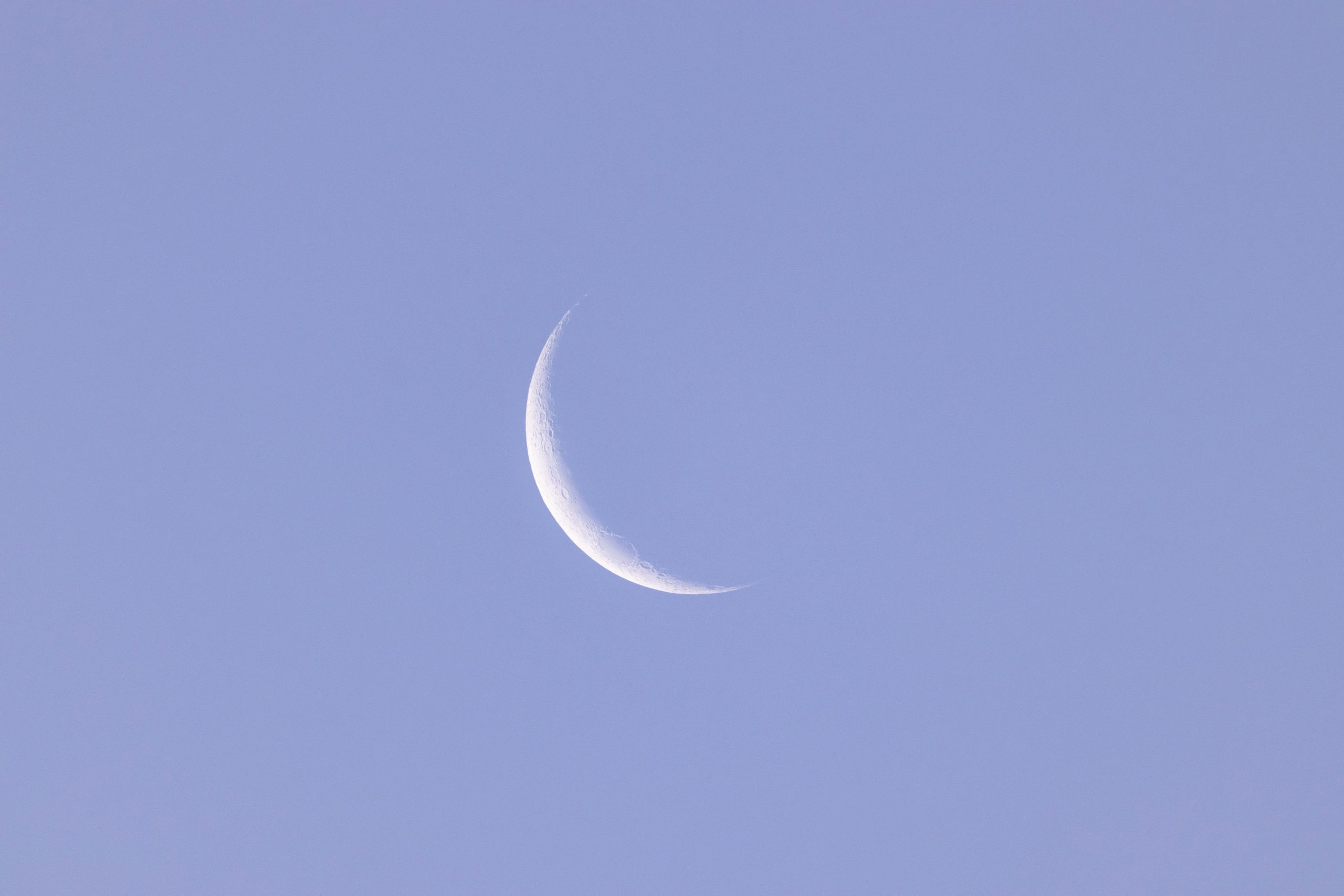
After conjunction, the moon slowly drifts away from the sun. A thin sliver of reflected light begins to form on its edge. This is the crescent. But it does not appear instantly. The moon needs to separate far enough from the sun, typically at least 7 to 10 degrees, and it needs to sit high enough above the horizon at sunset for that sliver of light to stand out against the twilight sky. In practice, the first possible crescent appears somewhere between 15 and 24 hours after the new moon, sometimes longer.
On the evening of Tuesday the 17th, only about six hours had passed since conjunction. That is not enough time. The crescent had not yet formed. This is not a matter of cloud cover or weather. Even under a perfectly clear sky, there was nothing to see. The United Kingdom Nautical Almanac Office, which publishes global crescent visibility predictions, confirmed that on 17 February, a naked-eye sighting of the crescent was impossible anywhere on earth.
By Wednesday evening, the 18th of February, more than 30 hours had passed. The angular separation between the sun and moon had grown. The crescent was now present. For Eastern Canada, calculations showed the moon setting roughly 90 minutes after the sun, providing ample time for the sky to darken and the crescent to become visible above the western horizon. Whether anyone actually stepped outside to look is beside the point. The calculation confirmed that the crescent could be there. On the 17th, it could not.
The first possible crescent for our region was Wednesday evening. So, the first day of Ramadan was Thursday, 19 February.
I then showed him something that made the whole thing click. The Holy Qur’an says:
يَسْـَـلُونَكَ عَنِ ٱلْأَهِلَّةِ ۖ قُلْ هِيَ مَوَٰقِيتُ لِلنَّاسِ وَٱلْحَجِّ
“They ask thee about the new moons. Say, ‘They are means for measuring time for [the general good of] mankind and for the Pilgrimage.’” (Surah al-Baqarah, Ch.2: V.190)
The word translated here as “new moons” is al-ahillah, the plural of hilal. And hilal does not mean “new moon.” It means “crescent”; it is the thin visible arc that appears in the first nights of the lunar month. The word comes from a root, meaning to appear, to become visible, to be greeted with joy. A hilal is, by definition, something that can be seen. The Quran did not say qamar, the general Arabic word for moon. It chose ahillah, crescents.
The Holy Prophet Muhammadsa reinforced this: “Begin your fast at the sighting of it and end it when you see it.” (Sahih al-Bukhari, Book of Fasting, Hadith 1797)[1] In earlier times, people looked at the sky because that was the only tool they had. Today, astronomical calculations can tell us with certainty whether the crescent is possible or not. The tool has changed. The principle has not. The month begins when the crescent can appear, not when the new moon is born.
My son thought about it for a moment. So, the new moon is invisible, he said, and the Holy Qur’an asks us to look for the crescent, which is the first thing you can see.
Exactly, I said. And this year, the first time a crescent could appear over Canada was Wednesday night. So, we start on Thursday.
He nodded. It made sense. It is supposed to. The method is straightforward. The month begins not with an invisible alignment in space, but with a slender arc of light above the horizon, announcing that a new month has arrived. Not before.
And by the same principle, the next crescent to watch for is the one that will mark the month of Shawwal and the beginning of Eid ul-Fitr. In North America, that crescent is expected to be visible on the evening of Thursday, 19 March 2026, Insha’Allah.
Reference: [1] https://new.alislam.org/library/books/sahih-muslim-05?page=21