کس قدر ظاہر ہے نور اُس مبدء الانوار کا
بن رہا ہے سارا عالَم آئینہ اَبْصار کا
How brilliantly shines the light of that Source of all light,
the whole world is becoming a mirror of vision and sight.
The Holy Quran does not merely invite the believer to read about the creation of God; it commands us to travel the earth and witness it with our own eyes. In Surah Al-Ankabut (29:21), Allah the Almighty declares:
“Say, ‘Travel in the earth, and see how He originated the creation. Then will Allah provide the latter creation.’ Surely, Allah has power over all things.”
And again, in Surah Aal-e-Imran (3:192), the Quran praises those who remember Allah standing, sitting, and lying on their sides, and who reflect upon the creation of the heavens and the earth:
“and ponder over the creation of the heavens and the earth: ‘Our Lord, Thou hast not created this in vain.'”
It was with this spirit, of purposeful wandering, of eyes and hearts open to the divine, that my dear companion, Basheer Islam, and I set out one afternoon in the spring of 2026 toward the far southeastern corner of Alberta. Our destination was the vast, wind-sculpted prairie along the Montana border, a land of ancient coulees, singing grasses, and skies so wide they seem to breathe.
The Promised Messiah, Hazrat Mirza Ghulam Ahmad (as), whose profound love for the Creator shines through every verse of his celebrated poem, wrote with luminous tenderness:
What a wondrous manifestation of Your power, O Beloved, in every direction, wherever we look, there is the path to Your beholding.
In the fountain of the sun, Your waves are manifest, in every star, there is a spectacle of Your radiance.
We did not merely read these lines. Over two extraordinary days, we lived them.
Day One: Southward Through the Prairie Sea
We departed in the early afternoon, the city dissolving behind us as Highway 2 carried us south through Lethbridge toward Milk River. The transition from farmland to open range is a gradual revelation. The cultivated fields give way, slowly and then all at once, to a rolling sea of native fescue and sage, unbroken to the horizon in every direction. The sky, already enormous, seems to grow still wider as the last grain elevator disappears from the rearview mirror.
Basheer and I spoke little. The land itself was speaking.
The terrain of this corner of Alberta is ancient and stoic. This is the Palliser Triangle, semi-arid shortgrass prairie, crossed by coulees carved by glacial meltwater ten thousand years ago. The soil is thin, the light is clear and harsh, and the wind is a constant companion. It does not feel like a land of scarcity, however. It feels like a land of essentials, of sky, grass, stone, and life that has adapted fiercely to all three.
Writing-on-Stone Provincial Park, Where the Coulee Meets the Stars
Our first destination was Writing-on-Stone Provincial Park, Áísínai’pi in the language of the Blackfoot Confederacy, meaning “it is written” or “where figures are drawn.” Situated along the Milk River valley just eight kilometres from the United States border, this UNESCO World Heritage Site is one of the most remarkable landscapes in all of Canada.

The park descends into a dramatic coulee carved by the Milk River over millennia. Sandstone hoodoos, tall, mushroom-shaped pillars of eroded rock, rise from the valley floor like sentinels from another age. The canyon walls are adorned with thousands of petroglyphs and pictographs left by the Blackfoot people over more than three thousand years, images of warriors, horses, shields, and spiritual visions etched into the living rock. To walk among them is to feel the full weight of human time.
Stargazing, The Luxury of Darkness
Writing-on-Stone is a designated Dark Sky Preserve, one of the finest in western Canada. And it was for this, as much as for the hoodoos and the hawks, that we had timed our journey to begin here.
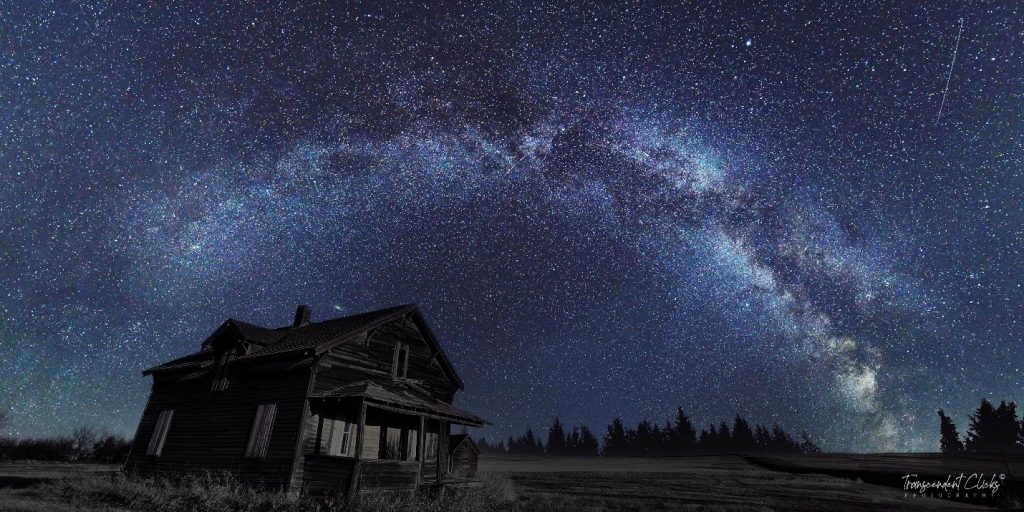
As the sun slipped below the Montana hills and the last orange thinned from the western sky, a transformation occurred that no city dweller can fully anticipate until they experience it themselves. The darkness did not simply fall; it arrived, comprehensive and velvet, and with it came a sky of impossible depth.
The Milky Way materialized overhead not as a vague smear but as a textured river of light, dense with structure, threaded with dark lanes of cosmic dust. The core of our galaxy rose in the southeast, luminous and three-dimensional, as if one could simply reach out and stir it. Thousands of stars became visible that the sodium glow of Calgary or Edmonton permanently erases from urban skies, stars behind stars behind stars, layer upon layer, the full architectural truth of the universe laid bare above two small figures in sleeping bags on a coulee rim in Alberta.
This is a luxury, there is no other word for it, utterly unavailable to the vast majority of Canadians who live in cities. The residents of Toronto, Vancouver, or even Grande Prairie will live their entire lives without once seeing the sky that those on this dark prairie see every clear night. We lay on our backs in the cooling grass for a long time, and I thought of the Promised Messiah’s words:
چاند کو کل دیکھ کر میں سخت بے کَل ہو گیا
کیونکہ کچھ کچھ تھا نشاں اُس میں جمالِ یار کا
Last night, beholding the moon, I was deeply restless,
for in it was a faint trace of the beauty of the Beloved.
How much more, then, is the believer moved by the full archive of heaven? There is no idol here, no intermediary, only the magnificent and deeply personal signature of the Creator, written across a hundred thousand light-years of stellar fire.
We slept deeply, cradled by the sound of the river and the breathing of the prairie wind.
Day Two: The Prairie Comes Alive
We rose before dawn. By the time the eastern horizon began to pale, we were already moving, hot tea in hand, cameras around our necks, the long day of watching ahead of us.
کیا عجب تو نے ہر اک ذرّہ میں رکھے ہیں خواص
کون پڑھ سکتا ہے سارا دفتر ان اسرار کا
How wondrous that You have placed properties in every particle,
who can read the full register of these secrets?
We were not attempting to read the full register. We were simply opening the book, one page at a time.
The Pronghorn, Ghost of the Open Prairie
Before we had driven ten kilometres from the park, Basheer spotted them at the roadside, a small band of Pronghorn antelope (Antilocapra americana) standing motionless on a low ridge, studying us with the calm intelligence of creatures who know they can outrun anything on this continent.
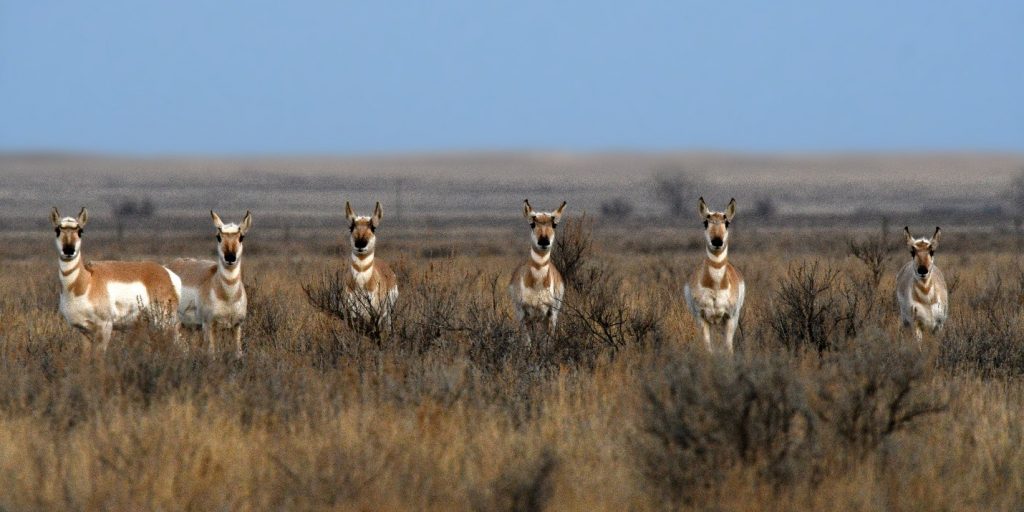
The Pronghorn is among the most extraordinary animals in North America, and one of the most misunderstood. They are frequently called “antelope,” but they are not antelopes. They are not deer. They belong to their own entirely unique family, Antilocapridae, with no close living relatives anywhere on Earth. They are, in the most literal sense, one of a kind.
Their bodies are built for velocity. The Pronghorn is the fastest land animal in the Western Hemisphere and among the fastest in the world, capable of sustaining speeds of 85 to 90 kilometres per hour, not in short bursts, like a cheetah, but over long distances. Their windpipe is unusually wide, their lungs enormous relative to body size, their legs long and slender and perfectly engineered for the flat sprint of the open plain. Evolutionary biologists believe this speed evolved millions of years ago as a response to now-extinct North American predators (cheetahs, long-legged hyenas) that once shared this landscape. The Pronghorn is, in a sense, running from ghosts.
They are beautiful in a lean and sculptural way quite different from the softness of a whitetail deer. Their coats are a rich tawny-gold, set off by white patches on the rump, belly, and throat. The bucks carry distinctive black and cream facial markings and pronged, slightly curved horns, unique in the animal kingdom because they are made of a keratinous sheath over a bony core, shed and regrown each year like antlers, but not like antlers, because no other animal does precisely this.
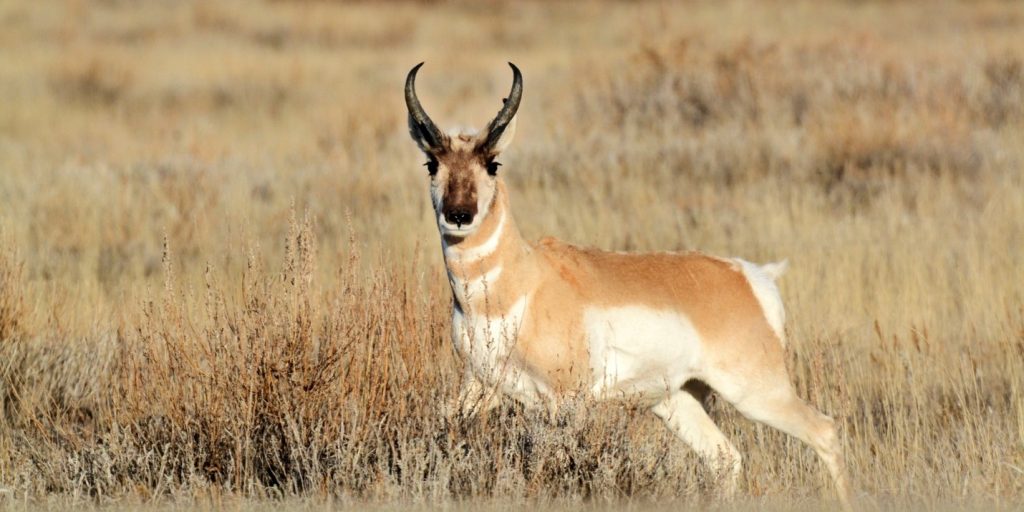
Their eyes are remarkable, large, amber-gold, and set wide on the head, giving them a nearly 360-degree field of vision. They can detect movement at distances of several kilometres. When alarmed, the white hairs of their rump patch erect into a bright flare, visible to other Pronghorn at enormous distances, a silent alarm across the open plain.
We watched the small band for fifteen minutes as they grazed and occasionally looked up at us, assessing the threat and finding it acceptable. In spring, the does are heavy with the fawns they will drop in May or June; twins are common, another evolutionary strategy for a prey animal on an open plain. A newborn Pronghorn fawn can outrun a human within days of birth.
They are quintessentially Albertan, shaped by this wide, wind-scoured land as surely as the grass and the coulees.
Ferruginous Hawks, Lords of the Prairie Sky
As we drove east through the morning along the gravel roads near Manyberries, we began to encounter the birds we had most hoped to see, the Ferruginous Hawks (Buteo regalis).
The name means “iron-rust” in Latin, and it is apt. These are the largest buteos in North America, true giants of the hawk world, with wingspans stretching to 140 centimetres or more. Perched on a fence post or a low earthen mound, a Ferruginous Hawk is a commanding presence, broad-shouldered, deep-chested, with a large head and a formidable pale-yellow gape that gives the impression of a bird built to mean business.
In flight, they are breathtaking. Their upperparts blaze in the morning light, rich chestnut-russet on the back and shoulders, with white flight feathers beneath and a distinctive V-shaped dark patch formed by the rusty leg feathering against the pale belly. Against a blue prairie sky, they look like something designed specifically to be beautiful.
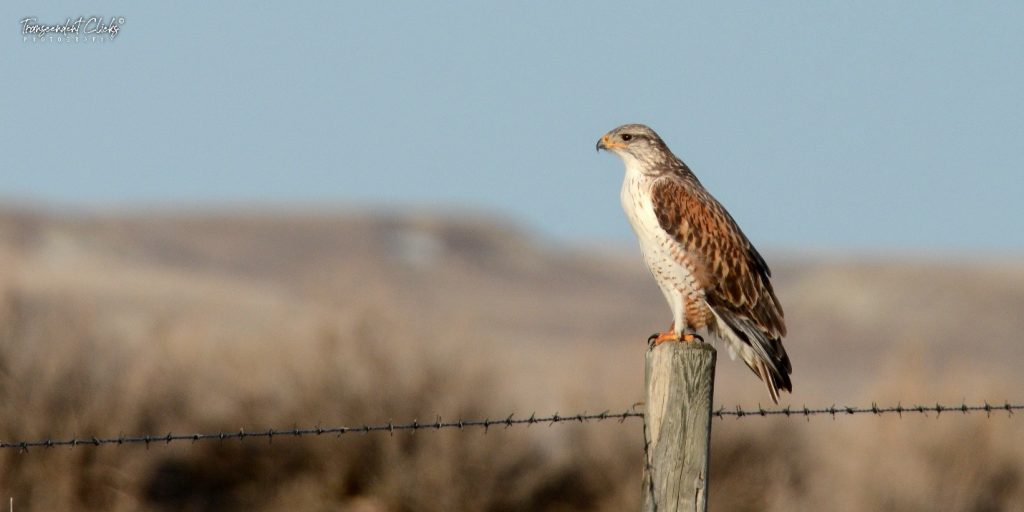
The Ferruginous Hawk is a bird of open country; it evolved on the prairie, and it belongs to the prairie in a way few other raptors do. It nests here, hunts here, and raises its young here. The southeastern Alberta grasslands are among their most important nesting grounds in Canada. In spring, pairs are establishing territories and building or refurbishing nests, large, conspicuous structures of sticks and dried cow dung placed on low cutbanks, haystacks, or occasionally on the ground itself.
They are ground squirrel specialists. The Richardson’s ground squirrel, the “gopher” of prairie vernacular, forms the bulk of their diet, and the hawks’ distribution maps over spring and summer correlate almost perfectly with the distribution of their prey. A good ground squirrel colony on a sunny morning is a reliable place to find Ferruginous Hawks hunting in long, low glides or stooping from height onto targets that have not moved quickly enough.
We watched one pair near a low coulee for nearly half an hour. The female was perched on a fence post, unhurried and regal, while the male coursed low over a hillside in the distance. These birds are listed as a species of special concern in Canada, their numbers declining with the loss of native grassland. To see them here, healthy and breeding, feels like a small grace.
Pakowki Lake, A Shimmering Prairie Inland Sea
West of Manyberries, Alberta, the land opens even further and the road delivers you to the edge of Pakowki Lake, a large, shallow, alkali lake that shimmers in the mid-morning light like hammered pewter. The name comes from the Blackfoot word for “bad water,” a reference to the high mineral content that makes it undrinkable. For wildlife, however, this lake is anything but bad.
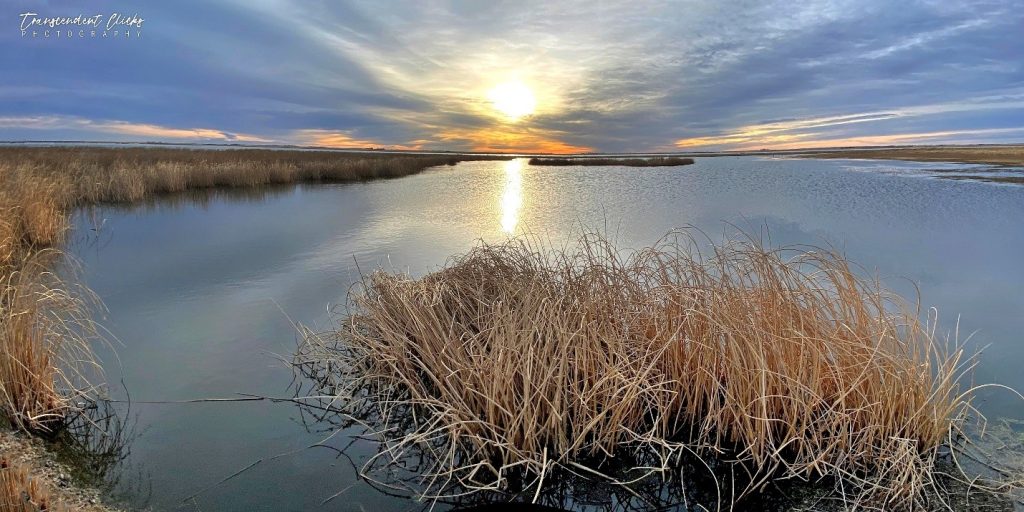
In spring migration, Pakowki Lake becomes a staging area for thousands of shorebirds, waterfowl, and wading birds moving north along the Central Flyway. The shallow margins and exposed mudflats provide crucial feeding habitat for birds that have crossed enormous distances and will cross enormous distances still before reaching their breeding grounds in the boreal forest and the Arctic.
We parked at the edge of a low ridge and glassed the lake with binoculars. The water surface was dotted with ducks, Canvasbacks, Redheads, and Northern Pintails among them, and along the margins, a scattering of shorebirds picked and probed with focused efficiency. The wind moved across the surface in long, grey-silver waves.
There is a quality of light on the prairie that is difficult to describe to those who have not experienced it. It is horizontal light, arriving from a low sun across an unbroken distance, and it illuminates objects, birds, grasses, stones, from the side rather than from above, casting long shadows and giving everything a clarity and depth that seems almost artificially crisp.
Sharp-Tailed Grouse, The Dancers We Could Not Find
Throughout the morning we encountered Sharp-tailed Grouse (Tympanuchus phasianellus) in gratifying numbers, flushing from roadsides, gliding low across grassy draws, or standing alert on fence posts and low mounds with the upright, watchful posture characteristic of their kind. A good many of them, in fact, enough to reassure us that this landscape still sustains a healthy population of one of its most emblematic prairie birds.
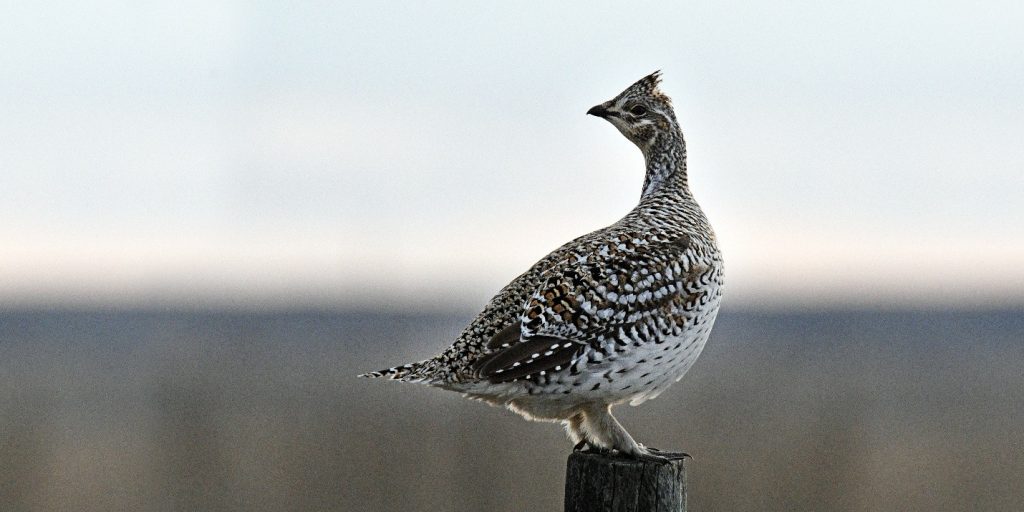
The Sharp-tailed Grouse is a medium-sized, mottled brown and white prairie grouse, heavily spotted above, with a distinctive pointed tail, the “sharp tail” of its name, that is visible both in flight and at rest. They are stocky, energetic birds, well-camouflaged against the dried grasses and patchy snow of early spring, and always somehow managing to appear both inconspicuous and dignified at once.
What we did not witness, and had very much hoped to, was the lek, the legendary dawn dancing ground where male Sharp-tails perform one of the most extraordinary mating displays of any North American bird. On these traditional gathering places, patches of short, open grass used year after year, sometimes for decades, passed down through generations of grouse by some combination of habit and memory, males gather before first light and compete in a ritualized spectacle that has to be seen to be believed. They inflate their purple neck sacs to luminous balloons, spread their wings low to the ground, erect their pointed tails, and rattle their wingtips in a rapid, stamping dance while emitting hollow, reverberating cooing calls that carry far across the still morning air. The display is frantic, competitive, and oddly beautiful, a small, ancient explosion of energy in the vast silence of the prairie.
The difficulty is that leks are discreet places. They are not marked on any map available to the casual visitor. Local ranchers and dedicated birders may know their precise locations, often a particular hillside or clearing used by the same family of birds for longer than living memory, but to a first-time visitor, even one scanning the right habitat at the right hour, a lek can remain entirely invisible. The birds do not advertise the address. They simply appear there, before dawn, to those who already know where to look.
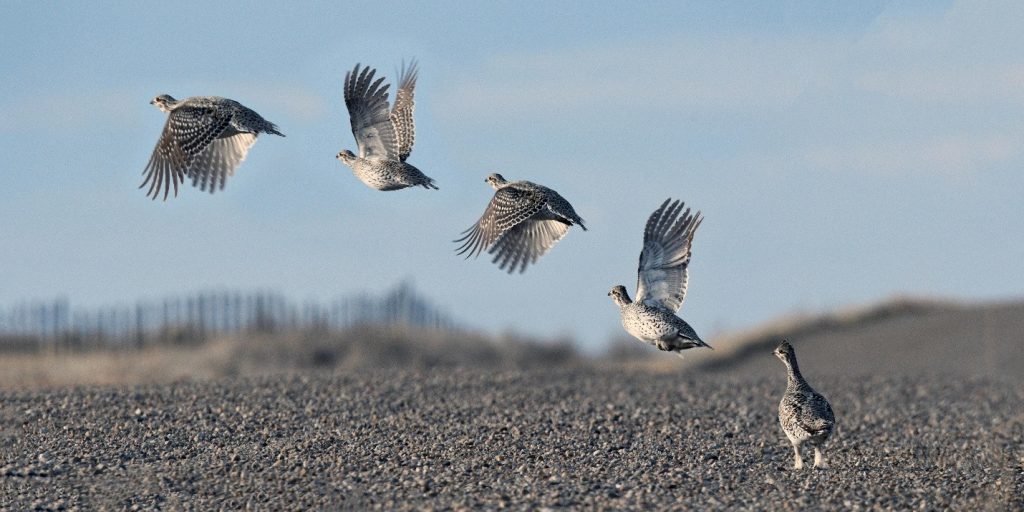
We drove the gravel roads in the grey pre-dawn light, glassing every open rise and shortgrass flat, hoping to stumble upon the gathering. We did not. It was a genuine disappointment, the kind that leaves you with a specific, purposeful reason to return. Witnessing a Sharp-tailed Grouse lek at first light, cameras trained on a dozen stamping, booming males in the cold April dawn, remains on our list, unfinished business with this magnificent prairie.
Ring-Necked Pheasants, Jewels in the Stubble
Along the roadsides and field margins near Foremost and heading back toward the north, we encountered Ring-necked Pheasants (Phasianus colchicus), not a native species, but one so thoroughly naturalized into the prairie agricultural landscape over the past century that they feel, in their own way, indigenous.
The rooster Ring-neck is one of the most visually spectacular birds in Alberta. The male’s plumage reads like an inventory of the colour wheel, a glossy, iridescent green-black head with a vivid red facial wattle, a clean white collar (the “ring neck”), a long, barred copper tail, and a body that shifts from bronze to chestnut to purple depending on the angle of light. In the low morning sun of the prairie, a pheasant rooster strutting through the edge of a stubble field is a genuinely dazzling sight.
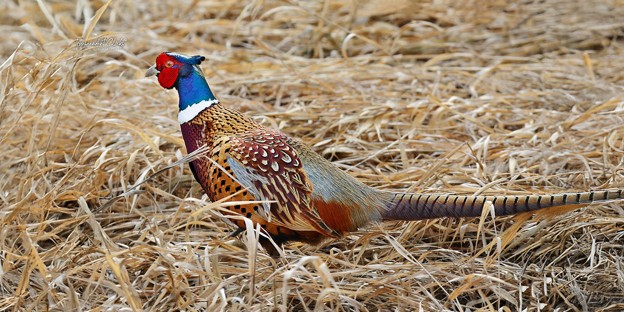
Hens are a masterpiece of the opposite approach, cryptic brown, streaked and barred to near-invisibility against the dry grass, perfect for a bird that will nest on the ground and must remain unseen. We flushed several from roadsides, the explosion of wings and that distinctive, cackling alarm call giving away their location a moment before they were airborne.
The Terrain, An Ancient, Austere Beauty
The southeastern Alberta landscape along the Montana border is not the postcard Alberta of the Rockies; there are no glaciers here, no dramatic vertical drama. What there is, instead, is a horizontal drama of enormous power and subtlety.
This is the northernmost reach of the Great Plains, and it carries all the marks of its ancient origins. The land was formed at the bottom of a shallow inland sea, then scraped and reshaped by glaciers, then colonized by grass that has now held the soil for thousands of years. The coulees, those sinuous, steep-sided valleys carved by water, break the uniformity of the plain with sudden depth, hiding springs and willows and wildlife from the eyes of those who do not look carefully.
The area around Manyberries, Alberta, is typical of this country, small ranching communities holding on in a landscape that has always been marginal for agriculture and magnificent for nature. The town itself is a handful of buildings and a grain elevator standing against the immense sky, the kind of place that looks like it is keeping a secret and perhaps is.
Pakowki Lake dominates the south, its alkali margins white and crystalline in summer, its surface hosting extraordinary concentrations of wildlife. The road to it crosses land that has changed little since the Blackfoot rode it on horseback, the same grass, the same sky, the same hawks turning on the same thermals.
And above it all, always, the sky. The Alberta prairie sky is one of the great natural phenomena of the Canadian west. It is not simply large; it is active, filled with cloud formations of operatic scale, with weather visible in motion a hundred kilometres away, with the kind of light that painters chase their whole careers and rarely fully capture.
The Road Home
We turned north in the late afternoon, the sun angling from our left, the shadows of the fence posts stretching long across the grass. We had seen over forty species of birds across the day. We had watched Pronghorn run. We had encountered Sharp-tailed Grouse in healthy numbers, even if their secret lek had eluded us. We had stood at the edge of Pakowki Lake while the wind moved across the water and felt, genuinely, the presence of something vast and purposeful in the world’s arrangement.
تیری قدرت کا کوئی بھی انتہا پاتا نہیں
کس سے کھل سکتا ہے پیچ اِس عُقدۂ دشوار کا
None can find any limit to Your power,
who can unravel the knot of this difficult enigma?
No, no one can. The prairie gives you no illusion that you have understood it. It gives you only more questions, more wonder, more of that blessed restlessness the Promised Messiah (as) described when he looked at the moon and found the trace of the Beloved’s beauty.
And that is enough. That is more than enough.
Brother Basheer and I drove home through the darkening plains largely in silence, the kind of silence that is not absence but fullness, two men who had been, for two days, exactly where the Quran told them to be, roaming the earth, looking at the creation, finding it inexhaustible.
Practical Notes for Fellow Travellers
Getting there. Writing-on-Stone Provincial Park is approximately 3.5 hours south of Calgary via Highway 2 and Highway 501. Manyberries and Pakowki Lake are reached via Highway 61 east from Lethbridge or south from Medicine Hat.
Best time. Mid-April through late May for spring migration and grouse leks. Ferruginous Hawks are on territory by late March.
Camping. Writing-on-Stone Provincial Park offers excellent campgrounds with fire pits, and reservations are recommended for long weekends. Bring warm layers, as prairie nights in April are cold.
Equipment. Binoculars are essential. A spotting scope is invaluable for Pakowki Lake shorebirds. A wide-angle lens for night sky photography, and patience.
Dark sky. The park has no artificial light interference to the south (Montana). New moon weekends in April offer the finest Milky Way viewing.
In beautiful faces is the sweetness of that beauty of Yours,
in every flower and garden is the colour of Your own Garden.