By the grace of Allah the Almighty, on Saturday, 12 September 2026, four Ahmadi Ansar cyclists completed the RBC GranFondo Whistler, one of the most scenic and demanding cycling events in North America. We rode in a field of more than 5,500 cyclists from across Canada and around the world.
For me, the ride fulfilled an eleven-year ambition. When I moved to Canada in 2015, the Whistler GranFondo was the ride everyone in the cycling community spoke of with awe, and it has been on my list ever since. In January 2026, I registered alongside Salman Kakar of Vancouver and set up a group for the Ahmadiyya Cycling Club on the event roster so that other members could join us. By race morning, our contingent had grown to four Ansar, with Maud Chaudhary and Irfan Shaheen joining Salman Kakar and me. Maud Chaudhary, a veteran of the route, had assured us from the outset that the mountain course would be worth every metre of climbing.
Before Dawn in Stanley Park
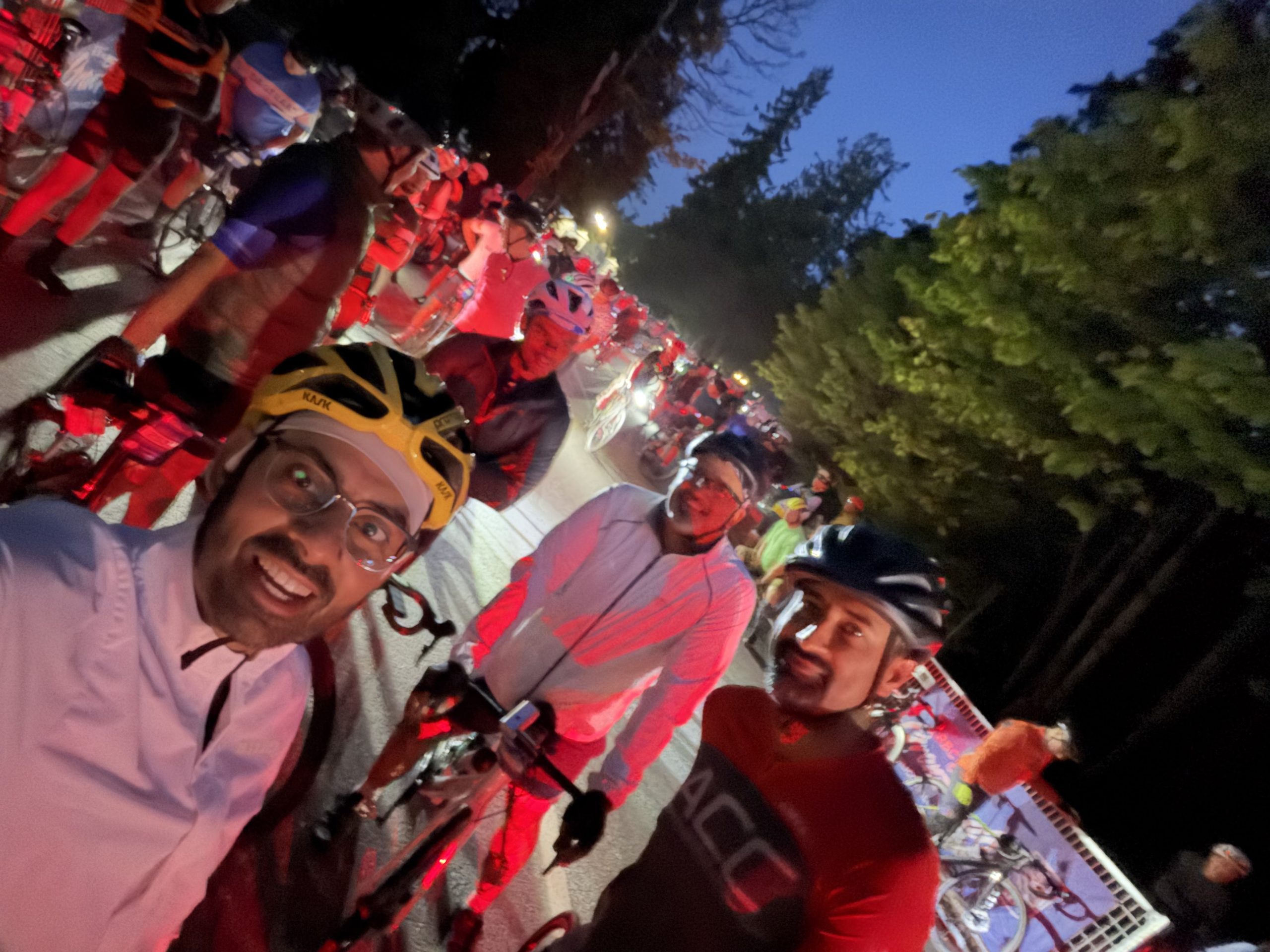
Our morning began well before sunrise. We left our homes and hotel rooms immediately after offering Fajr and reached Stanley Park in Vancouver at around 5.45 am. The air was a crisp 14°C, and thousands of brightly lit bicycles were gathering beneath the tall coastal trees. Before mounting our bikes, we took homeopathic remedies to guard against muscle cramps, and by the grace of Allah they served us well through the long kilometres ahead.
Standing together in one of the front starting corrals, the four of us bowed our heads in silent prayer. Foremost on our tongues was the comprehensive Qur’anic supplication.
“Our Lord, grant us good in this world as well as good in the world to come, and protect us from the torment of the Fire.” [Al-Baqarah, ch.2:v.202]
In Tafseer-e-Kabeer, Hazrat Musleh-e-Maud (ra) explains that adhab an-nar (the torment of the Fire) is not confined to the hereafter [1]. It also encompasses the calamities, physical perils and sudden catastrophes of this world.
With more than five thousand cyclists sharing narrow roads and technical descents, we repeated this prayer throughout the day, seeking the protection of Allah.
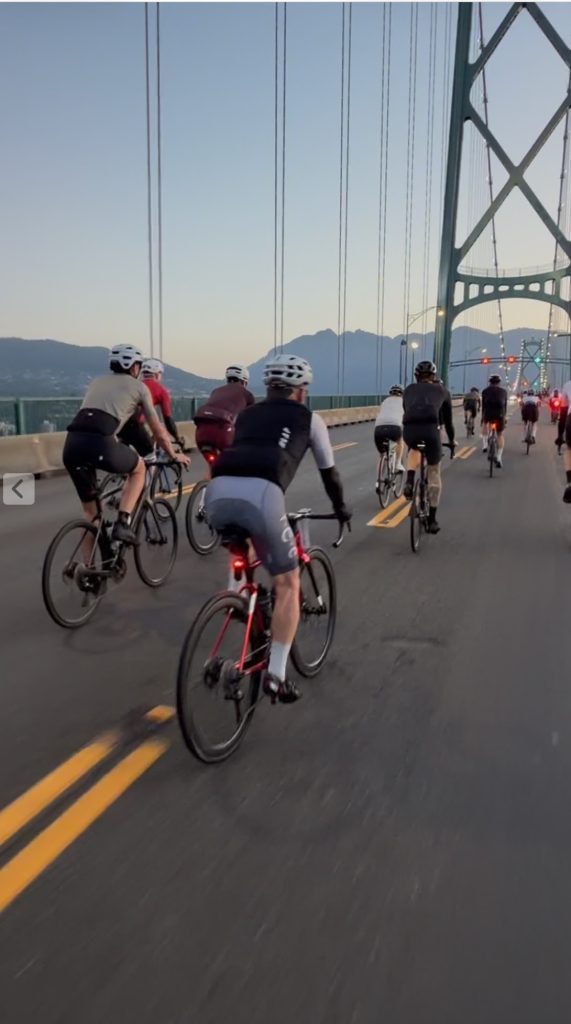
The mass start rolled out in successive waves at 6.20 am. Spectators lined the park roads, cheering in the cool morning twilight. The field funnelled through the park and onto the Lions Gate Bridge over Burrard Inlet, the hum of five and a half thousand freehubs carrying through the dawn mist.
Along the Sea-to-Sky
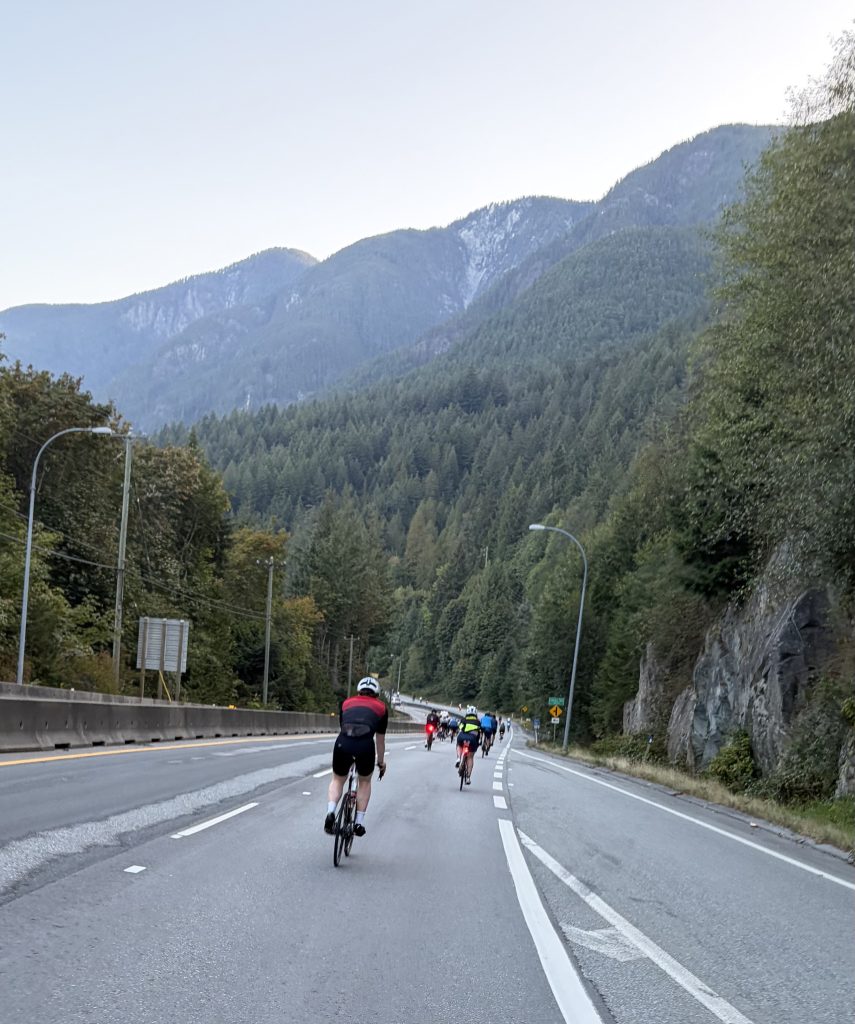
Beyond West Vancouver, the course joined Highway 99, the celebrated Sea-to-Sky Highway. It is often called the most beautiful highway in the world, and having now ridden it from sea level into the mountains, we can attest that the description is deserved. For the event, the authorities had closed one full side of the highway to traffic, giving cyclists an uninterrupted stretch of smooth tarmac.
To our left, the waters, coves and green islands of Howe Sound stretched into the distance; to our right, granite cliffs and coastal rainforest rose sheer from the roadside. As the morning went on, the temperature climbed gently from 14°C to an ideal 18 to 19°C under clear skies. In the small coastal towns along the route, residents came out to the roadside with bells and applause for the passing riders.
With the beauty came real danger. On the fast descents that follow the steep climbs, bikes quickly passed seventy kilometres an hour. At such speeds, braking distances grow sharply, and every curve demands careful feathering of the brakes and complete concentration. Several riders misjudged their speed into the sweeping bends. We passed serious crashes, with medical teams and an ambulance attending injured cyclists at the roadside.
In the tight packs there were heart-stopping moments when riders ahead suddenly locked their brakes or swerved without warning. More than once we escaped being brought down by a hair. In those instants, the prayer we had repeated at the start, to be saved from worldly calamity, became something we could feel. By the sheer mercy of Allah, His angels turned the danger aside, and all four of us stayed upright and safe.
For most of the ride, Maud Chaudhary and I rode as a pair. Sometimes he would surge ahead on a climb and I would bridge across; at other times I would set the tempo and he would close the gap. Together we joined several fast pacelines, tucking into organised groups that flew along the coastal straights at more than thirty kilometres an hour.
A Message of Peace on the Open Road
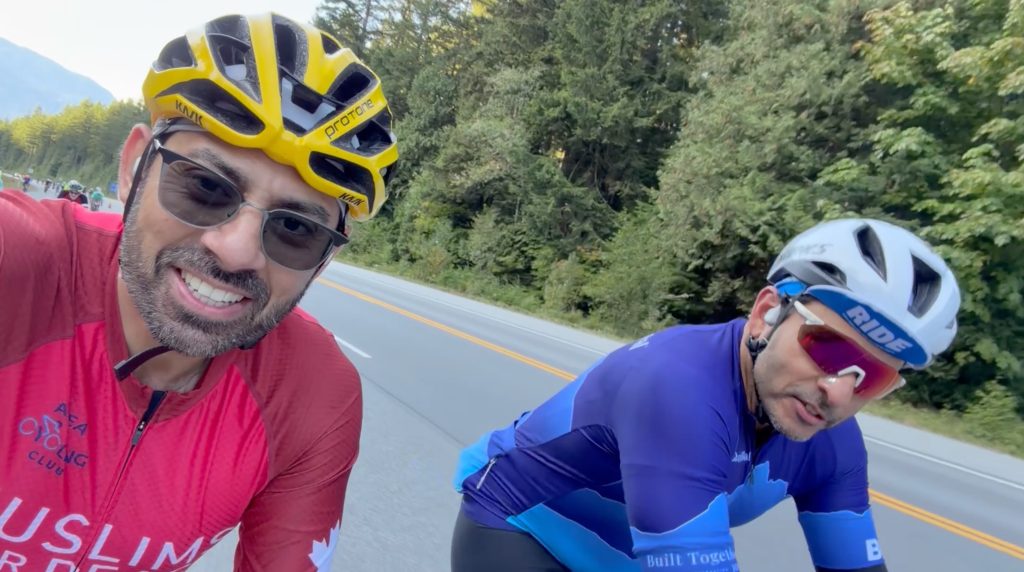
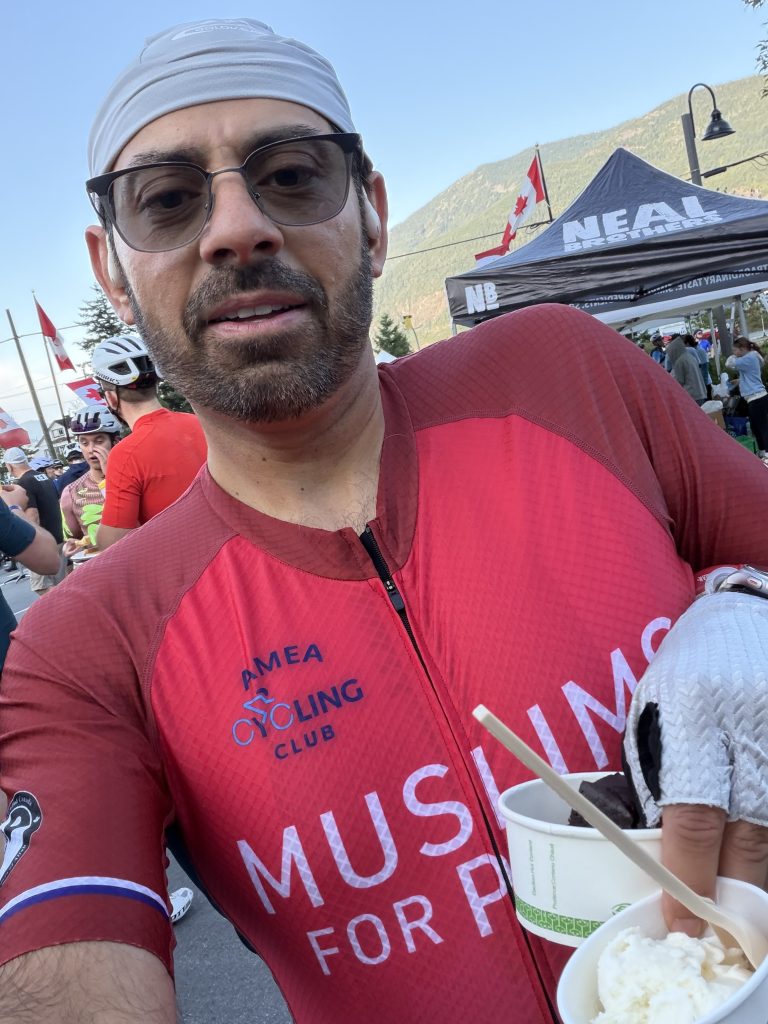
Our presence in the field also became a quiet form of outreach. We wore cycling kits bearing the words “Love for All, Hatred for None” and “Muslims for Peace”, with the crest of Majlis Ansarullah Canada. Several times along the highway, riders pulled alongside, read our jerseys and said warmly, “That is a very good message.” At a time so often clouded by tension and misunderstanding, carrying the motto of the Ahmadiyya Muslim Jama’at through the field opened small moments of goodwill with athletes from all walks of life, and served as a form of silent tabligh.
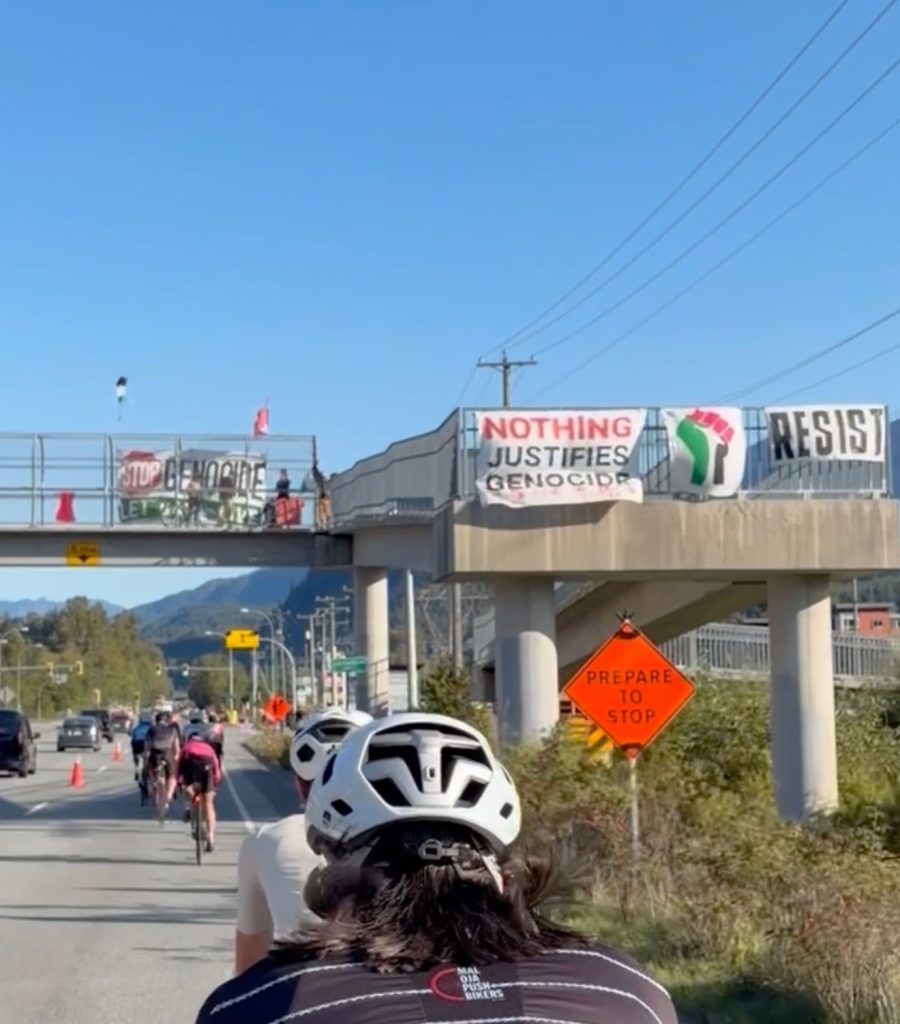
As we approached Squamish, this message of peace found a moving public counterpart. Overhead, a prominent pedestrian overpass spanning Highway 99 displayed large community banners calling for peace and an end to the genocide in Palestine—bearing the urgent appeals “NOTHING JUSTIFIES GENOCIDE”, “RESIST”, and “STOP GENOCIDE”. Passing underneath in our “Muslims for Peace” jerseys, the moment stood as a poignant reminder of our shared human conscience and the Islamic imperative to champion peace and justice for all oppressed peoples
Squamish to Whistler
The first 60 kilometres along the fjord were a scenic prelude. The real mountain began at Squamish. Roughly three quarters of the nearly 2,000 metres of climbing on the day is concentrated in the final 60 kilometres, from Squamish to Whistler.
Here the highway turns sharply upward. We faced long climbs averaging five to seven per cent that ran continuously for three to four kilometres at a time. The saving grace was the excellent organisation of the event. Aid stations were spaced roughly every twenty-five kilometres, placed either just before a daunting climb or just after a hard summit, when the legs were most in need.
Our first major stop, at the 50-kilometre mark, had already offered a welcome spread of snacks, brownies and even ice cream, along with a timely comfort break. Soon after that stop, Maud Chaudhary found his climbing legs, and together we settled into a steady, fast rhythm. At every station we refilled our bottles with electrolyte drink. On the bike, we relied on natural honey gels for quick energy, along with fruit jellies and chews at regular intervals. With this disciplined fuelling and our pre-race remedies, neither of us suffered cramps, apart from one brief moment when I tried to crest a climb standing on the pedals, smiling and enjoying the scenery. Perhaps I felt better than my legs did.
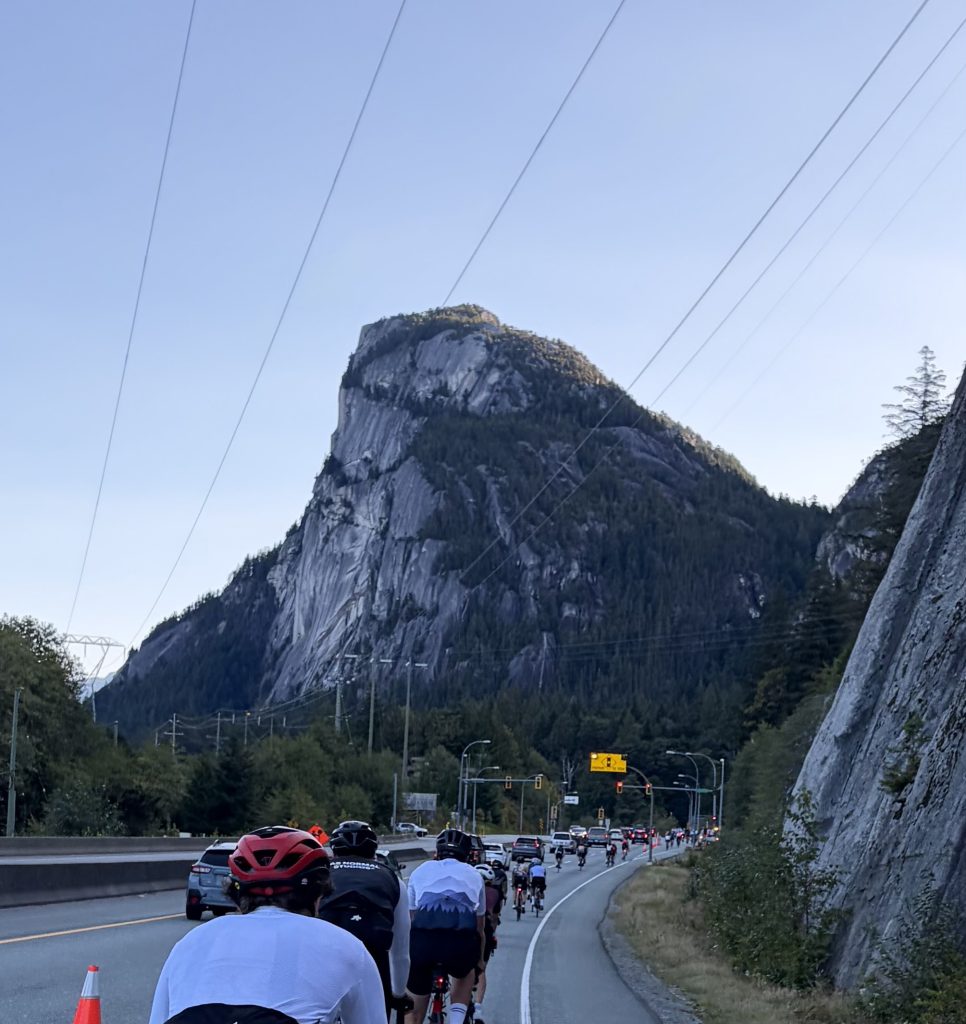
the gateway to the final 60 kilometers of alpine climbing.
Keeping Watch Across the Mountain
As Maud Chaudhary and I worked our way through the field, passing hundreds of riders who had started in earlier waves, we stayed in touch with Salman Kakar and Irfan Shaheen, who were riding behind us, through a WhatsApp group chat.
At each aid station, a quick message confirmed where we were and how we were doing. These brief check-ins became a lifeline of Ansarullah brotherhood across the mountain, a reassurance that each of us was riding strong and climbing safely. On the hardest stretches beyond Squamish and through the Cheakamus Canyon, the chat carried encouragement back and forth. Only twenty kilometres to go. The legs will hold. Whistler is within reach. Staying hydrated was a constant task; by the afternoon, Salman Kakar told us he had drunk nine bottles of electrolytes to beat the mountain heat.
Ease After Hardship
The Sea-to-Sky Highway saves its steepest ramps for the final approach to Whistler, with gradients nearing thirteen per cent in the closing kilometres. Pushing through those grades, heart and lungs at full stretch, prayers came naturally with every pedal stroke. In those moments, these lines of Hazrat Musleh-e-Maud (ra) rang with new clarity [2].
The task is hard, the destination far;
O my faithful ones, may your step never slacken.
In truth, the mountain asked nothing for which we had not prepared. Since June, I had completed fifty-three training rides, logging more than 1,700 kilometres and 18,000 metres of climbing. That summer built on a winter of competitive Zwift racing, a three-day, 300-kilometre Ride for Peace across Spain in March, the Paris to Ancaster gravel classic and a 117-kilometre gravel ride in May. An 80-kilometre ride in June had ended in severe cramping; by early September, a single 260-kilometre day, the Ansar Ride for Peace from Kingston to Durham Region, completed just eight days before Whistler, passed without a hitch. Maud Chaudhary and the other brothers had kept up similarly dedicated training. That summer of preparation turned what once looked like an insurmountable mountain into a joyful afternoon.
On paper, the profile looked formidable, with 124.4 kilometres and nearly two thousand metres of climbing. On the road, it felt smooth, serene and deeply uplifting. The Holy Qur’an gives this assurance twice in succession.
“Surely there is ease after hardship. Surely there is ease after hardship.” [Al-Inshirah, ch.94:vv.6-7]
That ease is not simply the absence of an uphill gradient. It is the resilience, stamina and inner peace that Allah the Almighty grants in His mercy through patient, unseen preparation. In Stanley Park we had prayed for safety, strength and ease, and throughout the climbs and the dangerous descents, that prayer was answered at every turn.
Arrival in Whistler
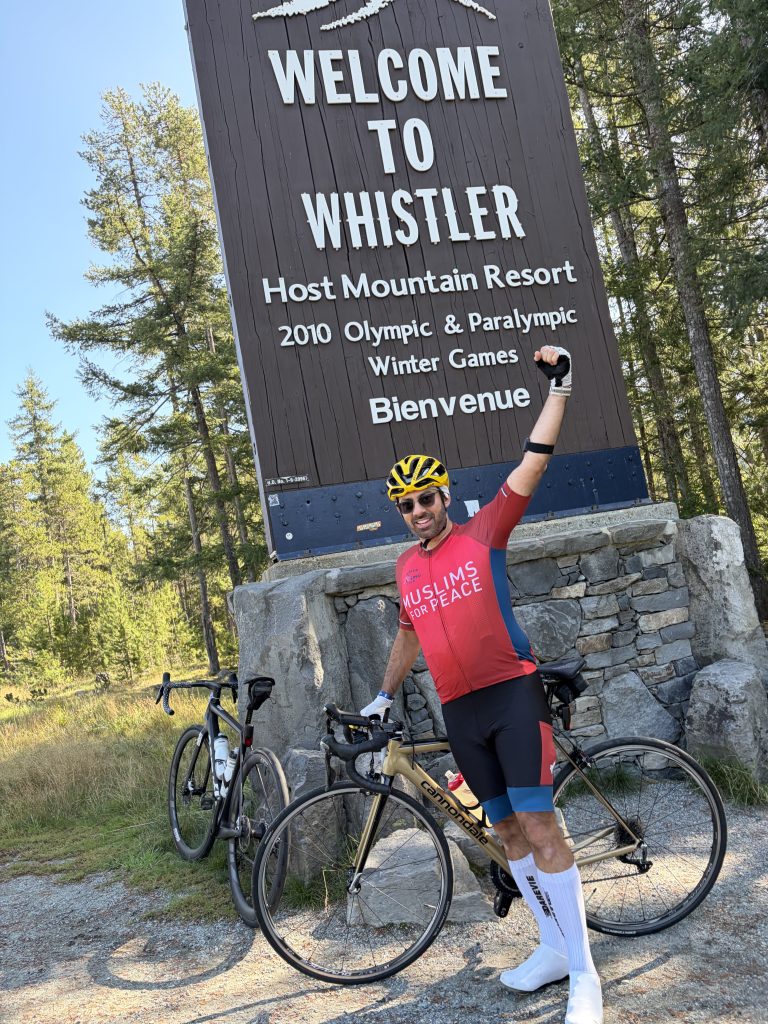
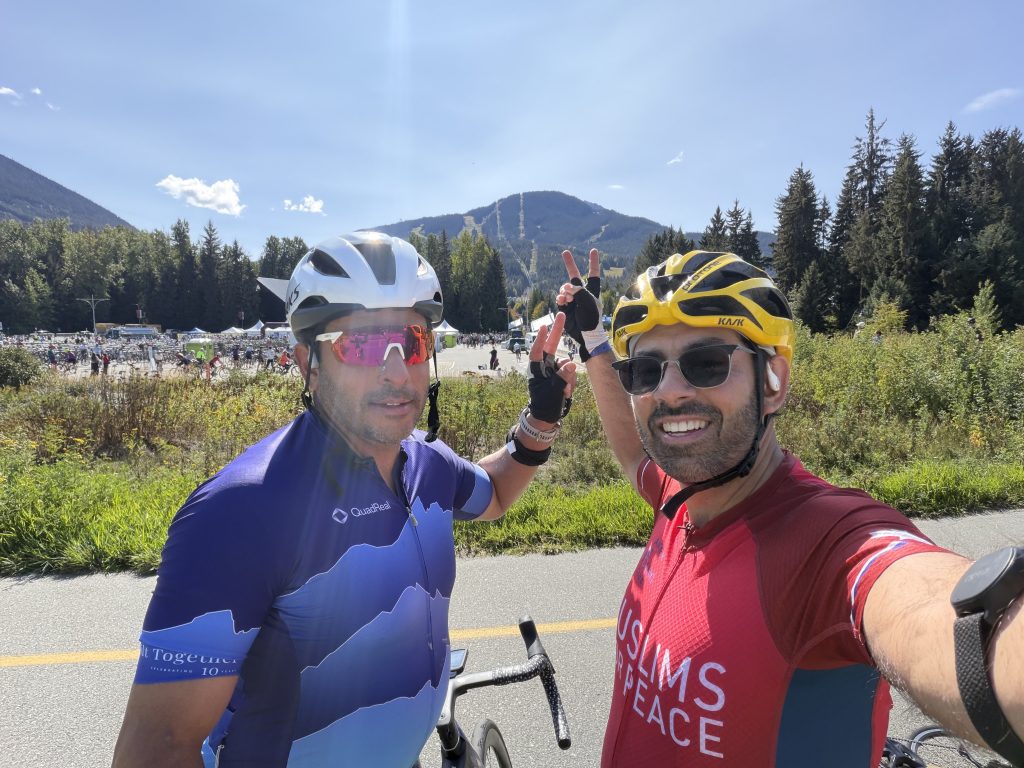
Rolling into Whistler Village, 617 metres above sea level, was a moment of celebration and thanksgiving. Our official chip time was 6:06:31. Our Karoo and Garmin computers recorded 5 hours 10 minutes of moving time, an average moving speed of 24.1 km/h, an average heart rate of 155 bpm, a top descending speed of 74 km/h and more than 3,300 calories burned, roughly the equivalent of twenty-two gulab jamuns.
At the finish, all four of us were reunited over a celebratory meal, recounting the highs and hurdles of the day. The message Irfan Shaheen posted in the group chat said what every heart felt. “Alhamdulillah. Made it. It was awesome!”
All four of us are members of Majlis Ansarullah Canada, the auxiliary organisation whose members Hazrat Khalifatul Masih V (aba) has encouraged to look after their physical health, including through cycling. During a virtual mulaqat with Majlis Ansarullah Finland on 18 May 2025, Huzoor (aba) addressed a nasir who had not cycled for fifteen years despite having a bicycle at home, which, Huzoor (aba) remarked, he “merely looked at with satisfaction”. Huzoor (aba) urged him to “use it at least three or four days a week”. [3]
Our bicycles, Alhamdulillah, are not just for display. They are our gyms and our instruments of endurance and health, and they reflect the commitment of Ansar to follow the guidance of our beloved Khalifa (aba). For its breathtaking route, its excellent organisation and the camaraderie it offers, I warmly recommend the RBC GranFondo Whistler to every Ansar cyclist in Canada. May Allah the Almighty accept the efforts of all who rode, keep every Ahmadi cyclist safe and well, and inspire many more Ansar and Khuddam to take to the saddle for the sake of their health and in the service of Islam Ahmadiyyat. Ameen.
References:
[1] Hazrat Mirza Bashir-ud-Deen Mahmood Ahmad, Musleh Maud (ra), Tafseer-e-Kabeer, Vol. 3 (2023 edition), pp. 266–267 (Surah al-Baqarah, v. 202; classic 10-vol ed. Vol. 2, pp. 443–444)
“Then He states: ‘Wa qina ‘adhaban-nar’ (and protect us from the torment of the Fire). This does not solely refer to the torment of the Fire that one faces after death; rather, this torment of fire also pertains to this world, because ‘Wa qina ‘adhaban-nar’ is uttered after prayers that concern both this world and the hereafter. Thus, the meaning of ‘Wa qina ‘adhaban-nar’ is: shield us also from the worldly torment of fire, and keep us protected from the torment of the Fire in the hereafter… In respect of ‘Adhab an-Nar’, worldly battle can also be understood, for war is indeed a torment of fire. Therefore, whoever offers this supplication—Rabbana atina fid-dunya hasanah wa fil-akhirati hasanah wa qina ‘adhaban-nar—prays, as it were, in the words stated by Allah the Exalted: ‘O Lord, let no ill moment befall me in this life; let battle remain far from me, and let this torment of fire not approach me.’ If a soldier engaged in battle offers this prayer, the meaning of his prayer will be: ‘Protect me from the ill effects of this battle. If a bullet from a gun comes flying, let it narrowly miss—let it pass to my right or to my left; let it pass above or below—in any event, let it not strike me, and keep me safeguarded from it.’ Thus, this is a comprehensive prayer taught by Islam, which the Holy Prophet (sa) used to recite in great abundance.”
[2] Hazrat Musleh-e-Maud (ra), Kalam-e-Mahmud, pp. 96-97, from the poem Naunihalan-e-Jama’at Mujhe Kuchh Kehna Hai
[3] Al Hakam, 23 May 2025, alhakam.org/majlis-ansarullah-finland-18-may-2025