How Hadith guides daily life, how scholars tested them, and how the great collections were written down
From the moment we wake until we lay our heads down at night, Muslims turn to the sayings of the Holy Prophet Muhammad (peace and blessings of Allah be upon him) for guidance. These sayings, the Ahadith, show us how to pray, how to give, how to treat a neighbour, and how to carry ourselves through joy, grief and uncertainty. Often a few lines of his words are enough to settle a troubled heart.
The Holy Prophet (sa) was sent for all of humanity, and what he left behind is a treasure no believer can afford to set aside. For those who hold on to it, it opens the way to the pleasure of Allah.
A Source of Guidance After the Holy Qur’an
After the Holy Qur’an, the Holy Prophet (sa) is our surest guide, and his guidance reaches us in two ways. The Sunnah is his practice, the things he did and the Companions did with him, handed down from generation to generation. Hadith are the reports of what he said and did, carried by narrators. The Promised Messiah (as) set out the order clearly. The Holy Qur’an comes first, then the Sunnah, then Hadith[2].
Allah has given every person free will, but free will is only useful when we can tell right from wrong. Authentic Hadith give that knowledge a practical shape. The Holy Qur’an commands believers to establish Prayer and to pay Zakat, yet it is through the example of the Holy Prophet (sa) that we learn when each Prayer is offered, how it is performed, and how much Zakat is due on savings or crops. He told his Companions simply, “Pray as you have seen me praying.”[1]


Classical jurists such as Imam Malik (rh) and Imam Abu Hanifah (rh) gave their lives to making sure these teachings were understood and not forgotten. Their work rested on a question every Muslim still has to ask. How do we know the Holy Prophet (sa) really said it?
Testing What Was Narrated
Scholars first described Hadith by their form. A Qauli Hadith records something the Holy Prophet (sa) said. A Fi’li Hadith describes something he did, as his Companions watched him do it. A Taqriri Hadith records his silent approval, when a Companion said or did something in his presence and he let it stand. At times his silence was itself the lesson.
Every Hadith then has two parts to examine. The isnad is the chain of people who passed it on, and the matn is the text itself. For each narrator in the chain, scholars asked three things. Was their memory sound? Did they understand what they were passing on? Were they known for honesty? Whole libraries were written about the lives of narrators so these questions could be answered, a field known as ‘Ilm al-Rijal. Where a link in the chain was missing, the Hadith was called munqati, or broken.
From this work came the familiar grades. A Sahih (sound) Hadith has an unbroken chain of trustworthy narrators with accurate memories, and nothing in its text that contradicts better evidence. A Hasan (good) Hadith meets the same conditions, except that one of its narrators was slightly less precise in memory. A Da’if (weak) Hadith falls short on one or more of these points. A Mawdu’ Hadith is a fabrication, invented and falsely attributed to the Holy Prophet (sa).
The text faced its own tests. A narration could not contradict the Holy Qur’an. It could not contradict the established Sunnah or the shared practice of the Companions. It could not go against a proven fact or plain common sense[3].
The Promised Messiah (as) placed all of this in its proper frame. The Holy Qur’an is certain, while a Hadith carries some degree of conjecture, so a Hadith can never be given precedence over the Holy Qur’an. Yet where a Hadith agrees with the Holy Qur’an and does not oppose it, accepting it is necessary. He also reminded us that we need Hadith to understand the Holy Qur’an properly, because its commandments were first put into practice by the Holy Prophet (sa) and then by his Companions under his guidance[4][5][6].
How the Collections Came Together
These tests did not appear all at once. They grew out of habits the Companions practised from the very beginning.
During the lifetime of the Holy Prophet (sa), the Companions committed his words to memory, and some also wrote them down. With his permission, Hazrat Abdullah ibn Amr ibn al-As (ra) kept a written collection known as al-Sahifah al-Sadiqah, one of the earliest written records of Hadith.
Care in accepting reports began early too. Hazrat Abu Bakr (ra) was once approached by a grandmother asking what share of an inheritance was due to her. He told her he found nothing about it in the Holy Qur’an and knew of nothing from the Holy Prophet (sa), and asked the people. Hazrat Mughirah ibn Shu’bah (ra) said the Holy Prophet (sa) had given a grandmother one sixth. Hazrat Abu Bakr (ra) asked whether anyone else could confirm it. Only when Hazrat Muhammad ibn Maslamah (ra) said the same did he grant her the sixth[7].
After the passing of the Holy Prophet (sa), Companions such as Hazrat Abu Hurairah (ra), Hazrat Aishah (ra), Hazrat Abdullah ibn Umar (ra) and Hazrat Abdullah ibn Abbas (ra) became teachers. Two things made their teaching urgent. The Companions were growing old and passing away one by one, and the many people entering Islam were eager to learn how the Holy Prophet (sa) had lived.
By then the Companions had settled in almost every land where Muslims lived, and people gathered around them to hear what they remembered. Circles of learning grew up around each one. A student who had learned all he could from one Companion would travel to the next, sometimes across great distances, to collect more. Because the Holy Prophet (sa) was sent for all people, what they gathered was not tied to one culture. It taught how any person, anywhere, should live and behave.
Formal compilation came later. Early on, there was concern that writing Hadith alongside the Holy Qur’an might cause the two to be confused. As the generations who had known the Companions passed on, relying on memory alone became riskier. Around 100 AH, the Umayyad Khalifah Umar ibn Abd al-Aziz (rh) ordered that Hadith be gathered and written down.
The great work of sifting followed in the third century AH. The scholars who did it, the Muhaddithin, spent their lives searching for Hadith and chose their collections from hundreds of thousands of narrations. Six of these collections became the standard reference works, known as the Sihah Sittah.
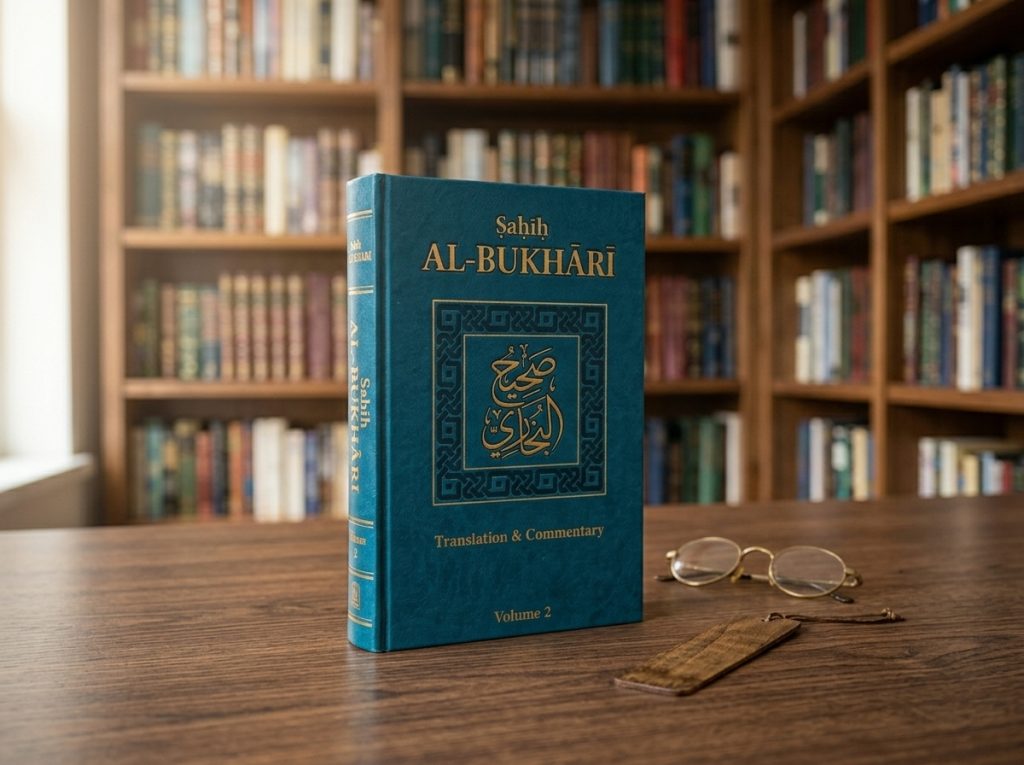
- Imam Muhammad ibn Isma’il al-Bukhari (rh) (194 to 256 AH), Sahih al-Bukhari. It is regarded as the most authentic book after the Holy Qur’an.
- Imam Muslim ibn al-Hajjaj al-Qushairi (rh) (206 to 261 AH), Sahih Muslim. It is held to be the next most authentic.
- Imam Abu Dawud (rh) (202 to 275 AH), Sunan Abi Dawud.
- Imam Abu Isa al-Tirmidhi (rh) (209 to 279 AH), Jami al-Tirmidhi. He was a student of Imam Bukhari (rh).
- Imam Abu Abd al-Rahman al-Nasa’i (rh) (214 to 303 AH), Sunan al-Nasa’i.
- Imam Ibn Majah (rh) (209 to 273 AH), Sunan Ibn Majah.
An earlier work, the Muwatta of Imam Malik ibn Anas (rh) (93 to 179 AH), is one of the oldest surviving collections and laid much of the groundwork for those that followed.


The titles of these books tell us how each is arranged. A Sahih contains only narrations that met its compiler’s strict standard of soundness. A Sunan is arranged by topics of law and practice, such as purification, Prayer and fasting. A Jami gathers Hadith on every subject, from belief and worship to manners, history and commentary on the Holy Qur’an.
The whole Muslim world owes these scholars a debt it can never repay. May Allah grant them the highest reward.
Conclusion
The path to attaining any virtue and the love of Allah is through following every word of the Holy Prophet Muhammad (sa). The Promised Messiah (as) guided us, saying,
“I truthfully say and proclaim on the basis of my own experience that no one can perform true virtue, attain the pleasure of God Almighty, and be fortunate enough to receive the divine favours, blessings, insights, verities and visions, that are bestowed upon one who purifies their soul to the highest degree, until they are lost in subservience to the Messenger of Allah, peace and blessings of Allah be upon him. Evidence of this is found from the word of God Almighty Himself:
قُلۡ اِنۡ کُنۡتُمۡ تُحِبُّوۡنَ اللّٰہَ فَاتَّبِعُوۡنِیۡ یُحۡبِبۡکُمُ اللّٰہُ
Say, ‘If you love Allah, follow me: then will Allah love you.’ [Al-e-Imran, ch.3:v.32]
“I am a practical and living proof of this claim by God Almighty. Recognise me in light of the hallmarks that represent the saints and beloved of God Almighty as established by the Holy Quran.” [8]
May Allah enable us to attain more knowledge of the Ahadith and to imbibe every word of the Holy Prophet (sa) in our lives.
References
- Sahih al-Bukhari, Kitab al-Adhan, Hadith 631.
- The Promised Messiah (as), Our Teaching, p. 17.
- Hazrat Mirza Bashir Ahmad (ra), The Life and Character of the Seal of Prophets, Vol. 1, pp. 13 to 15.
- The Promised Messiah (as), Review on the Debate Between Batalwi and Chakralvi, Ruhani Khaza’in, Vol. 19, pp. 209 to 212.
- The Essence of Islam, Vol. II, pp. 129 to 135.
- Gems of the Promised Messiah and Imam Mahdi (as), “The Error of the Muslims Regarding the Qur’an and Ahadith,” Religious Concepts, October 2024 edition.
- Sunan Abi Dawud, Kitab al-Fara’id, Hadith 2894.
- The Promised Messiah (as), Malfuzat [English Translation], Vol. 1, p. 211, as quoted in Jazib Mahmood, “Reaching Allah through love for the Prophet (sa),” Al Hakam, 6 November 2020, https://www.alhakam.org/reaching-allah-through-love-for-the-prophet
Photos of Medina courtesy of Abdul Razzaq Qureshi from Halifax.