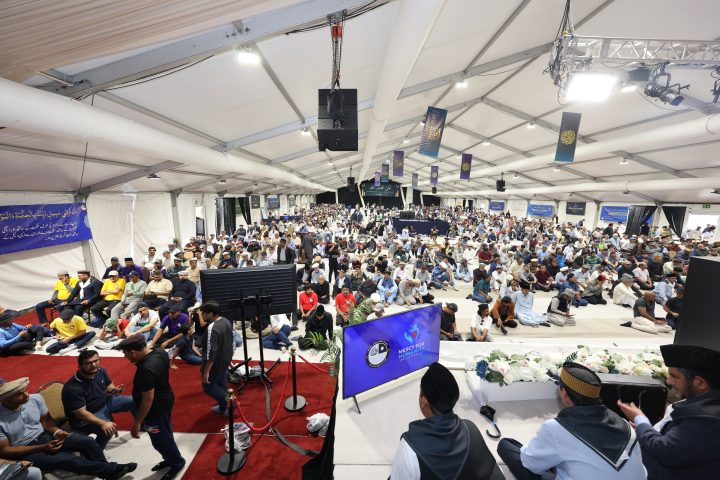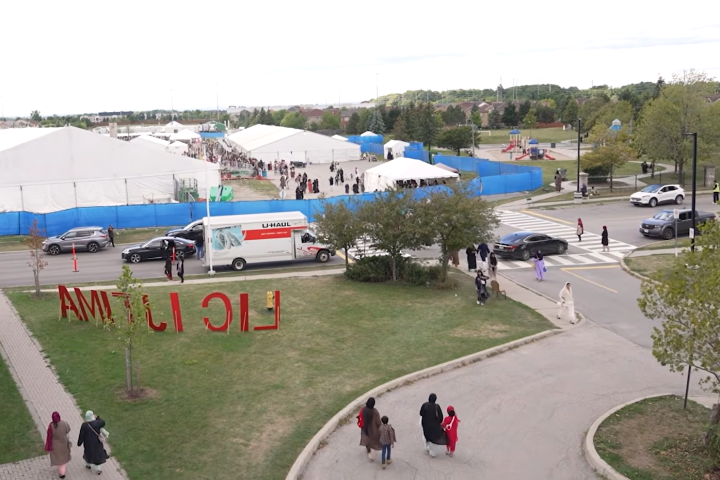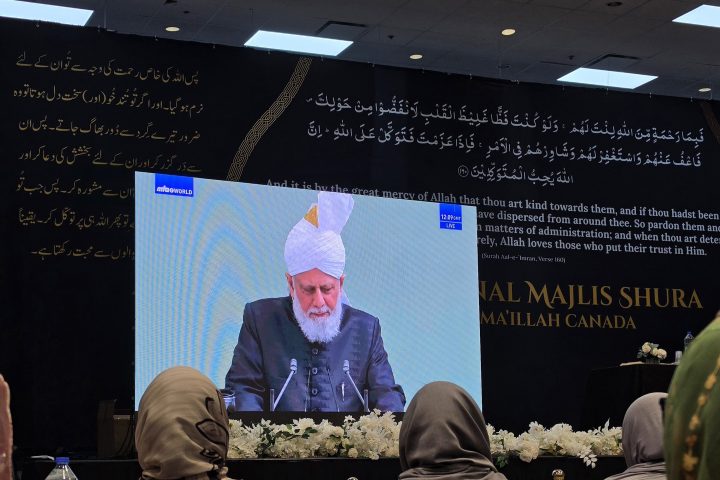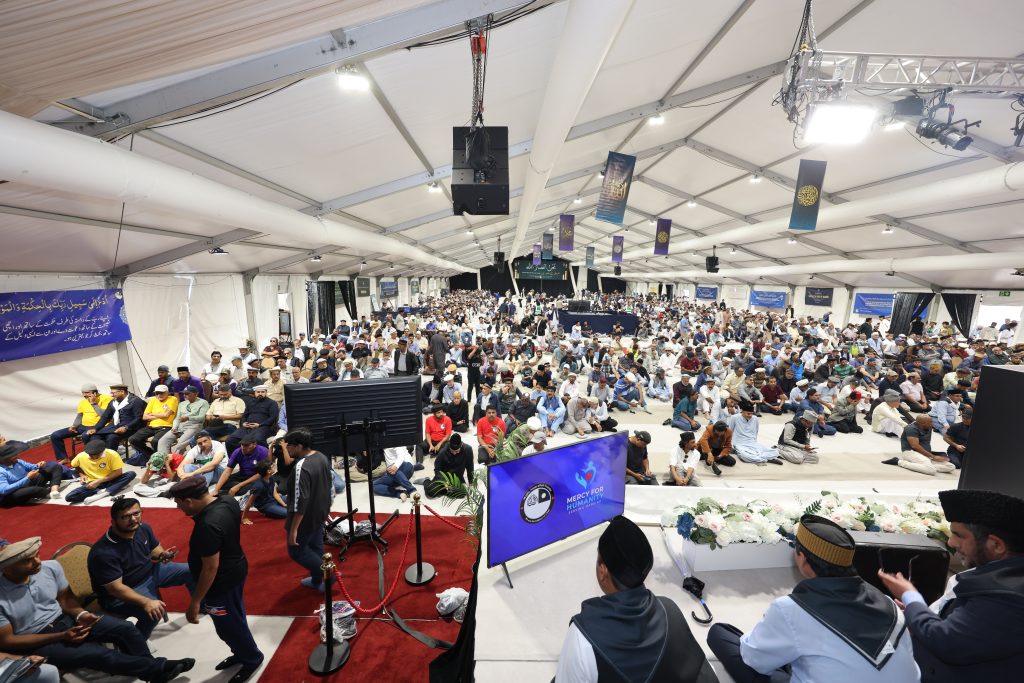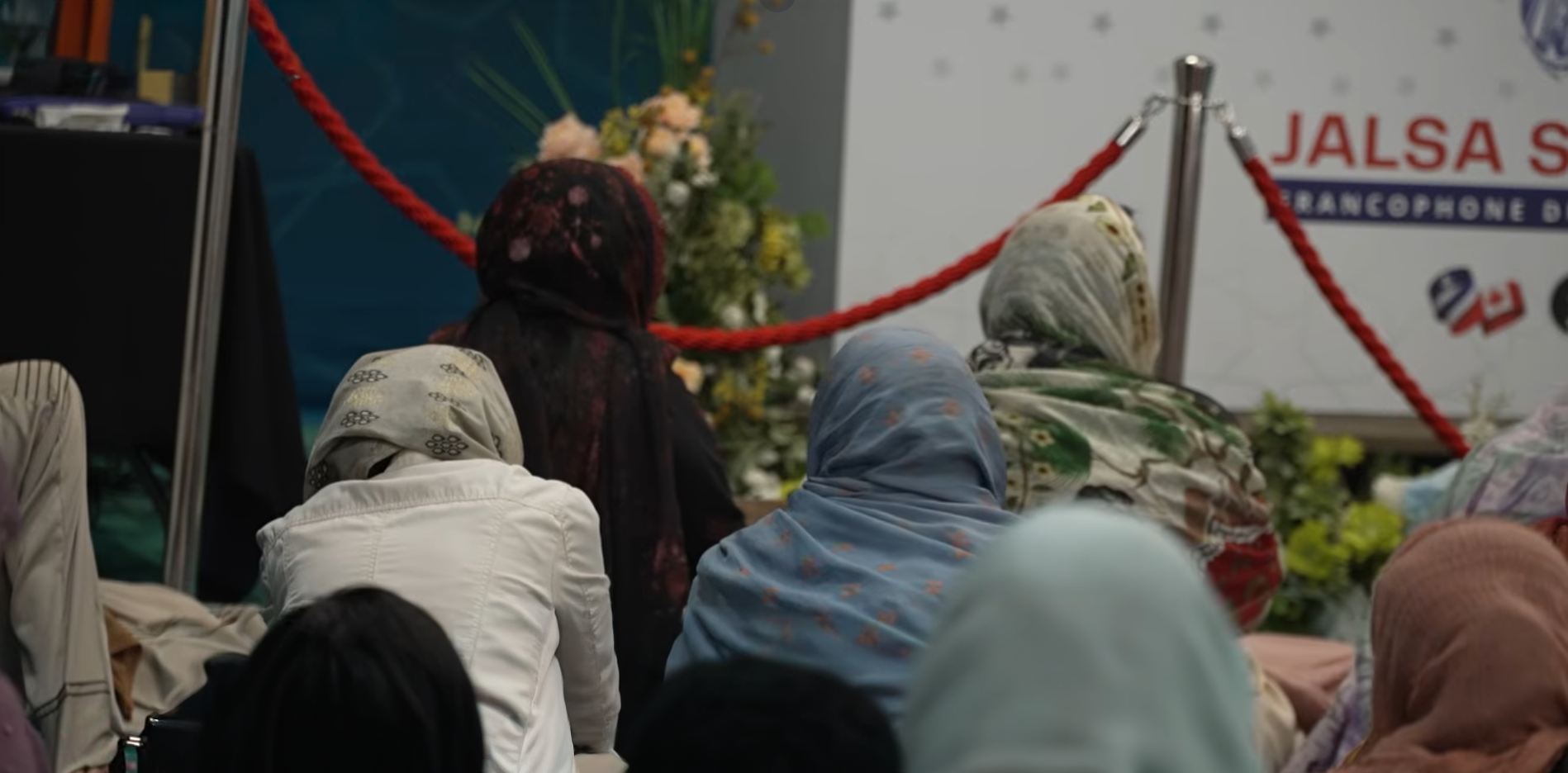
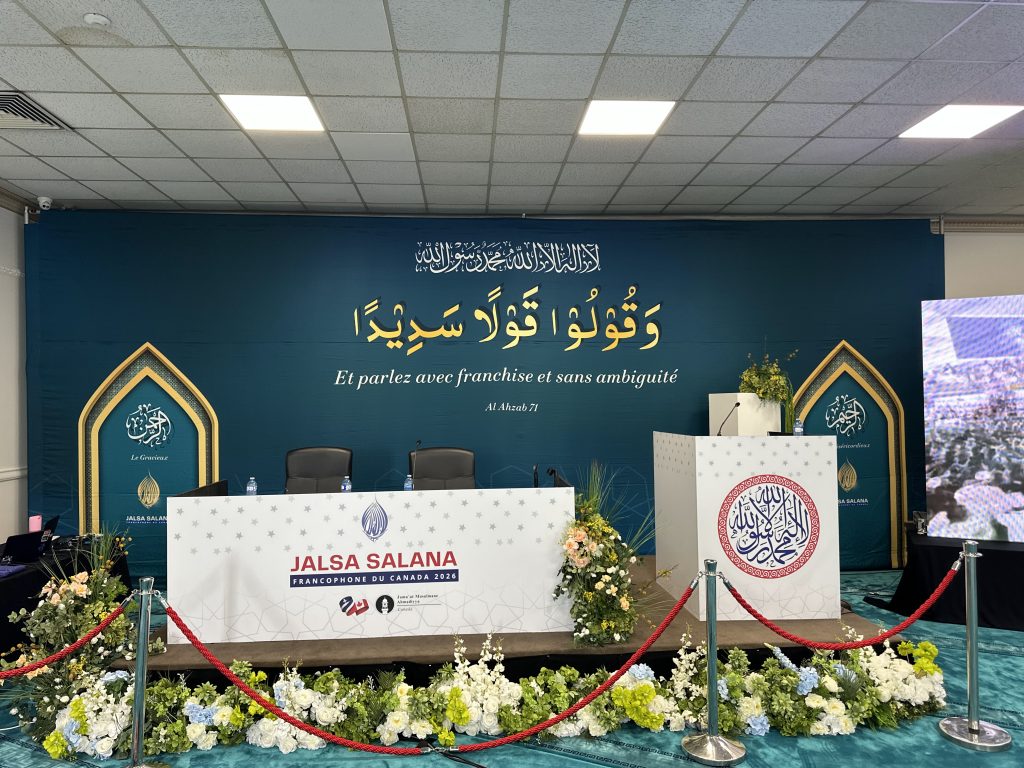
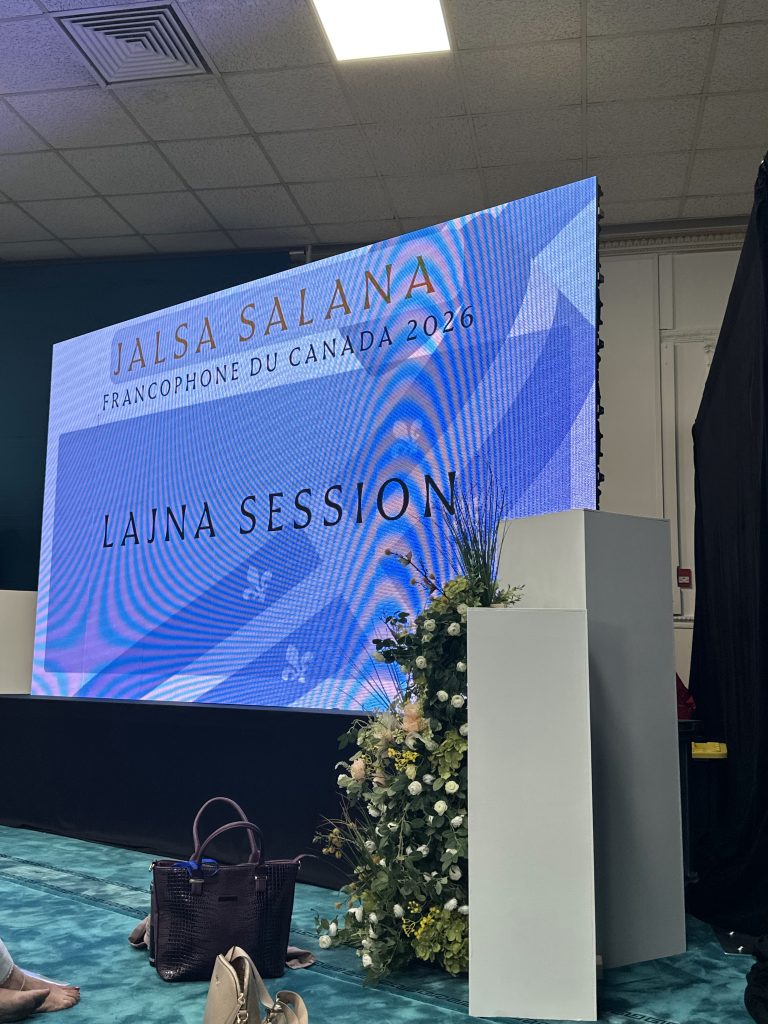
Alhamdulillah, on Saturday 12 September 2026, the Lajna Imaillah session of the 9th Annual Jalsa Salana Francophone was held at An-Nusrat Mosque in Montréal-Nord. The session brought together the Holy Qur’an, the writings of the Promised Messiah (as), the guidance of Khilafat and examples from the lives of righteous women. Its programme moved attendees beyond acquiring knowledge to consider how that knowledge should transform their lives. All four speeches returned to the same principle, that spiritual development requires knowledge, reflection and action. Each speaker reminded attendees that faith must not remain something inherited or merely spoken about; it must be visible in character, worship and daily conduct.
The session opened with Zuhr and Asr prayers offered in congregation. Noumana Ali Sahiba then recited from the Holy Qur’an [Luqman, ch.31:v.14-20 and v.23], [Al-Ahzab, ch.33:v.22] and [Al-Qalam, ch.68:v.5], with French and Urdu translations. Salmana Janjua Sahiba presented Mahasin-e-Qur’an-e-Karim, a poem of the Promised Messiah (as) from Durr-e-Sameen, with French translation. The Academic Awards Ceremony closed the opening portion of the programme, recognising the scholastic achievements of Lajna members over the past year.
Pourquoi L’Islam Ahmadiyyat
Saimah Manahel Sharif Sahiba opened the addresses with an image of a traveller lost in the dark, holding a map that is useless without light to read it by. Islam, she said, had never disappeared. The Qur’an and the example of the Holy Prophet (sa) remained intact, but centuries of division, misinterpretation and extremism had obscured its true beauty. God sent His Messiah (as), who established his Community in 1889, to relight that map.

She built her case for Ahmadiyyat on three pillars. The first was fulfilled prophecy. Citing the Qur’anic principle that a false claimant to divine office is seized and cut off [Al-Haqqah, ch.69:v.45-48], she contrasted the violent, early ends of other nineteenth- and twentieth-century claimants to prophethood or messianic status with the natural, decades-long life and growing following of the Promised Messiah (as). Among those claimants were Joseph Smith, killed by a mob in 1844; the Bab, executed in Iran in 1850; and Muhammad Abdullah al-Qahtani, killed days after being proclaimed the Mahdi at Mecca in 1979. The Community founded by the Promised Messiah (as), she noted, is now recognised as the fastest-growing branch of Islam worldwide.
The second pillar was unity through Khilafat. Drawing on an image used by Hazrat Musleh Maud (ra), of a planet mostly covered in water yet parched without rain, she argued that Khilafat is the “rain” sustaining the spiritual life of the Community. She quoted the Qur’anic promise of successorship [Al-Nur, ch.24:v.56] and described Ahmadis, from West African villages to Canadian commutes, tuning in to the same Friday sermon on MTA. It was, she said, a living picture of the Holy Prophet (sa) describing believers as one body.
The third pillar was conduct as testimony. Invoking the Qur’anic call to be witnesses over mankind [Al-Baqarah, ch.2:v.144], she pointed to Dr Abdus Salam, the first Muslim Nobel laureate in physics, whose own country disowned him as a Muslim. She pointed also to the quieter witness of Ahmadi shopkeepers trusted by their neighbours. She cited the relief work of Humanity First and the mosques, schools, hospitals and Qur’an translations the Community has built over more than a century without state support. Facing persecution in Pakistan, Bangladesh, Algeria and elsewhere, she said, the Community still answers with prayer, patience and peace, and with “Love for All, Hatred for None.”
Sur les traces des Compagnonnes
Nudrat Ahmed Sahiba addressed the session in Urdu. She opened with the Qur’anic promise of gardens to believing men and women alike [Al-Taubah, ch.9:v.72] and with the Holy Prophet (sa) likening his Companions to stars by which one is rightly guided. She then traced a lineage of footprints left by women, not in sand but in faith and sacrifice.
She began with Hazrat Khadijah (ra), who gave her wealth for the cause of Islam, and Hazrat Aisha (ra), whose learning led the Holy Prophet (sa) to instruct believers to “learn half of religion from Aisha.” She recalled Hazrat Sumayyah (ra), tortured on the burning sands of Mecca and killed for refusing to renounce her faith, the first martyr of Islam. Hazrat Umm Ruman (ra) made sacrifices of her own alongside those of her husband, Hazrat Abu Bakr (ra). Hazrat Asma bint Yazid (ra) won praise from the Holy Prophet (sa) for asking him directly whether women share equally in reward. Hazrat Asma bint Abi Bakr (ra) endured poverty with patience and, on his counsel, learned to give generously despite scarcity. Hazrat Umm Sulaym (ra) asked for no mahr except that her husband, Hazrat Abu Talha (ra), accept Islam, and she met the death of her young son with a composure the Holy Prophet (sa) praised as pleasing to God.
She carried the thread into more recent history. Hazrat Amma Jan (ra) sold her own land and property to help fund the Al Fazl newspaper and the Minaratul Masih. Hazrat Hussain Bibi (ra), mother of Hazrat Chaudhry Sir Muhammad Zafrulla Khan (ra), refused superstitious rites even as she lost five children. Shah Jahan Bibi, wife of Hazrat Sahibzada Abdul Latif (ra), bore the martyrdom of her husband and the severe exile and imprisonment of her sons with faithful steadfastness.
She closed with contemporary examples. There was an African-American convert who taught modesty to young women, and a poor African Ahmadi woman whose entire Tahrik-e-Jadid donation preceded the end of her financial hardship. There were mothers who met the martyrdom of their sons with composed submission to the will of God. She urged the audience to ask not only whether these stories moved them, but whether they were truly walking in these footsteps today.
A Qaseedah of the Promised Messiah (as) followed the address, recited by Rida Hashmat Sahiba with French translation by Basmah Chughtai Sahiba.
Les voies du progrès spirituel
Shazia Mahnoor Sahiba spoke in French about why believers pray daily to be guided to the straight path even after accepting the Holy Prophet (sa) and the Promised Messiah (as). Finding the path, she said, is not the same as advancing along it. She set out spiritual progress as a journey built on six disciplines.
The first is a genuine desire to seek Allah, since the Qur’an promises guidance only to those who strive [Al-Ankabut, ch.29:v.70]. The second is transforming Salat from a routine into an encounter with a God who is near [Al-Baqarah, ch.2:v.187]. The third is making the Qur’an a living guide rather than a text merely recited; she recalled that Hazrat Aisha (ra) described the character of the Holy Prophet (sa) as “the Qur’an” in practice. The fourth is struggling against the self through daily, unspectacular effort rather than dramatic gestures. The fifth is translating devotion into moral character, since prayer that leaves a household suffering under the temper of the one who prays has not truly drawn that person closer to God. The sixth is constancy, a small and steady effort sustained over time rather than a dramatic burst abandoned within days.
She reminded listeners that love, too, must be rightly ordered [Al-Taubah, ch.9:v.24]. She cited the statement of the Promised Messiah (as) that belonging to his Community will mean nothing in the next world without real advancement in righteousness. She also cited a hadith counselling believers to guard their tongues, find contentment within their own homes, and weep over their own sins rather than measure themselves against others. She invited each woman present to leave with a single resolution, one prayer improved or one habit broken, rather than many resolutions soon abandoned.
Sadia Khan Sahiba then presented Bashir Ahmad, Sharif Ahmad aur Mubaraka ki Amin, a further poem of the Promised Messiah (as) from Durr-e-Sameen, with French translation by Attia Tul Mujeeb Sahiba.
Lajna Imaillah – Ambassadrice de la Khilafat
The final address came from Tayyaba Mansoor Sahiba. She opened with the Qur’anic description of believers as the best of peoples [Al-e-Imran, ch.3:v.111] and traced the founding of Lajna Imaillah to 25 December 1922 under Hazrat Khalifatul Masih II (ra), who taught that the progress of Islam is tied to the reform of its women. She compared the role to that of a diplomat, who must first be devoted to the homeland before representing it abroad. Ambassadorship of Khilafat, she argued, likewise begins with the attachment of the heart, proven through obedience, prayer and action rather than sentiment alone. She contrasted the weeks or months it once took earlier generations of Lajna to receive the guidance of the Khalifa with the instant access MTA now gives.
She located that ambassadorship in three roles. As mothers, she said, women shape the moral and spiritual direction of the next generation more than any institution. Here she cited the teaching of Hazrat Khalifatul Masih V (aba) that the example of a mother is the most effective religious education a child receives. As wives, she cited his guidance that fidelity, patience and the protection of the rights of a husband, even in his absence, are themselves a form of piety. As daughters and sisters, she argued, women represent Khilafat quietly through modesty and chastity, amid a culture of “indecency” and blurred boundaries between men and women.
She turned finally to what she called the trials of the present age. These included the normalisation of practices she said conflict with Islamic teaching, restrictions on religious expression in workplaces and schools, and pressures on the upbringing of children. An Ahmadi woman rooted in Khilafat, she argued, meets these not with despair but with prayer, patience and, where appropriate, a jihad of the pen on social media in defence of her faith.
She closed by relaying three prayers that Hazrat Khalifatul Masih V (aba) has urged members to recite daily in this age of trial. These are Durood recited 200 times, Istighfar recited 100 times, and the supplication Rabbi kullu shai’in khadimuka for protection and mercy. She described them as a fortress for the believer and her family.
Four Addresses, One Theme
Each address focused on a distinct topic, whether the evidence for the truth of Islam Ahmadiyyat, the example of the female Companions, the disciplines of spiritual progress or the responsibilities of ambassadorship. Yet all returned to the theme of the day, Tarbiyat. Faith, the session made clear, is not accepted once or inherited. It is examined, defended, disciplined and lived out daily, in our homes, with our families and the wider world, by every Ahmadi woman.