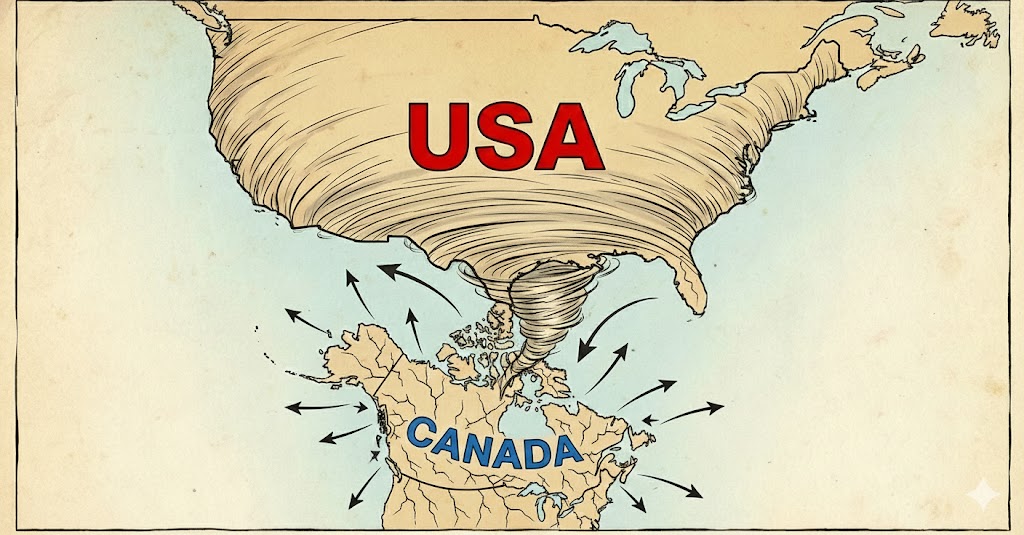
The notion that Canada might one day become American territory is almost as old as the United States itself. It has surfaced in congressional chambers and on battlefields, in newspaper editorials and presidential speeches. Most recently, in 2025, Donald Trump suggested that Canada should become the “51st state.” [1] The proposal prompted diplomatic friction and near-universal rejection north of the border. Yet the idea persists, resurfacing across nearly 250 years in radically different forms. As the historian Stacy Schiff observes, the courtship has invariably played out “with all the grace and romance of Pepé Le Pew on the trail of Penelope Pussycat.” [2]
Revolutionary Ambitions
The story begins during the American Revolution. The region then called “Canada” was not yet a nation but the British Province of Quebec, a colony created after Britain’s victory in the Seven Years’ War against New France. [3] Its French-speaking Catholic majority had recently been granted religious and legal protections under the Quebec Act of 1774, legislation that American colonists counted among the “Intolerable Acts.” [4] Control of the St Lawrence River and the continental interior made Quebec strategically vital. The Continental Congress turned its attention northward.
In October 1774, the First Continental Congress dispatched an appeal to Quebec. Over eighteen pages, the letter enumerated the rights of a free people and urged the Canadians to send delegates to Philadelphia. It concluded with a pointed reminder that Canada would be wise to count the rest of North America among its “unalterable friends” rather than its “inveterate enemies.” [2] “You are a small people,” the letter noted, “compared to those who with open arms invite you into a fellowship.” [2] No Canadian delegates materialised.
Congress remained undeterred. A second letter, drafted by John Jay, warned Canadians that British rule reduced them to slavery. “We can never believe that the present race of Canadians are so degenerated as to possess neither the spirit, the gallantry, nor the courage of their ancestors,” it declared. [2] The letter ended with a threat the Americans hoped the Canadians would not “reduce us to the disagreeable necessity of treating you as enemies.” [2]
By August 1775, Congress authorised an invasion. George Washington informed the Canadians that Benedict Arnold was heading their way. “Come then, my brethren,” he wrote, “unite with us in an indissoluble union, and let us run together to the same goal.” [2] Around the time Washington penned this hopeful letter, Arnold and his men were surviving on dead dogs and boiled cartridge belts. [2]
Benjamin Franklin’s involvement in these efforts has sometimes been exaggerated, but it was real enough. In 1776, he joined a congressional commission dispatched to Montreal to persuade French Canadians to join the rebellion. [5] The other commissioners were Samuel Chase, Charles Carroll of Carrollton, and Father John Carroll. Charles Carroll, thought to be the richest man in the colonies, was a Catholic and fluent in French. The delegates erroneously believed Franklin was also fluent in French. [6] John Adams approved: “The unanimous voice of the Continent is Canada must be ours and Quebec must be taken.” [6]
The commissioners set out in late March. Their route took them from Philadelphia up the Hudson River to Saratoga, then across Lake George and Lake Champlain to Montreal. The journey was brutal. They met with gale winds and ice floes, slept in the woods and pillaged cabins. Franklin’s legs swelled; boils erupted on his skin. At seventy, he wrote farewell letters to friends, recognising he may die on this mission. [2] They arrived in Montreal on April 29, 1776, where Benedict Arnold greeted them with a cannon salute. [6]
In Montreal, the commissioners discovered they had embarked on “the original Canadian goose chase.” [2] It was difficult to convince people to place themselves under American protection when American troops were without provisions or funds, undisciplined, underdressed and unfit for duty. Nearly half had succumbed to smallpox. [6] The commissioners reported to Congress that Canadians “have suffered us to enter their country as friends,” and the Americans managed to turn “their good dispositions towards us into enmity.” [2]
Father Carroll noted that the Canadians did not believe themselves oppressed. When he told a priest that Catholics would have freedom of religion under the Americans, he was informed that they had it already under the British. [6] Congress appointed a committee to investigate the fiasco. It produced a long list of causes but omitted the most obvious one, that the Canadians had no interest in revolt. Franklin, said to be “pitifully unwell,” returned home. [2] By the close of the decade, serious discussion of adding Canada as a fourteenth state had expired.
The idea resurfaced during the War of 1812. Congress pushed for an invasion of Upper Canada. [9] Thomas Jefferson predicted the conquest would be “a mere matter of marching.” [10] They were wrong. British regulars, Canadian militia and Indigenous allies repelled American incursions. Brigadier General William Hull crossed into present-day Windsor, Ontario, and demanded that Canadians welcome his troops as liberators. [2] Two summers later, in a retaliatory raid, the White House went up in flames. [2] The war concluded in 1814 without territorial change, and Canadian national identity was born.
The mid-nineteenth century brought Manifest Destiny, an ideology that imagined the United States expanding across the continent as a providential right. While most expansion efforts went west, some expansionists wanted to move north, too. Newspapers predicted that Canadian provinces would “fall like ripe fruit” into American hands. The Confederation of Canada in 1867, which created a self-governing dominion within the British Empire, put an end to such speculation. [11]
Then came 2025. President Trump’s declaration that Canada should become the 51st state marked the most prominent revival of annexationist language in generations. His arguments bore no resemblance to Franklin’s revolutionary diplomacy. Trump framed the matter in transactional terms, claiming that the border is “artificial,” and America should not “subsidise” the Canadian economy through supposedly unfavourable trade arrangements. [12] He raised the possibility of using economic pressure to force the issue, suggesting tariffs as leverage. [13]
The reaction in Canada was swift. Prime Minister Justin Trudeau said Trump wanted “a total collapse of the Canadian economy because that’ll make it easier to annex us.” [1] Provincial premiers who had previously sought warmer relations with Washington pushed back sharply. Polling confirmed what most observers suspected, that approximately nine in ten Canadians rejected any notion of joining the United States, and American public opinion showed only tepid interest. [14] Most analysts saw Trump’s statements as a way of applying pressure on a close ally rather than a serious proposal.
At each moment of its appearance, the idea of absorbing Canada has taken a different form. In 1776, it was a revolutionary strategy. During the War of 1812, it was military opportunism. In the era of Manifest Destiny, it was an expansionist ideology. In 2025, it was economic grievance dressed up as geopolitics.
Yet the relationship between the two countries remains remarkably successful. We have one of the longest undefended borders in the world, deep economic ties, shared democratic values and close security cooperation. This partnership has flourished because it respects the independence of both parties. The American fantasy of annexation has never seriously threatened the arrangement. It has, however, occasionally tested Canadian patience and reminded us that we are an independent nation “Strong and Free.”
References
[1] ABC News, “Trump keeps talking about making Canada the 51st state. Is he serious?”, March 2025; CBC News, March 2025. https://abcnews.go.com/Politics/trump-talking-making-canada-51st-state/story?id=119767909
[2] Stacy Schiff, “The Truly Terrible Idea That Franklin, Washington and Trump All Share,” The New York Times, March 30, 2025. https://www.nytimes.com/2025/03/30/opinion/canada-annex-us-trump.html
[3] The Canadian Encyclopedia, “Quebec Act, 1774.” https://www.google.com/search?q=https://www.thecanadianencyclopedia.ca/en/article/quebec-act-1774
[4] Mount Vernon Digital Encyclopedia, “The Coercive (Intolerable) Acts of 1774.” https://www.mountvernon.org/library/digitalhistory/digital-encyclopedia/article/the-coercive-intolerable-acts-of-1774/
[5] Founders Online, National Archives, “Instructions and Commission from Congress to Franklin, Charles Carroll, and Samuel Chase for the Canadian Mission, 20 March 1776.” https://founders.archives.gov/documents/Franklin/01-22-02-0228
[6] Madelaine Drohan, “He Did Not Conquer: Benjamin Franklin’s Failure to Annex Canada” (Dundurn Press, 2025); excerpt published in Toronto Star, September 28, 2025.
[7] Britannica, “Battle of Quebec 1775”; History.com, “Battle of Quebec 1775.” https://www.history.com/topics/american-revolution/battle-of-quebec-1775 and https://www.google.com/search?q=https://www.britannica.com/event/Battle-of-Quebec-1775
[8] American Battlefield Trust, “Quebec Battle Facts and Summary.” https://founders.archives.gov/documents/Jefferson/03-05-02-0231
[9] Britannica, “War Hawk”; National Park Service, “‘War Hawks’ urge military confrontation with Britain.” https://www.nps.gov/articles/war-hawks.htm
[10] Founders Online, National Archives, “Thomas Jefferson to William Duane, 4 August 1812”; National Park Service. https://founders.archives.gov/documents/Jefferson/03-05-02-0231
[11] UK Parliament, “British North America Act 1867”; The Canadian Encyclopedia, “Constitution Act, 1867.” https://www.thecanadianencyclopedia.ca/en/article/constitution-act-1867 and https://www.parliament.uk/about/living-heritage/evolutionofparliament/legislativescrutiny/parliament-and-empire/collections1/parliament-and-canada/british-north-america-act-1867/
[12] Al Jazeera, “‘Closest target’: Why is Donald Trump so focused on Canada?”, March 2025.
[13] Fortune, “Trump says he will double his planned tariffs on Canadian steel and aluminium,” March 2025; CBC News, “Trump placing 25% tariff on steel, aluminium,” March 2025. https://www.cbc.ca/news/politics/canada-retaliatory-tariffs-1.7481258
[14] Angus Reid Institute, “51st State: Canadian resolve in saying ‘no’ continues,” March 2025; Ipsos Canada, January 2025. https://angusreid.org/trump-carney-51st-state-canada-usa/