Book reviewed:
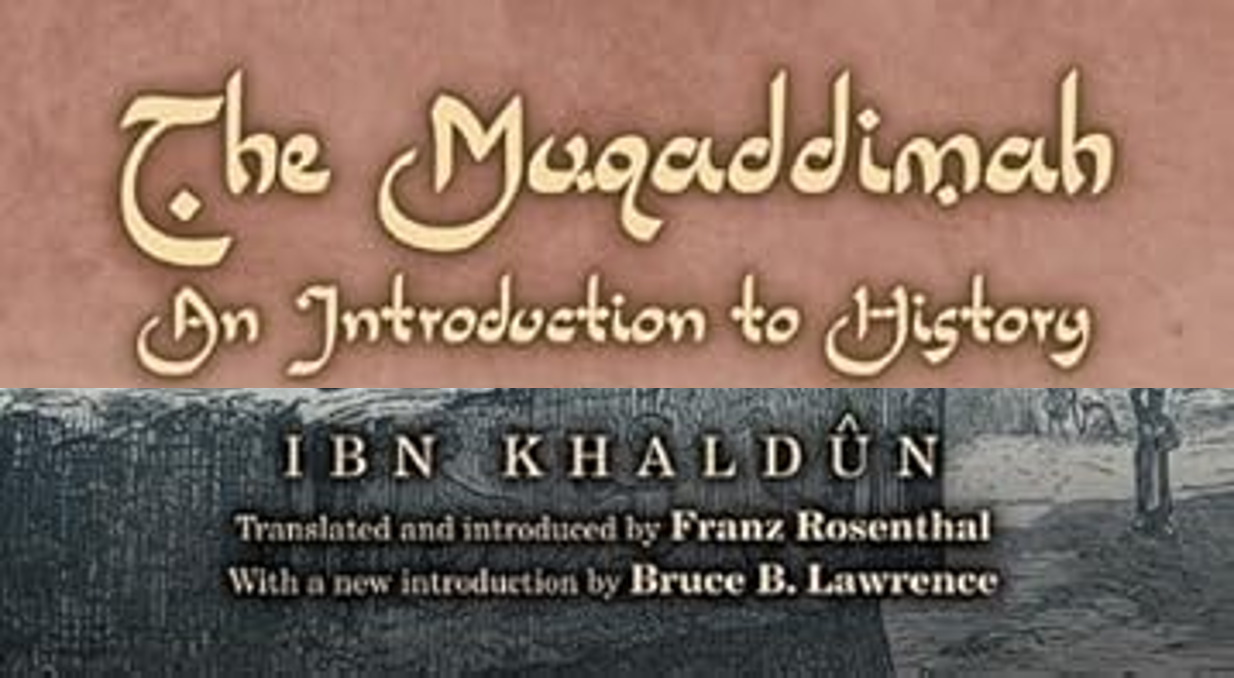
The Muqaddimah: An Introduction to History (Princeton Classics) Paperback
by Ibn Khaldun (Author), N. J. Dawood (Editor), Franz Rosenthal (Translator) – 1989 edition
By: Fazal Masood Malik, Prince Edward Island
There are a few books that every person should have in their library. The Muqaddimah by Ibn Khaldun is definitely one of them.
Ibn Khaldun lived through a very turbulent time. Spain had fallen, the Christian conquest was advancing in North Africa, and the plague (Black Death) was ravaging havoc in Europe and the Middle East. The Ottoman Empire was expanding as the Byzantine Empire declined. Everything Ibn Khaldun had learned and read about his world was crumbling to pieces. There was an urgent need to record history in an unbiased and factual manner. Ibn Khaldun understood the need for such work, and the result was his magnum opus Kitab al-‘ibar (Book of Lessons), a seven-volume work on the history of the world, which spans about 3,000 pages. The Muqaddimah (prologue) serves as an introduction to Kitab al-‘ibar and has been translated into various languages, mostly during the past century.
The significance of the Muqaddimah is that in it Ibn Khaldun laid down the principles for the methods that should be used for recording history, thereby establishing the new science of ‘Umran (Civilisation). He argued that history requires more than the mere narration of historical events and that a historian should critically investigate the impact of natural, social, economic, and political environments over time. He warned about the many ways that historians could err and was critical of previous and contemporary historians and their methods of presenting history.
The central theme of the Muqaddimah is why nations rise to power and what causes their decline. The discussion revolves around what makes humans come together, build civilisations and then ultimately destroy them.
The Muqaddimah begins by praising Allah, as it is He who created races and nations. Ibn Khaldun then seeks to understand why civilisations experience a life-cycle of formation, growth, stagnation, and eventual decline. This has always been the case, from Biblical civilisations to Persia, Greece, Rome, and the great Arab-Muslim civilisation of his time. What is of interest is his focal point in trying to understand this from the viewpoint of a Muslim.
The book is ripe with his astounding observation of social behaviour. He discusses the significance of thought and how humans have been able to dominate the earth, despite their vulnerability in comparison to other animals, like lions. It is because humans possess the ability to think and have dexterous hands that they have been able to shape human civilisation and defend themselves from animals possessing far greater power.
Ibn Khaldun’s observations on the relationship between climate and civilisations are of great interest. Being a Canadian, as I apply those observations to Canada, they become self-evident. The parameters of his world were defined by the geography of the Mediterranean and Mid to North Africa, yet his observation applies to the world. He proposed that warmer climates have produced the greatest of civilisations, whereas harsher climates have civilisations that are constantly in survival mode. It follows that climate can influence the character of the people living in a particular area. He discusses how the Egyptians, who enjoy a warm climate, are carefree and do not stockpile food, and compares it to Fes (in Morocco), which is surrounded by snowy mountains and is much cooler. People in Fes are gloomier than Egyptians and tend to stock food to safeguard themselves against disasters.
Towards the end of a lengthy Chapter 1, he discusses how certain people have been chosen by God to act as His prophets. These people are a direct link between God and His creation and urge their followers “to let themselves be guided aright.[1]” The author reasons that although there have been many prophets, the revelations granted to Muhammad (sa) make the Holy Qur’an the greatest miracle ever. He establishes that the Holy Qur’an “is its own proof. It requires no outside proof…[2]” One of the reasons for its (the Qur’an) greatness transpires from the fact that the Holy Qur’an was revealed word for word, and the Prophet of Islam (sa) did not communicate in his own words, but in the words of God. In scriptures like the Torah and the Bible, God revealed His message in “form of ideas…” which were later expressed by the prophets in their own words.
A key concept discussed in the book is that of asibiyah or group solidarity. Humans are not solitary or separated individuals and tend to be naturally social; the closer the bond among them, the stronger the solidarity. This feeling among the group is vital for support and aid of individuals, and that is one of the key reasons why humans desire to become members of an organised body.
Asabiyyah, according to Ibn Khaldun, is the cradle of civilisation. It is what unites people and gives them a sacrificial character in which members are willing to die for others. This is a crucial characteristic for the continuity of their tribe, as it gives them their fighting spirit. The idea of asabiyyah is known as “love of kith and kin” in the Western world.
This feeling of ‘asabiyyah’ naturally demands that there be leadership among the group. This gives rise to the royal authority, which is necessary to guide us and to restrain the evil within us. The reason why royal authority succeeds is that power is entrusted to them by the people in the tribe. In order for this royal authority to succeed, it must be careful in its methods and be guided by the goodness of faith and not by an urge to oppress and dominate. Ibn Khaldun observes how Bedouins desiring the goods of a sedentary life come together and settle down. The same thing happens when tribes of rural or remote nature adopt a city life. As time passes, they lose their nomadic harshness. A few generations later, their grandchildren, never having known anything but a city life, start to demand goods and luxuries that their ancestors never knew. As the people come to expect goods and luxuries, political factions form, and a ruler emerges, which, in turn, has an economic impact. One of the first indicators of organised civilisation is that the land prices go up in the city of the ruler, and there is an abundance of arts and various crafts. However, with the passage of time, the laws change to favour the rulers, and their harshness destroys the happiness of their constituents, making way for revolution. Hence begins the cycle of governance once again.
Summary:
Ibn Khaldun’s Muqaddimah is a classic with astounding original thoughts. He observed things no person had observed and documented before him. He was the first to perceive regularity and rules in the social behaviour and development of mankind. His message is simple, yet astounding. The road to civilisation is riddled with a great many roadblocks, such as the need of humans to belong to a tribe, the desire to lead a sedentary life, making the future easier for posterity, and our inner evil self. However, using the guidance of the Holy Qur’an and following in the footsteps of the Holy Prophet (s.a.), we can create a long-lasting civilisation that is not prone to the life cycle of civilisations discussed in the book.
About the author
Ibn Khaldun (also known as Abu Zayd ‘Abd al Rahman ibn Muhammad) was born in Tunis on May 27, 1332. He was a historiographer and a historian and stands out as one of the most prominent scholars of medieval Islam.
Ibn Khaldun lived in a world decimated by the Black Death, political upheaval and military expansion of the Ottoman Empire. He held many posts in the turbulent Islamic courts of North Africa, becoming a major political player as well as a teacher and a writer.
His most important philosophical work is the Muqaddima, an introduction to a much longer history of the Arabs and Berbers – Kitab al-‘ibar. Yet the author of the Muqaddima is not as well known as he should be.
He died on March 17, 1406, in Cairo, shortly after his appointment to the senior-most office of qadi (judge).
[1] Muqaddimah, pg 70
[2] Muqaddimah, pg 73