A heartwarming account of a difficulty and deliverance
My father’s name was Sheikh Latif Ur Rahman, a B.A. in Imperial India of the early 1930s. He had earned honours in Economics, but was somewhat ascetic about it and never even mentioned it in passing to me until after I earned my Ph.D. in Economics from Canada.
When I was to proceed to Canada for higher studies, Hazrat Sahibzada Mirza Tahir Ahmad (rh) saw me off. I had no means of passage, but Professor Dr. Abdus Salam persuaded Sir Chaudhari Muhammad Zafarullah Khan (ra) to pay my airfare. It was a tremendous kindness. I carried with me the weight of the expectations and prayers of my illustrious mother, Shakira Begum, and my pious and supportive father.
My mother was a graduate of Muslim College of Lucknow, which was established by Sir Ross Masood, the visionary son of the well-known educationist and founder of Aligarh Muslim University, Sir Sayed Ahmad Khan, K.C.S.I. She had lived in Qadian when her father, La’al Muhammad of Lucknow, left his service as a military doctor in Imperial India. There, she attended many Holy Qur’an sessions, and the speeches and sermons of Hazrat Musleh-e-Mau’d (ra). She had a sort of mysterious telepathic relationship with me, her only son, and became instantly aware if I was either unwell or in any trouble.
A Convergence of Urges
It was during the turbulent years of Zulfiqar Ali Bhutto’s government, a time when the Jama’at faced mounting political pressure, that the events of this episode began to unfold. They started, as such things often do, with small, unexplained impulses.
This story begins on a balmy day in 1976 at Quaid-e-Azam University, Islamabad, where I was studying for a Master’s degree in Mathematical Economics. I felt a sudden urge to leave for Lahore, a distance of 170 kilometres, but strangely, I had no particular agenda for the journey.
In a parallel development, my cousin Rafique Muhammad Khan Tahir, a commerce graduate of Hailey College of Commerce, Lahore, also had an unexplained urge to visit his maternal aunt, my mother Shakira, in Rabwah. It was around 10:00 a.m. when he knocked at her door and was greeted by her. Nobody had any inkling that a major event was underway in which Allah’s protection would be their only succour and would leave an indelible mark on our family.
An Uncanny Dream
What we did not yet know was that the events about to unfold had been foreshadowed weeks earlier. After Fajr prayer one morning, my father had told my mother, “I saw in a dream last night that someone was handing me a lawyer’s file, which was captioned, ‘Shakira vs. the State of Pakistan.’” My mother said, “We should write a letter for prayer to Hazrat Khalifatul-Masih III (rh). It must be related to a matter that may have Jama’at-wide significance.” But my parents did not think much about it any further, and took no precautionary steps.
Around the same time, my father had been called to Peshawar to represent the Jama’at in a legal case. An Ahmadi young man, a first-position holder, had challenged a court decision that would only permit his admission to the local medical college if he applied as a non-Muslim minority. He refused, because it was an anathema to him as an Ahmadi Muslim. My father thus found himself in Peshawar on this legal matter. Within a day or so, he was advised not to return home to Rabwah, otherwise he could be jailed. “Why?” he wondered, but obeyed the instruction.
A Narrow Escape
Things started to converge in a less mysterious direction later that day. A Volkswagen arrived at my cousin Rafique’s house in Lahore, where I happened to be, driven by a retired Sessions Judge and accompanied by Sheikh Mahmood-ul-Hassan, a retired high-ranking civil servant who had been decorated with the Star of Pakistan and had formerly served as Deputy Chairman of the Board of Revenue.

Sheikh Mahmood-ul-Hassan came unannounced. When I appeared at the door, he wasted no words: “Get your mother into the back of the car. Now.” There was no time for questions. Within minutes, the car sped away, bound for a vacated manor in an undisclosed town, a safe house known only to a trusted circle. I stood watching it disappear, full of unanswered questions. Should I go back to Islamabad? Would the police apprehend me, too? I wasted no time and left for Islamabad, on the heels of my mother’s curious departure. She was just a purdah-observing housewife who had nothing to do with law or police authorities.
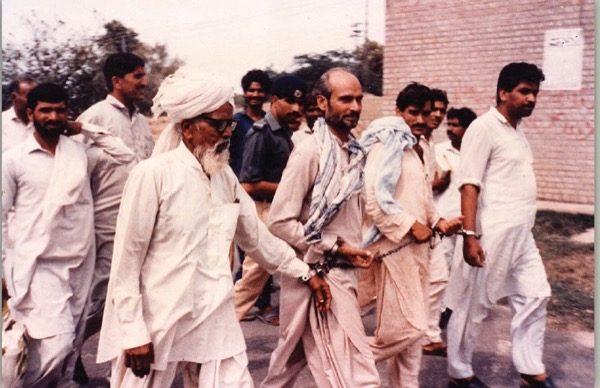
She had narrowly escaped arrest thanks to my cousin Rafique’s presence of mind. Moments earlier, a teary-eyed little girl had come to my mother’s house. Her father, Arshad the Scribe (katib), had sent my mother a message to make herself scarce; he was already in handcuffs, being led away by policemen who believed my mother was still at large and hoped to apprehend her soon.
The Charges
The sketchy details of the charges against my mother were beginning to emerge in the newspapers. She was to be tried under the infamous Defence of Pakistan Rules (DPR), since the Federal Minister for Religious Affairs in Zulfiqar Ali Bhutto’s cabinet was the prime mover on the side of the prosecution. A non-bailable warrant of arrest had already been issued against her. Persons tried under DPR included those accused of seditious misleading of military personnel and other related offences.
Briefly, it was alleged that my mother had conspired to cause a Shia-Sunni religious riot by referring to the word “Panjtan” (the Five Persons), mentioned in a poetic couplet of the Promised Messiah (as). The accusers conflated this with the “Panjtan Pak,” who are widely known as the five close relatives of the Holy Prophet of Islam and carry Shia overtones: the Holy Prophet Muhammad (sa), Hazrat Ali (ra), Hazrat Fatima (ra), Hazrat Hassan (ra), and Hazrat Hussain (ra).
The reality was entirely different. My mother, being in charge of Nasirat-ul-Ahmadiyya, an auxiliary organization for Ahmadi young girls, had to set an examination paper for them. One of the questions on the paper quoted an Urdu couplet of the Promised Messiah (as):
“Yeh paanchon jo ke nasl-e Sayyeda hain
Yehi hain panjtan jin per bina hai”
These five, who are the blessed progeny of Sayyeda,
They are the five upon whom the foundation of my house rests.
Note: The verses refer to the five children born of Sayyeda Nusrat Jahan Begum (ra). They are Mirza Bashiruddin Mahmood Ahmad, Mirza Bashir Ahmad, Mirza Sharif Ahmad, Nawwab Mubaraka Begum, and Nawwab Amatul Hafiz Begum.
My mother then asked the examinees: “In this particular couplet of the Promised Messiah (as), who is called panjtan?” There was no ground for any ambiguity. But the Federal Minister for Religious Affairs was obviously looking for an excuse to pounce on the Jama’at.
The Ordeal
Since my mother was inaccessible to the government of Z.A. Bhutto and was staying incommunicado at a safe place, the time hung heavy for me. I did not have a clue about the location of the safe house where she was being lodged. I was, therefore, a silent partner in this grim ordeal, though my mother, as I later learned, remained cheerful wherever she was. Her trial at Lahore High Court was being held in absentia.
After a couple of months, the Lahore High Court bench could not prove anything and was seeking ways to hand the case over to a military court. Since they could not establish any charge against my mother, they decreed that although the case would proceed under a military court, she would not be arrested. This cleared the way for a military tribunal constituted under Martial Law to summon her.
As she entered the precincts of the military court, my mother saw the other two “culprits” waiting in the lounge. One was Sardar Sherbaz Mazari, the veteran politician of Baluch origin who had once been placed under the guardianship of the British Imperial Government in India. The other was the veteran journalist and Urdu Digest editor, Altaf Hassan Qureshi. “I am ‘guilty’ in elect company,” my mother thought with some amusement, in an otherwise unamusing situation.
When the military tribunal, too, could not find any culpable charge against my mother, they quashed the case but let the DPR matter stay in abeyance. I did not see my mother for more than a year. When she finally returned home, and I met her, I was pleasantly surprised to find her calm and unperturbed, despite the grim ordeal she had endured.
The Jhang Court
But Allah had another reason to test her resolve before smiling upon her with His mercy and grace. A notorious anti-Ahmadiyya religious cleric, Manzoor Ahmad Chinioti, brought a legal case against my mother in the local courts of District Jhang. This time, she had to appear in court in person. There were 22 hearing dates, which I later saw noted in a personal diary of my father. Of those many appearances, one in particular stands out as an example of the hostility my mother faced.
“I was escorted by a Jama’at-appointed man through the pathway that led to the court building,” she told me. “The path was thronged on either side by hundreds of non-Ahmadi lawyers, who spat hatefully on the ground a few feet ahead of me as I walked. Their derisive shouts were a ‘treat’ for the ears.”
At the courthouse, the Reader asked her probing questions about her education and her relationship with the Head of Lajna Ima’illah, Hazrat Maryam Siddiqa, wife of Hazrat Musleh-e-Mau’ood. He constantly alleged that my mother was “working for” Hazrat Maryam Siddiqa, and his attempts were clearly designed to implicate her in the case. In the end, he established the fact that my mother was only a housewife who, based on her past experience in Qadian, had been able to lead the Nasirat organization.
A Miraculous Sign from God
When my mother was finally back at our home, I asked her, “While you were at the safe house, did you have any extraordinary experiences that showed Allah the Almighty was with you, every step of the way, to lighten your burden during this ordeal?”
“Yes, that was my main succour,” she said, glowing with gratitude to Allah, the Most Merciful. “I will give you just one example. One day, while I was in my room performing Ishraq prayer, I heard a voice say: ‘The Sun will shine at 10:00 a.m.’”
She was stunned by this clear voice and looked all around that small, almost bare room, but there was nothing that could help her understand its meaning.
She was about to resume her prayer when the telephone rang. “Good news, Allah is the Greatest!” It was her brother, S.M. Hassan, the retired civil servant. “I am sending Taqi Muhammad to fetch you. He knows where you are and has my instructions to bring you safely to Lahore. The authorities have just confirmed that you are out of danger of being arrested.”
My mother quickly looked at the clock to confirm what she already sensed. It was exactly 10:00 a.m.
I found it deeply reassuring that Allah the Exalted was indeed helping her, after first testing her resolve to persevere through this unprecedented and harrowing experience.
My mother endured this ordeal with patience and cheerfulness that I still marvel at. She was not a scholar or a public figure; she was a housewife who trusted her Lord. And her Lord did not forsake her. I have penned this remarkable episode in the hope that when trials visit any of us, as they inevitably will, we may take solace in remembering that the same God who sent a voice to a small, bare room at exactly 10:00 a.m. is listening still.