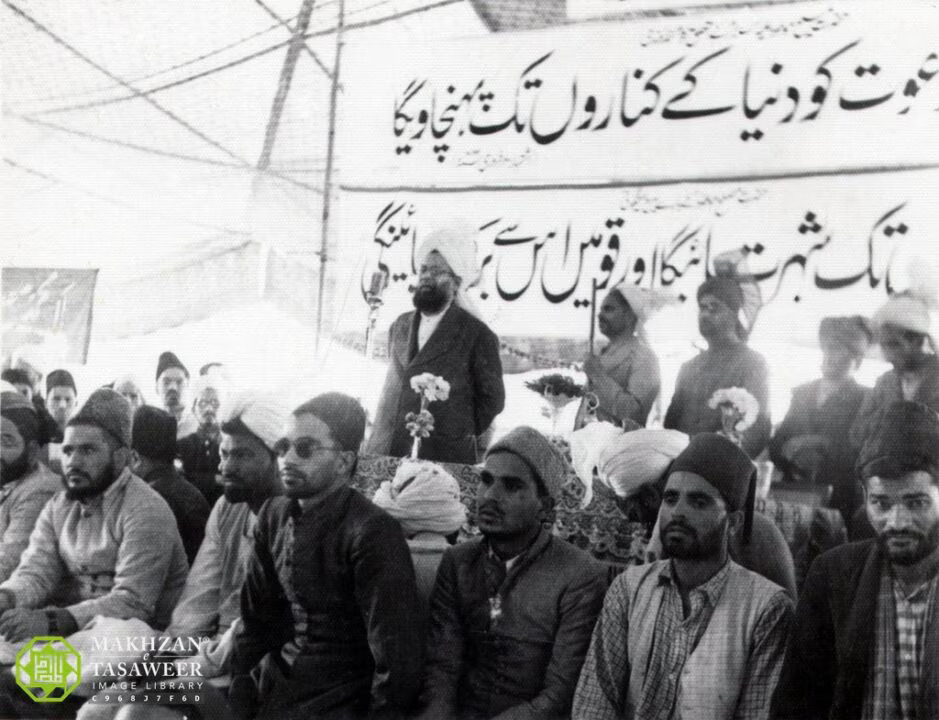
Musleh Maud Day, observed on 20 February, commemorates a grand prophecy made by Hazrat Mirza Ghulam Ahmad (as), the Promised Messiah. In 1886, the Promised Messiah (as) travelled to the city of Hoshiarpur, under guidance from Allah the Exalted, for the sole purpose of prayers. After a 40-day period of seclusion and prayer, he received many divine revelations. One of the revelations foretold the birth of a son who would be endowed with extraordinary qualities, including great knowledge, a deep understanding of faith, and a far-reaching influence in serving Islam.
This prophecy, known as the “Prophecy of Musleh Maud” (the Promised Reformer), was fulfilled in the person of Hazrat Mirza Bashiruddin Mahmud Ahmad (ra), who was born on 12 January 1889 and went on to become the second Khalifa of the Ahmadiyya Community. On 20 February 1944, he publicly declared that he was the fulfillment of this prophecy, presenting detailed evidence showing how the prophesied attributes had manifested in his life and service to Islam. His 52-year Khilafat (1914-1965) produced a legacy of scholarly, organizational, and spiritual achievements that bear powerful testimony to the fulfilment of the prophecy.
His magnum opus, Tafsir-e-Kabir, is a multi-volume commentary of the Holy Qur’an that remains one of the most comprehensive exegeses in Islamic literature. He also authored Tafsir-e-Saghir, a shorter but equally significant commentary, along with Da’watul Amir (Invitation to Ahmadiyyat), which provides a systematic presentation of the claims and teachings of the Promised Messiah (as). Anwarul Uloom is a collection of his extensive writings, essays, and discourses spanning numerous volumes. He also wrote Tuhfatul Muluk, addressing world leaders, and delivered hundreds of Friday sermons and addresses that were compiled into published volumes.
On the institutional front, he established Majlis-e-Shura, the consultative body of the Community, and formalized the auxiliary organizations: Lajna Ima’illah (for women), Khuddam-ul-Ahmadiyya (for young men), Atfal-ul-Ahmadiyya (for children), and Ansarullah (for elder men). In addition, he formulated the entire administrative structure of the Jama’at. He also founded the Tahrik-e-Jadid scheme in 1934 to fund international missionary work and Waqf-e-Jadid in 1957 to support rural outreach and education. He also laid the foundation for the Fazl-e-Umar educational institutions and hospitals.
Under his leadership, the Jama’at expanded far beyond the Indian subcontinent, with missions established across Europe, Africa, Southeast Asia, and the Americas. He sent missionaries to dozens of countries and oversaw the construction of prominent mosques, including the Fazl Mosque in London (1924), the first purpose-built mosque in the city.
He also played a significant role during the partition of India in 1947, guiding the Community through the migration to Pakistan and establishing Rabwah as the new headquarters. He was a vocal advocate for the rights of Muslims and consistently championed education, interfaith dialogue, and the peaceful propagation of Islam.
The day is celebrated annually across the Jama’at worldwide with special gatherings, speeches, and reflection on the remarkable fulfilment of this prophecy and the monumental legacy that Hazrat Musleh Maud (ra) left behind.