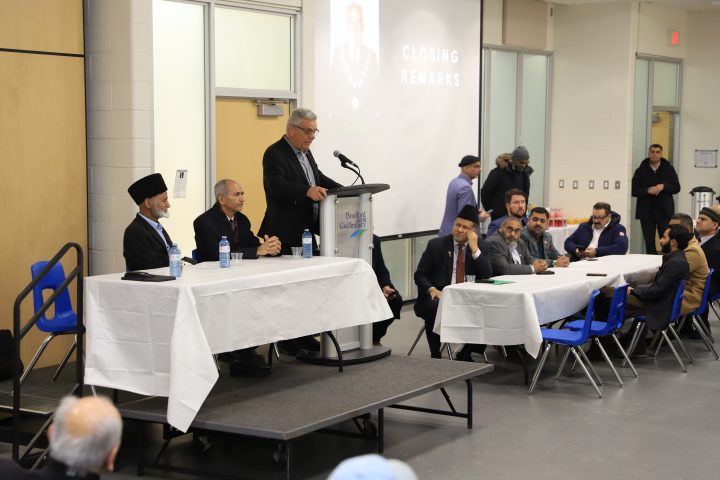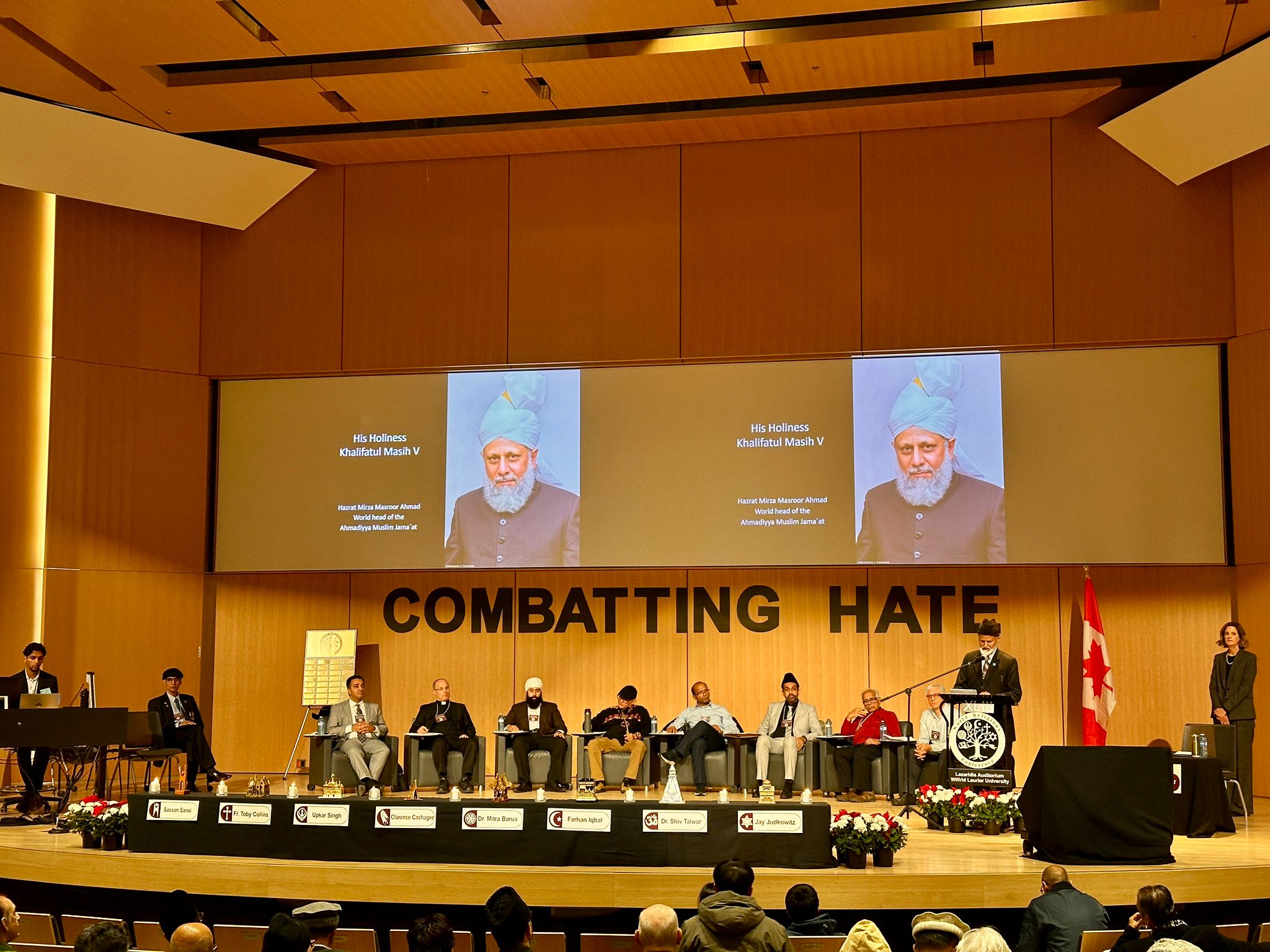
Representatives of eight faith traditions gathered at Wilfrid Laurier University on November 23 for the 43rd World Religions Conference, exploring how religious teachings can help combat rising hatred in Canada and around the world.
The conference, organized by the Ahmadiyya Muslim Jamaat of Canada, brought together speakers representing Judaism, Hinduism, Islam, Buddhism, Indigenous spirituality, Sikhism, Christianity and Humanism at the Lazaridis Auditorium. Prime Minister Mark Carney and Waterloo Mayor Dorothy McCabe sent messages of support.
Lal Khan Malik, National President of the Ahmadiyya Muslim Jamaat Canada, said the conference sought to transform division into dialogue. “Ignorance of others creates doubts, doubts result in fear and hatred,” he said. “World Religions Conference brings us together. We discover that we have so much in common.”
Imam Farhan Iqbal, representing the Islamic perspective, emphasized tolerance as foundational to his faith. He cited the Holy Prophet Muhammad (sa), who stood in respect when a Jewish funeral procession passed by. When told the deceased was Jewish, he replied simply, “Was he not human?”
Clarence Cachagee, a Sixties Scoop survivor and founder of Crow Shield Lodge, spoke about the ongoing impact of residential schools on Indigenous communities. “Our traditional teachings and stories emphasize the importance of forgiveness, healing and reconciliation,” he said.
The event was moderated by Mary Lou Roe, a Waterloo city councillor, and supported by approximately 95 volunteers and numerous partner organizations, including Martin Luther University College, the Waterloo Regional Police Service and the cities of Kitchener and Cambridge.
Abstracts
Judaic Perspective
Jay Judkowitz, President of Temple Shalom
Jay Judkowitz recently concluded nearly three years as president of Temple Shalom, the Reform Jewish congregation in Waterloo. During that time, he led his community through a period marked by a dramatic rise in religious hatred, antisemitism in particular, globally, across Canada and locally in KW. He has worked to build bridges between Temple Shalom and other faith communities, Jewish and non-Jewish alike, while also advising civic leaders on how to address hate and promote understanding.
In his address, Judkowitz explored a paradox at the heart of religion, its power to both heal and harm. Religion, practiced by human beings, can be used to enlarge our moral vision, to see every person as sacred and every life as cherished. But it can also be used to justify fear, division and violence, convincing us that God loves only our group, that our wounds are unique, that our own people are blameless and that others deserve vengeful punishment.
Across traditions, including Judaism, we see both tendencies: the parochial impulse to restrict our concept of humanity to only our own people, and the universalist call to love and respect everyone. Drawing on Jewish texts and stories, from ancient scripture to mystical prayers and prophetic teachings, he shared lessons that command Jews to love not just their own people, but the entire human family.
Hindu Perspective
Dr. Shiv D. Talwar, Shen Network
Dr. Talwar, a scholar and author profoundly shaped by the interfaith violence of India’s Partition, explored how hate can be combatted by fostering a neurobiological and spiritual shift toward holistic human integration.
Drawing from insights in neuroscience, psychology and contemplative traditions, he examined how the autonomic nervous system shapes identity formation. When dominated by the sympathetic branch associated with stress and survival, our sense of self becomes fragmented, reactive and tribal. In contrast, when the autonomic system is balanced through parasympathetic activation, we experience a broader, more inclusive awareness that enables empathy and interconnectedness.
Hate, he argued, is not an inevitable human trait but a conditioned response rooted in dysregulated biology and distorted identity. By cultivating practices that restore autonomic balance, such as mindfulness, breathwork, prayer and interfaith dialogue, we can reawaken the integrative capacities of the human mind.
Faith traditions, when interpreted through this lens, become powerful allies in the fight against hate. At their mystical core, all religions point toward unity, compassion and transcendence. The teachings of Jesus, Muhammad, Buddha, Krishna and countless others emphasize love over fear, inclusion over exclusion and the sacredness of all life.
Islamic Perspective
Imam Farhan Iqbal, Missionary, Ahmadiyya Muslim Jamaat Canada
Imam Farhan Iqbal highlighted three main ways in which Islam combats hate: promoting tolerance, promoting compassion and sympathy, and emphasizing absolute justice.
On tolerance, he noted that many Muslims in Canada, especially those from the Ahmadiyya Muslim Community, came here because Canada stands for tolerance and respect for people of all faiths. The Holy Quran teaches, “For you your religion, and for me, my religion.” When a Jewish funeral procession passed by, the Holy Prophet (sa) stood up out of respect. When told it was a Jewish man, he said, “Was he not human?”
On compassion, he explained that the God of Islam is introduced as “Rabbul-Alameen,” the Lord of all the worlds, meaning He is the Lord of Christians, Jews, Muslims, Hindus, Sikhs and people of every faith. The Promised Messiah, Hazrat Mirza Ghulam Ahmad (as), stated, “I proclaim to all Muslims, Christians, and Hindus and Aryas, that I have no enemy in the world. I love mankind with the love that a compassionate mother has for her children, even more so.”
On justice, the Holy Quran commands believers to be steadfast in bearing witness in equity, not letting enmity incite them to act otherwise than with justice. The Holy Prophet Muhammad (sa), in his Farewell Sermon, emphasized that Arabs are not superior to non-Arabs, whites are not superior to blacks, nor vice versa.
Buddhist Perspective
Dr. Mitra Barua, Martin Luther University College
Dr. Barua, Assistant Professor in Asian Studies and Buddhist Scholar in Residence at Martin Luther University College, drew on the Dhammapada to explore the Buddhist approach to hatred.
The verse reads, “Hatred is never overcome by hatred in this world. Loving-kindness alone can overcome hatred. This indeed is an eternal truth.” This teaching was true at the time of the Buddha 2,500 years ago, remains true today and will be true in the future.
The Buddha suggests that hatred is not an inherent property of our heart and mind. Our mind is like pure water that becomes polluted with mental impurities like hatred. Just as polluted water can be purified, our contaminated heart and mind can be freed from external hatred through self-examination.
The Buddha recommends Metta Bhavana, or the cultivation of loving-kindness. First, we observe our destructive energy called anger and understand that with supportive conditions hatred rises, stays for a while and finally fades away when its supporting conditions disappear. Second, we investigate where that anger comes from. Finally, the Buddha gives a spiritual practice to be friendly to ourselves and the world around us, recognizing that every sentient being does not want to suffer and wishes for happiness and joy.
Indigenous Spiritual Perspective
Clarence Cachagee, Crow Shield Lodge
Clarence Cachagee, a Sixties Scoop survivor from Chapleau Cree First Nation and founder of Crow Shield Lodge, spoke about the impact of historical traumas on Indigenous communities and the ways to combat hate and promote healing.
The residential school system and the Sixties Scoop were designed to erase Indigenous identities, cultures and languages. The trauma inflicted upon ancestors continues to affect families and communities today, manifesting in complex ways. However, despite the pain and suffering, Indigenous communities have shown remarkable resilience and strength, holding on to cultures, languages and traditions.
Traditional teachings and stories emphasize the importance of forgiveness, healing and reconciliation. Indigenous peoples believe in the power of ceremony, language and culture to heal and bring people together.
Combating hate requires acknowledging historical traumas, recognizing their ongoing impact and working toward a more just and equitable society. Education and awareness can break down stereotypes and misconceptions. Community-based initiatives such as healing circles, cultural camps and language programs provide safe spaces for individuals to reconnect with their cultures.
“Let us rise above the hate and build a world that celebrates diversity, promotes understanding and honours the dignity and worth of all individuals,” he said.
Sikh Perspective
Upkar Singh, Community Leader
Upkar Singh, who studied traditional Sikh philosophy in India and holds a degree in Psychology from the University of Toronto, explored how Sikhi’s message of Oneness addresses hate.
The One is described as Nirbhau (without fear) and Nirvair (without hatred). Because the One is all, there is no other. Existence is whole and unified, and love unites. Hate is the opposite of Oneness, a division derived from fear that emerges from ignorance.
This vision was not only preached but embodied and practiced, from Guru Nanak’s travels interacting with people from diverse backgrounds, to the building of the Golden Temple with four doors welcoming all of humanity, to including writings from various creeds into one scripture, to the institution of community kitchens where emperors and beggars dined together.
Sikhs have long faced hate and intolerance. To be a Sikh was once punishable by death. In November 1984, Sikhs were lynched in Delhi. After 9/11, hundreds of hate crimes targeted Sikhs in North America. The Oak Creek Gurdwara tragedy of 2012 shook the community to its core. Yet Sikhs responded with strength, courage and zeal, guided by the teachings of Guru Nanak that the answer to hate is compassion, understanding and fearlessness.
The Guru Granth Sahib teaches, “Hatred is gone, there are no enemies; the One is seen in all.”
Christian Perspective
Father Toby Collins, St. Mary’s Church
Father Toby Collins, Pastor of St. Mary’s Church in Kitchener, outlined five core responses to hate that Christians seek to emulate from Jesus.
First, identifying the origins of hatred coming from the human heart. In Mark 7:21, Jesus points out that it is within the human heart that evil intentions arise. Christians believe that through prayer, we discover how to ask God to transform and heal any hatred we may find in our hearts.
Second, turning the other cheek. Jesus asked his followers not to return insult with insults and to pray for enemies. He reveals that we have the power to choose not to retaliate so that violence does not perpetuate more of the same.
Third, forgiveness. When men attempted to stone a woman caught in adultery, Jesus said, “He who is without sin should cast the first stone.” After every man dropped their stones and walked away, Jesus told the woman, “Neither do I condemn you, go and sin no more.”
Fourth, avoidance. In Luke 4:28-30, Jesus walked through crowds that tried to throw him off a cliff, demonstrating that some situations may call for a quick escape to avoid the evils of hatred.
Fifth, triumphant submission to reveal new life. Jesus entered Jerusalem, knowing he could not withstand their power to condemn him but believed something would be revealed if he faced the hatred. As he was crucified, he prayed that those crucifying him would be forgiven. For Christians, the resurrection demonstrates that hatred never has the final say.
Humanist Perspective
Sassan Sanei, Society of Ontario Freethinkers
Sassan Sanei, a philosopher and electrical engineer who serves on the Board of Humanist Canada, argued that hate is a human problem created, perpetuated and ultimately solvable by human action.
Humanism offers a non-religious way of life that values reason and compassion, guided by rational thought, informed by scientific inquiry and inspired by the creativity of human culture. Humanist groups recognize that morality does not require a deity but arises from our capacity for empathy and our understanding of the consequences of our actions.
Hate thrives where ignorance, fear and tribalism take hold. When people are taught to see others as threats rather than neighbours, they respond with blame and prejudice instead of intelligent reflection. Humanists therefore see education as essential to recognizing patterns of oppression, challenging false narratives and resisting manipulation.
Social psychology demonstrates that hate is mitigated through exposure to diverse perspectives and cooperative problem-solving. Studies of reconciliation and restorative justice show that societies heal fractured relationships when grounded in mutual recognition and empathy.
“Combating hate is an ethical, civic and human responsibility,” Sanei said. “It is not a task delegated to an invisible higher power. It is a challenge that requires human intelligence, human creativity and human courage.”
Note: The Abstracts have been edited for brevity.
View the proceedings here
Read full report: