The Holy Quran describes the bounties of Allah the Almighty as treasures held with Him and released in careful measure:
وَ اِنْ مِّنْ شَيْءٍ اِلَّا عِنْدَنَا خَزَآىِٕنُهٗ وَ مَا نُنَزِّلُهٗۤ اِلَّا بِقَدَرٍ مَّعْلُوْمٍ
“And there is not a thing but with Us are the treasures thereof and We send it not down except in a known measure.” (Surah al-Hijr, Ch.15: V.22)
Knowledge is among those treasures, and it too is given in measure. Every generation receives its portion – enough to see further than the one before, but never enough to see everything. Our generation, in the time of the Promised Messiah (as), has received a large portion, and it has arrived suddenly.
On 8 September 2026, OpenAI announced that ten thousand autonomous artificial intelligence (AI) agents, running on an unreleased model, had produced a proof that the Navier–Stokes equations, which describe how liquids and gases flow, can break down. Navier–Stokes is one of the seven Millennium Prize Problems, unsolved since they were posed in 2000. Mathematicians have not yet confirmed the result, and its credit is disputed
(openai.com, 8 September 2026; Quanta Magazine, 8 September 2026). Even so, a problem at the frontier of human mathematics now has a proposed solution produced by a machine.
Few expected this so soon. As recently as December 2024, a survey of 1,580 AI researchers gave even odds that AI would solve such a problem, entirely without human input, only by around 2053 (AI Impacts, September 2026). People directed the Navier–Stokes work, so it does not strictly meet that test, as the survey’s authors note; yet something close to it has arrived within two years. In May 2026, an OpenAI model also disproved a conjecture that Paul Erdős had posed in 1946, using methods nobody had applied to the problem before (Quanta Magazine, 3 August 2026). These answers were not sitting in the training data to be copied. They had to be found.
Can a machine bring new knowledge?
Does AI, then, bring new knowledge? Many scientists, some inside the AI labs themselves, say no. Tom Zahavy of Google DeepMind argues that AI remains “structurally incapable of the abductive ‘Jump’” required to formulate new axioms – the first principles from which a theory is built. It can settle a problem once the terms are set; it cannot set them
(tomzahavy.com, 27 January 2026). Two Oxford scholars, Teppo Felin and Matthias Holweg, strike the balance: dismissing these models as “glorified auto-complete” underestimates them, but “ascribing LLMs the ability to actually reason and generate new knowledge vastly overestimates their ability” (Felin and Holweg, Strategy Science, 2024).
For an Ahmadi Muslim, the deeper question is not whether a machine can create knowledge, but where knowledge comes from in the first place. The Holy Quran answers:
اِقْرَاْ وَ رَبُّكَ الْاَكْرَمُ الَّذِيْ عَلَّمَ بِالْقَلَمِ عَلَّمَ الْاِنْسَانَ مَا لَمْ يَعْلَمْ
“Convey! And thy Lord is Most Generous, Who taught [man] by the pen, Taught man what he knew not.” (Surah al-Alaq, Ch.96: V.4-6)
It speaks even of the future as bringing new creation, and with it new knowledge:
وَ يَخْلُقُ مَا لَا تَعْلَمُوْنَ
“And He will create what you do not [yet] know” (Surah an-Nahl, Ch.16: V.9)
No machine, then, takes knowledge out of Allah’s hands. A system trained on the past can only search within what Allah has created. AI is a gift that gathers the knowledge of our age – a tool to reach knowledge, not its creator. The right response to such a gift is gratitude, humility and its proper use – not fear, and not pride. However, humans must still make the final judgement on the answers AI provides.
An attendant’s place
In Surah ad-Dahr, the Holy Quran describes the believers in paradise, waited upon by attendants who never tire:
وَ يَطُوْفُ عَلَيْهِمْ وِلْدَانٌ مُّخَلَّدُوْنَ اِذَا رَاَيْتَهُمْ حَسِبْتَهُمْ لُؤْلُؤًا مَّنْثُوْرًا
“And there will wait upon them youths who will not age. When thou seest them, thou thinkest them to be pearls scattered about.” (Ch.76: V.20)
These verses describe the hereafter; however, the corollary here is that an AI agent can serve as an untiring attendant – waiting for us to instruct it to carry out a task, while its true purpose is ours to decide.
Relief from mundane tasks frees time, but AI does not tell us what to do with it. The Holy Quran states the purpose of human life:
وَ مَا خَلَقْتُ الْجِنَّ وَ الْاِنْسَ اِلَّا لِيَعْبُدُوْنِ
“And I have not created the Jinn and the men but that they may worship Me.” (Surah adh-Dhariyat, Ch.51: V.57)
If these tools return hours to us, the measure of success is not whether we are more productive, but whether we find more time for the worship of Allah and the service of His creation.
The same surah describes the reward of the righteous:
اِنَّ هٰذَا كَانَ لَكُمْ جَزَآءً وَّ كَانَ سَعْيُكُمْ مَّشْكُوْرًا
“This is your reward, and your labour has been appreciated.” (Ch.76: V.23)
That promise is something we now see in the world of AI too: the sincere intellectual effort of mankind has been appreciated. What we are handed now, in the time of the Promised Messiah (as), is the accumulated labour of many generations, gathered and returned in a form we can use – a gift promised for this very time, when Islam is being revived, to assist in
that revival. The Promised Messiah (as) explained that the prayer of Surah al-Fatihah asks for exactly this kind of collective knowledge:
اِهْدِنَا الصِّرَاطَ الْمُسْتَقِيْمَ
“Guide us in the right path” (Surah al-Fatihah, Ch.1: V.6)
“O God, grant us collectively, all kinds of true knowledge, true insights, profound secrets, and subtle verities that You have been granting individually to all people of excellence in the world from time to time.” (Barahin-e-Ahmadiyya, Part IV, 2016, p. 30)
However, a greater gift calls for greater effort, not less:
وَ جَاهِدُوْا فِي اللّٰهِ حَقَّ جِهَادِهٖ
“Strive in the cause of Allah a perfect striving.” (Surah al-Hajj, Ch.22: V.79, translation by Hazrat Muhammad Zafrulla Khan (ra))
Learning in an age of answers
AI should therefore improve our learning, not weaken it. Used naively, it can indeed weaken learning. In a randomised experiment in seven English schools, 405 students aged 14 and 15 who took notes understood and remembered more than those who studied with a chatbot, though they rated the chatbot more enjoyable (Kreijkes et al., Computers & Education, 2026). In another, high-school students given an unrestricted AI assistant did better during practice but worse afterwards, when they worked alone; a version built with learning safeguards removed most of that harm (Bastani et al., PNAS, 2025). Assistance that replaces effort weakens the learner; assistance that supports effort can strengthen him.
Huzoor (aba) warned of the same risk:
“I can see that although your robots or AI is helping you, it can also decrease the mental capability and capacity of your mind. The level of intelligence can become low because you are relying on AI. Thus, you can take help from AI or robots, but do not completely rely on them.” (Al Hakam, 22 February 2025)
The practical rule is simple. Attempt the problem before asking for the answer. Read the source. Explain the result in your own words. In religious matters this discipline should be even stricter: Huzoor (aba) instructed the Al Islam team that answers generated by AI must be verified before they are published (Al Hakam, 21 February 2025). A machine may help us find a passage, but only the original text can settle what it says.
Huzoor’s (aba) call to AI mastery
Addressing Canada’s National Majlis-e-Amila on 2 February 2025, Hazrat Khalifatul Masih V (aba) said:
“You can also increase your knowledge of artificial intelligence! You can become so proficient in it that you can create new systems for them and thereby secure employment. However, artificial intelligence only does what you feed it and instruct it to do. It does not use its own mind. Ultimately, a human brain is needed to run it. Companies will also look for fertile minds capable of feeding new and innovative ideas into AI. Ahmadis should be among those people. You should strive for this objective.” (Al Hakam, 10 February 2025)
He also set the boundary of this work:
“Nevertheless, we must compete with the world. Whatever field the world excels in, we too should endeavour to excel in that field, so that eventually we may be in a position to guide them on the [ethical] boundaries of artificial intelligence.” (Al Hakam, 10 February 2025)
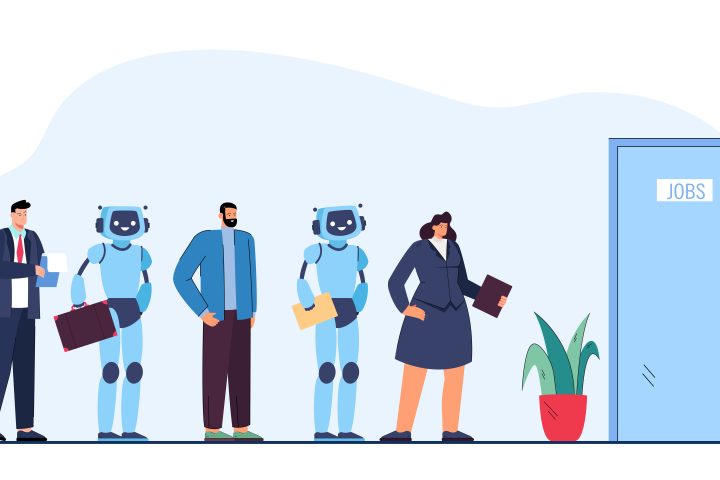
Competence is not an end in itself. Huzoor (aba) has addressed the fear that AI may replace jobs and warned that wealth could become concentrated in fewer hands (Al Hakam, 15 November 2025). When a Lajna Imaillah president from Germany raised the misuse of a
person’s identity, voice or image, he gave a programme rather than a prohibition: teach members both the dangers and the benefits of AI, share the warnings of experts in the field, and hold regular classes with the Jamaat’s technical experts (Al Hakam, 9 October 2025).
Where these tools reduce routine work, the benefit is not the paperwork saved but the people who receive the time: a secretary freed from formatting a memorandum or poster can sit with someone to teach him religious knowledge; a khadim can visit an elderly neighbour.
Conclusion
The Quran teaches the seeker of knowledge the following prayer:
رَبِّ زِدْنِيْ عِلْمًا
“O my Lord, increase me in knowledge.” (Surah Ta-Ha, Ch.20: V.115)
That prayer assumes all that has been said here: knowledge is asked for, and it is given, in measure, by the One who taught man what he knew not. Young Ahmadis should approach this field with ambition, but not with the expectation that a machine can spare them the work of becoming knowledgeable. Study deeply. Check what you are told. Build things that
serve people, and remain answerable for how you use them.
AI can help us complete a task. It cannot tell us what the task is for. That remains ours: to learn from it, but keep our focus on the worship of Allah and the service of humanity.
(This is a shorter version of an article first published on alislam.org.)