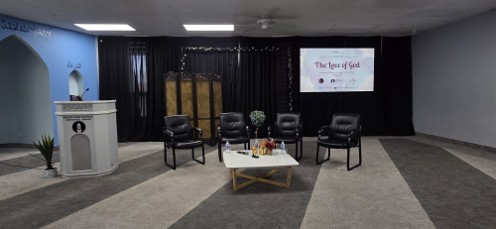
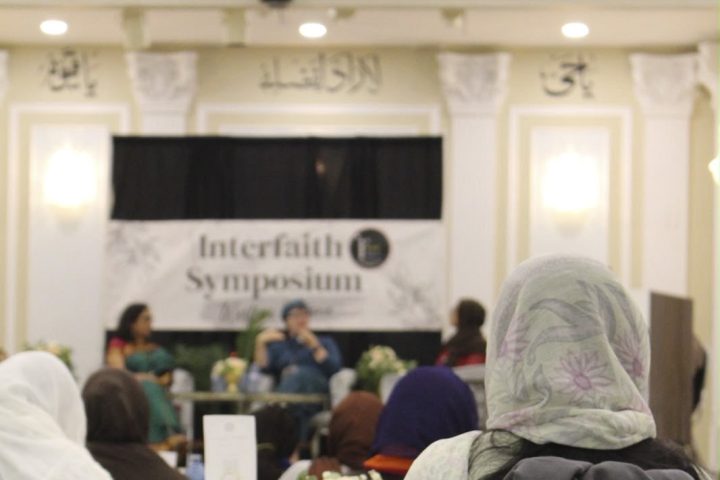
On 3 October 2026, Lajna Imaillah Alberta Region (the Ahmadiyya Muslim Women’s Association) held its annual Interfaith Symposium at the Baitul Hadi Mosque in Edmonton. Women from several faith communities across the city spent the afternoon reflecting on the theme “The Love of God”.
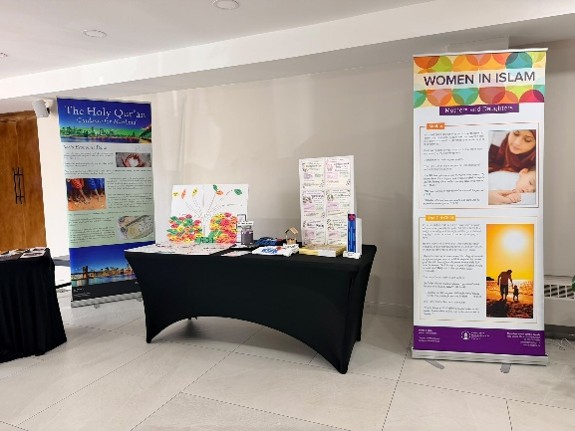
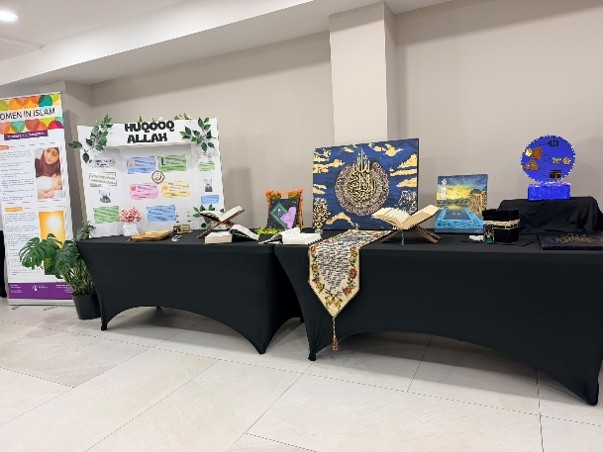
Guests were welcomed with exhibitions on Huquq Allah (the rights of God) and Huquq-ul-Ibad (the rights of mankind), a book stall and a refreshments table. On a poster wall, attendees left sticky notes describing what the love of God means in their daily lives. Guided tours of the mosque introduced visitors to Islamic worship and to the building itself.
The panel
Representatives of the Christian, Hindu and Islamic traditions each spoke on the nature of God and on how divine love is lived out in their faith.
Rev Dr Britt L Aerhart presented the Christian perspective. She described God as Creator and Father, whose relational nature is reflected in the Trinity of Father, Son and Holy Spirit. She spoke of agape, a love that is selfless, patient and protective, and said that devotion to God shows itself in quiet daily acts of kindness, justice and service to neighbours.
Savita Patel presented the Hindu perspective. She explained how the Supreme Being manifests through the Om mantra, Dharma and the Trimurti. Highlighting both masculine and feminine divine energies, she said that each of the 330 million deities is prayed to for a different need or purpose, yet all point to one Supreme Being. She also emphasised selfless service to creation.
Tajalli Sahir Sahiba, Regional Naib Sadr of Lajna Imaillah Alberta, presented the Islamic perspective. She introduced God as the Holy Qur’an presents Him, One, without partner, son or equal, wholly independent while all creation depends on Him. Drawing on [Al-Fatihah, ch.1:v.2-4], [Al-Ikhlas, ch.112:v.2-5] and [Al-Hashr, ch.59:v.24-25], she described Him as the Lord of all the worlds, a God for all humanity regardless of faith or race, and as the Gracious, the Merciful, the Sovereign, the Source of Peace, the Bestower of Security, and the Mender of every breakage and Restorer of every loss, two meanings of al-Jabbar.
She explained that love for God has two sides. The first is a personal relationship, built through the five daily prayers, reading the Holy Qur’an, and turning in every need to a living God who is available at every hour. The second is love for His creation, which Islam treats as inseparable from love for Allah. She quoted the Promised Messiah (as), who wrote,
“There are two aspects of faith. Firstly, it is to love Allah the Almighty and secondly to love mankind to the extent wherein one considers their troubles as if they were his own and thus pray for them.” (Naseem-e-Dawat, Ruhani Khazain, vol. 19, p. 464)
She then cited [Al-Dahr, ch.76:v.9-10], which describes those who feed the poor, the orphan and the prisoner for the love of Allah, seeking neither reward nor thanks. Serving others in this spirit, she said, is itself an act of divine love.
Faith in a distracted age
The second question turned to the barriers people face in living a spiritual life today. Speaking for Islam, Tajalli Sahir Sahiba named distraction as the greatest challenge. Islam does not ask believers to withdraw from family, career or technology, she said, but it warns against becoming so absorbed in blessings that the Giver is forgotten. Citing [Al-Munafiqun, ch.63:v.10], she said that love requires the sacrifice of worldly desires.
She shared guidance that His Holiness, Hazrat Mirza Masroor Ahmad (aba), Head of the worldwide Ahmadiyya Muslim Community, has given on many occasions. In a Waqf-e-Nau class, Huzoor (aba) said,
“If you have fear of Allah the Exalted, then you will have love for Him, as well. Allah the Exalted says that if you take one step towards me, I will take two steps [towards you] and if one comes to me walking, I will go to him running.”
Huzoor (aba) then said,
“If the worldly desire increases so that one is engrossed in TV dramas and the Internet and is late in offering Salat, then love for Allah cannot develop. Gaining this love requires sacrifice of desires.” (Waqf-e-Nau class, Baitur Rasheed Mosque, Germany, 8 October 2011)
She added that Salat, offered through the day, keeps turning a person back towards God, loosens excessive attachment to the world, and separates what is temporary from what lasts.
The panellists then spoke of their own experiences of divine comfort, guidance and communication in times of hardship and quiet reflection.
Closing reflections
Each speaker left the audience with one piece of advice. Rev Aerhart encouraged quiet daily acts of service, kindness and prayer. Savita Patel urged guests to live peacefully, criticise less and serve humanity. Tajalli Sahir Sahiba advised that no one should wait for hardship to remember God, or wait to become perfect before beginning. One sincere and steady step, through daily prayer, gratitude and kindness, can be nurtured like a plant until a whole life reflects that care.
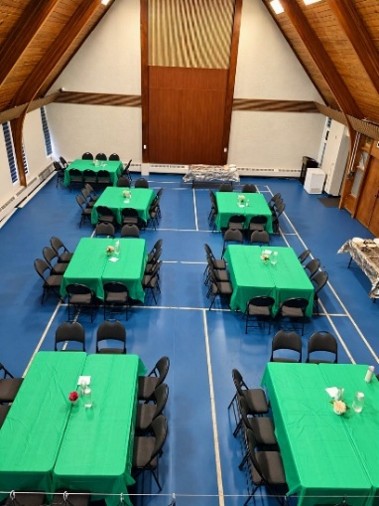
An audience question-and-answer session followed. Samina Mian Sahiba, Regional Sadr of Lajna Imaillah Alberta, gave closing remarks, and the programme ended with silent prayer. Guests then stayed for dinner and continued their conversations with members of Lajna Imaillah. In all, 41 guests and 50 Lajna members attended.