This day gathers moments from several weeks, and is presented as one day for readability and engagement.
Before Fajr
The house was still dark and quiet when I came downstairs, switched on the small light over the kitchen table, and opened my laptop. A few weeks earlier I had asked an AI agent where the Promised Messiah (as) wrote about two paradises. It searched my folder of his books for about a quarter of an hour and returned passages from six of his works, each with its page number. This time the alislam.org search found the same theme in seventeen volumes of his writings, from Barahin-e-Ahmadiyya to Malfuzat, in about a second. Even so, I did not take the machine at its word. I still checked each passage against the printed page.
All six passages turned on one short verse of the Holy Quran:
وَ لِمَنْ خَافَ مَقَامَ رَبِّهٖ جَنَّتٰنِۚ
“But for him who fears to stand before his Lord there are two Gardens” (Surah ar-Rahman, Ch.55: V.47)
What is this first garden, and when does a believer enter it? The Promised Messiah (as) explains that it is given right here in this life: “Righteous conduct proceeds from him not as labour but as delight and pleasure. This is the paradise that is bestowed upon a spiritual person in this very life.” It grows from within: “A person’s paradise is developed inside him and everyone’s paradise is his faith and his righteous actions, the delight of which begins to be tasted in this very life” (The Philosophy of the Teachings of Islam, 2010, pp. 115-116, 123).
Huzoor (aa) has explained that when a person fears Allah, Allah’s grace descends, prayers are accepted and ease is created, and the believer regards this as a kind of paradise in this world (“Unchecked desires and shifting priorities lead to ruin”, alhakam.org).
I sat back in the stillness with that thought. An AI agent could never create that inner garden, because faith and righteous conduct cannot be automated. Still, it could increase our efficiency and free our time from mundane tasks, giving us the hours to cultivate our garden on this earth. While I was turning this over in my mind, the adhan sounded softly on my phone. I picked up my coat and keys and stepped out into the cold morning air toward Baitur Rafi mosque here in Milton.
After Fajr
As I drove home and the first grey light touched the rooftops, I thought about the means Allah gives to each age. Allah had promised the Promised Messiah (as) in a revelation: “Have We not facilitated everything for you?” He explained that this meant “all the means for the communication and propagation of the truth”, among them the printing press, through which “more copies of a book can be printed in ten days than was previously possible in ten years!” (Barahin-e-Ahmadiyya Part V, 2018, p. 148).
By the grace of Allah, our age has its own means, and our Jama’at has always put them in the service of faith. In 2010, Huzoor (aa) announced that the Ruhani Khazain had been added to a search engine. He said: “With the grace of Allah, a team of our youth has accomplished this.” (Friday Sermon, 31 December 2010) I think that AI agents were the next natural step. A search engine finds the page. An agent reads the pages, gathers what matters, drafts, checks and reports back while I attend to something else.
Back home, in the quiet after fajr, I sat by the window and read the Holy Quran on my phone, in an e-book reader that needs no internet and sends no notifications. An agent had made the file in about twenty minutes from a Quran database it had built for me from Alislam, with the Arabic and four of my favourite translations. As I read, I remembered the words of the Promised Messiah (as): “Ponder over the Holy Quran; everything is within it” (Malfuzat, Vol. IX, p. 42).
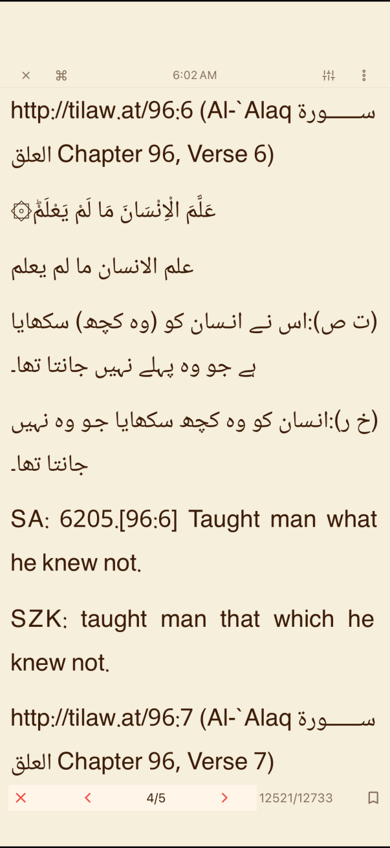
The Holy Quran offline in an e-book reader on my phone: Surah al-Alaq, verse 6, in Arabic with two Urdu and two English translations.
Morning
Later that morning, with a second cup of tea steaming beside my keyboard, I opened the books of the Promised Messiah (as) on Al-Islam. By the grace of Allah, much has been translated into English, although of the 94 books in Ruhani Khazain, 25 still have no English edition on alislam.org. I needed a reference from Izala-e-Auham, which has not been translated. So I asked an AI agent to translate the whole book for my personal study only (not for publication), and it finished the task in a couple of hours. One model translated it, a second checked it, and a third ruled on the findings, checking the hardest pages against the printed book. Of course, it is no substitute for an official translation and this was just a personal project. Huzoor (aa) has recently warned that we should not rely completely on AI for translation, “because translation also turns out wrong sometimes” (This Week With Huzoor, MTA, 16 October 2026). That is why, where a passage mattered, I read the Urdu myself to confirm.
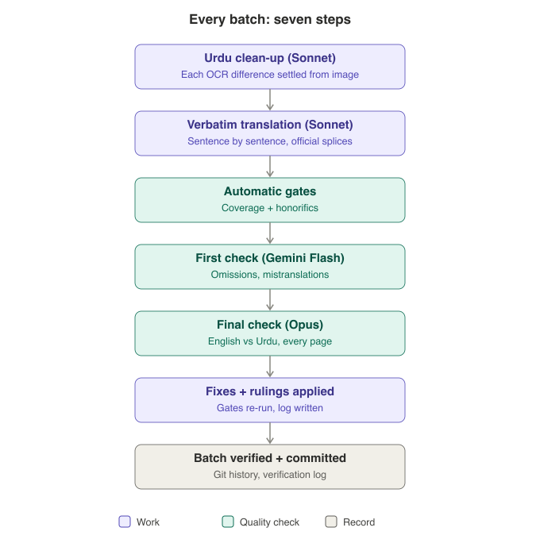
How each batch of the Izala-e-Auham study translation was made and checked: one model translates, others check, and every fix is logged.
Then I remembered a friend who had once wished he could read Noah’s Ark with the Urdu beside the English. A coding agent built that book from official texts: the alislam typed Urdu and the official English translation. No model translated anything. Where three readings of the typed Urdu disagreed, AI readers checked the words against the printed page, and only a dozen small corrections needed to be made, each reviewed manually, entered the Urdu. In about an hour I had a 108-page side-by-side book for personal study.
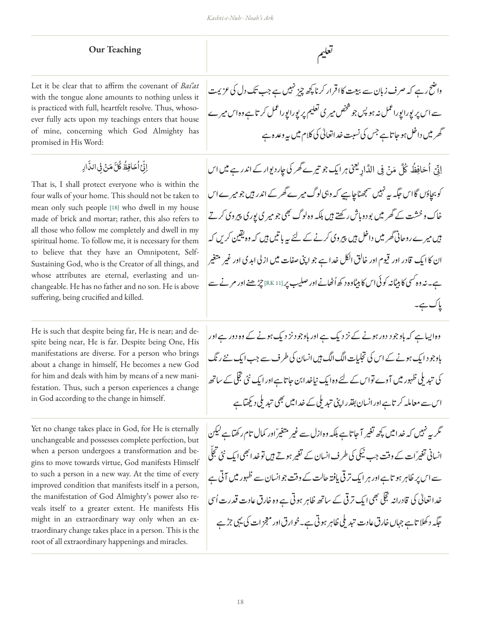
A page of the side-by-side Noah’s Ark, made for personal study: the official English beside the Urdu original.
By then my second cup of tea had gone completely cold, and my day job at the university was calling.
At work
At the university, I study how sweeteners, including honey, affect human health. My work is to find data, extract it from papers and analyze it. In my experience, AI has sped this up so much that projects that once took months can now be done in weeks. AI does the grunt work, while people still oversee and verify it. Sitting at my desk, I let myself hope: the 50 or so research ideas in my notebook no longer looked like a pipe dream.
After Zuhr
After Zuhr I turned to Jama’at work. How often do we tell ourselves that we are simply too busy to serve? My agents drafted emails, and nothing was sent until I had read it myself. My role shifted from staring at a blank screen to reading, correcting, softening a phrase here and there, and deciding. Huzoor (aa) has noted that everyone has 24 hours in a day, yet some will not give even two hours a week or a month to the Jama’at (“Allah desires the establishment of brotherhood”, alhakam.org). The time AI saves can become those very hours.
Afternoon
In his Friday Sermon of 9 October 2026, Huzoor (aa) quoted the Promised Messiah (as) on trust in God. The next day an agent found the passage in Malfuzat (Urdu Vol. 10, p. 212; English Vol. X, p. 319). It checked the printed page and restored the verse of the Holy Quran that the short excerpt online had omitted. Then it drafted the card. Our cards carry the Urdu original above the English, and each says whether the translation is official. For other cards, where no official English exists, the translation is our own and unofficial. AI drafts and checks it, and a Jama’at scholar reviews it before I send it.

A Ta’lim card: the Urdu original above the official English translation (Malfuzat, Vol. IX, p. 370).
A little later my phone buzzed on the desk. Someone had posted a sharp attack on Ahmadiyyat on X. My trained agent automatically drafted a reply based upon a verse of the Holy Quran, quoted word for word, and a second agent checked it for accuracy and a calm tone. Then the decision came back to me: whether it was worth replying at all, and what to post. Huzoor (aa) has told us that those who respond to others on social media “should do so with patience and composure”, for “Allah even instructed Hazrat Moses (as) to speak gently and calmly, even to the Pharaoh” (“Embody honesty, humility, empathy, fairness, and patience”, alhakam.org).
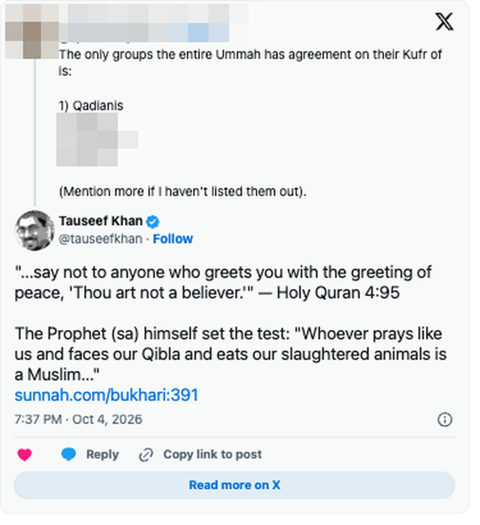
One of my replies on X: a verse of the Holy Quran, quoted word for word, answering an attack gently (the other account is blurred).
Evening
After Maghrib I put my phone face down in another room and sat on the sofa with my daughter to hear about her day. Meanwhile an agent read the day’s emails, drafted replies and listed what I needed to do. When family time was over, I revised each draft and sent it myself. Huzoor (aa) has said that if parents sit with their children even for half an hour and discuss the teachings of Islam, children will not remain absorbed only in mobile phones, tablets or other devices (“Allah desires the establishment of brotherhood”, alhakam.org). Half an hour, and the phones could wait. So could the agent’s drafts.
After Isha
After Isha the house grew quiet again. My inbox was clear, though another glowing screen still beckoned from the desk. I thought of what Huzoor (aa) had told the Khuddam of Canada’s Prairies Region, in a mulaqat shown on This Week With Huzoor that very week. He compared AI to what the Holy Quran says of wine: it has some benefits, but “its harms are greater than its benefits”. It can be used, he said, but “adopt it in such a manner that its harms are reduced and its benefits increase… there is a very subtle line — if you cross that line, there you will start suffering harm.” He also warned: “You ask religious questions to AI, and it misguides you” (This Week With Huzoor, MTA, 16 October 2026; English from MTA subtitles, youtube.com).
In line with Huzoor’s (aa) guidance, we need careful boundaries if we are to draw benefit from AI. Every garden needs a fence to protect what grows inside it, and I try to keep three.
First, use the means but do not rely on them. During the plague, the Promised Messiah (as) wrote: “You are not prohibited from having recourse to the necessary means and appropriate remedies, but you are forbidden to rely upon them” (Noah’s Ark, 2018, p. 22). Huzoor (aa) has given similar advice about AI: one should not rely entirely upon it, especially in matters of religious knowledge (“Unchecked desires and shifting priorities lead to ruin”, alhakam.org). If you need to ask a religious question, tell your AI agent to answer only from the Jama’at’s website, alislam.org, and not from its training memory. The Holy Quran commands:
يٰۤاَيُّهَا الَّذِيْنَ اٰمَنُوْۤا اِنْ جَآءَكُمْ فَاسِقٌۢ بِنَبَاٍ فَتَبَيَّنُوْۤا اَنْ تُصِيْبُوْا قَوْمًۢا بِجَهَالَةٍ فَتُصْبِحُوْا عَلٰى مَا فَعَلْتُمْ نٰدِمِيْنَ
“O ye who believe! if an unrighteous person brings you any news, ascertain the correctness of the report fully, lest you harm a people in ignorance, and then become repentant for what you have done.” (Surah al-Hujurat, Ch.49: V.7)
So my rule is simple: no quotation without the book and the page image or PDF that it can show.
Second, shun what is vain. What good is it if an agent saves us an hour, only for us to hand that hour straight back to idle distraction? The Holy Quran describes believers as those:
وَ الَّذِيْنَ هُمْ عَنِ اللَّغْوِ مُعْرِضُوْنَ
“who shun all that which is vain” (Surah al-Mu’minun, Ch.23: V.4)
Hours saved by an agent can easily be lost again to a screen. Huzoor (aa) has warned that “idly watching TV, or scrolling endlessly on electronic devices can damage your physical and mental health”, adding, of harmful online content: “Now A.I. is adding a new dimension” (Address, Khuddam-ul-Ahmadiyya UK Ijtema, 21 September 2025, pressahmadiyya.com).
Third, keep faith the priority in our use of AI. The Promised Messiah (as) explained: “The oath of allegiance that is taken at my hand is to affirm that one will give precedence to religion over worldly affairs” (Malfuzat, Vol. IV, p. 25). There is nothing wrong with using AI for our studies, careers and livelihoods. But our religious duty comes first, so let us also ask how these tools can serve the Jama’at and the propagation of Islam Ahmadiyya, as the printing press once did. A tool that saves time but steals that priority has cost more than it gave.
Before going to sleep, I smiled at a memory. In September a friend in a WhatsApp discussion about AI agents joked that an agent might soon pray, fast and pay chanda for us, and then go to heaven on our behalf. We laughed, yet the joke invites reflection: no garden, in this world or the next, is entered by proxy. Its delight has to be our own. So as I switched off the lamp, I ended the day with the prayer the Holy Quran teaches for both gardens:
رَبَّنَاۤ اٰتِنَا فِي الدُّنْيَا حَسَنَةً وَّ فِي الْاٰخِرَةِ حَسَنَةً وَّ قِنَا عَذَابَ النَّارِ
“Our Lord, grant us good in this world as well as good in the world to come, and protect us from the torment of the Fire.” (Surah al-Baqarah, Ch.2: V.202)
The Promised Messiah (as) explains this verse: “It is the good of this world (hasanatud-dunya) which becomes a means by which to reap good in the hereafter” (Malfuzat, Vol. II, p. 265).
So, dear Khuddam, research these tools, as Huzoor (aa) has encouraged, and use them within limits and under control, for good purposes that benefit humanity (“Learn and act on the Holy Quran’s teachings”, alhakam.org). Then take the hours they free and spend them where a believer’s heart comes alive: on prayer, the Holy Quran, reading the books of the Promised Messiah (as), the Jama’at and your families. Walk the subtle line Huzoor (aa) described: draw the benefit, avoid the harm, and never let these tools become our teachers in matters of religion. InshaAllah, this age of AI machines can then also be an age in which we cultivate our first garden .
This article was written with AI assistance. Every quotation was checked against its printed or published source.