No Comment
Third of four parts, drawn from conversations recorded in August and September with six men who lived through 1974. Part Two ended with the release of seventy-two men from Sargodha Central Jail at fifteen minutes to midnight, on the day one of them completed ten thousand istighfar.
Were you or your loved ones affected by the events of September 7th ,1974? We would love to hear your story. Click here to contact us.
The house in Islamabad
While police wreaked havoc and clerics forced a boycott in Rabwah, Hazrat Khalifatul-Masih III (rh) appeared before the special committee of the National Assembly.
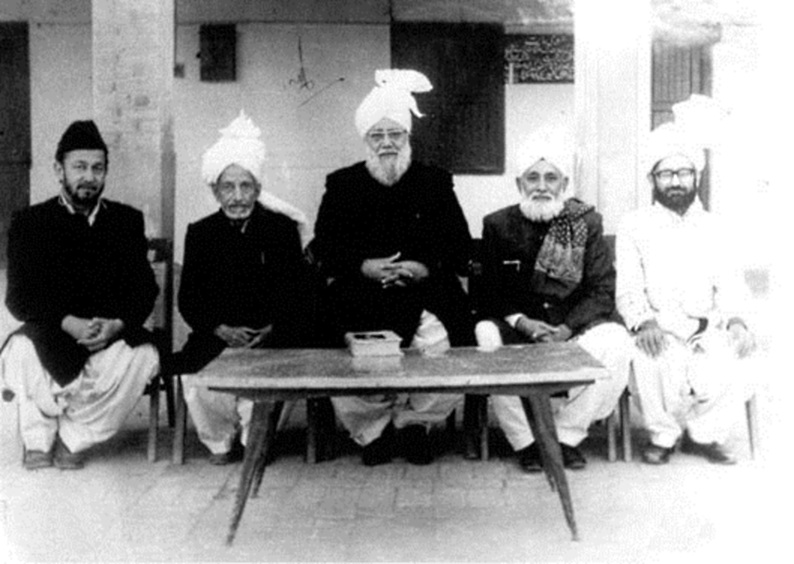
Mirza Muhammad Afzal Sahib was one of four young men, three from Sargodha and himself from Jamia, given the duty of personal security at the house where Huzoor (rh) stayed. Before they went, they were asked to commit that they would give their lives if it came to that. They answered as one that life was the least of what they would give.
They arrived days early and checked the house, the walls, the windows, the bedding, everything, in the manner they had been taught. They stayed there for as long as Huzoor (rh) stayed, and each day the party left for the Assembly in convoy.
The daily proceedings were not published, a moratorium having been placed on reporting them, and Mirza Muhammad Afzal cannot say whether any account of them reached the general membership at all. What he had was private and could not be passed on. The security men prayed Maghrib and Isha together each evening, led by Maulana Dost Muhammad Shahid Sahib, and the understanding was that he would brief them afterwards on what had happened that day.
Huzoor (rh) described the reason for the arrangement himself some years later. When it was proposed that questions be put and answered on the spot, Sadr Anjuman Ahmadiyya submitted in writing that the literature of the Jama’at is spread over ninety years, that there are hundreds of books, and that the Imam of Jama’at Ahmadiyya makes no claim whatsoever to know them by heart. Let the questions be submitted a day in advance, and the answers would be provided.[1] Abdul Samee Khan Sahib, who heard Huzoor (rh) speak of those days more than once, adds what lay behind it. He was not a hafiz of every word of that literature. He was a hafiz of the Holy Quran, and he asked that any passage put to him be examined together with what came before it and after it. Yahya Bakhtiar, who was conducting the examination, agreed to the arrangement.
A team then worked on those references through the night. Maulana Dost Muhammad Shahid told Abdul Samee Khan that time and again the citations turned out to be false. The page numbers were wrong. They would spend a whole night hunting for a passage, and the labour would come to nothing, and in the morning Huzoor (rh) would tell the committee that neither on that page nor anywhere near it was there any such thing.
One morning the whole of that labour came out in public. A cleric had objected on the basis of something the Promised Messiah (as) had supposedly written on a particular page of a particular book, and Huzoor (rh) had said he would answer the following day. When the next day came, he asked the man to repeat the question, so that everyone in the room would have it clearly in mind. Then he said that he had the book with him, that it did not contain the page number cited, and that the book was not long enough to have such a page. The committee erupted. There had to be a break.
And there is a smaller detail that brings joy to this author’s heart. Huzoor (rh) greeted the committee each day, saying Assalamo Alaikum, in a loud voice, and most of them answered walaikum assalam, and then looked at each other, rather sheepishly, having understood what they had just done.
Abdul Samee Khan says that the help of God was in the outcome, and that the outward means was that every answer was properly researched before it was given.
Of that cross-examination, Huzoor (rh) later gave the Jama’at a figure and repeated it more than once. It lasted fifty-two hours and ten minutes. And in those fifty-two hours and ten minutes, he said, he found the angels of God standing at his side, every single moment.[2] Fifty-two years have now passed since that room.
The evening of 7 September
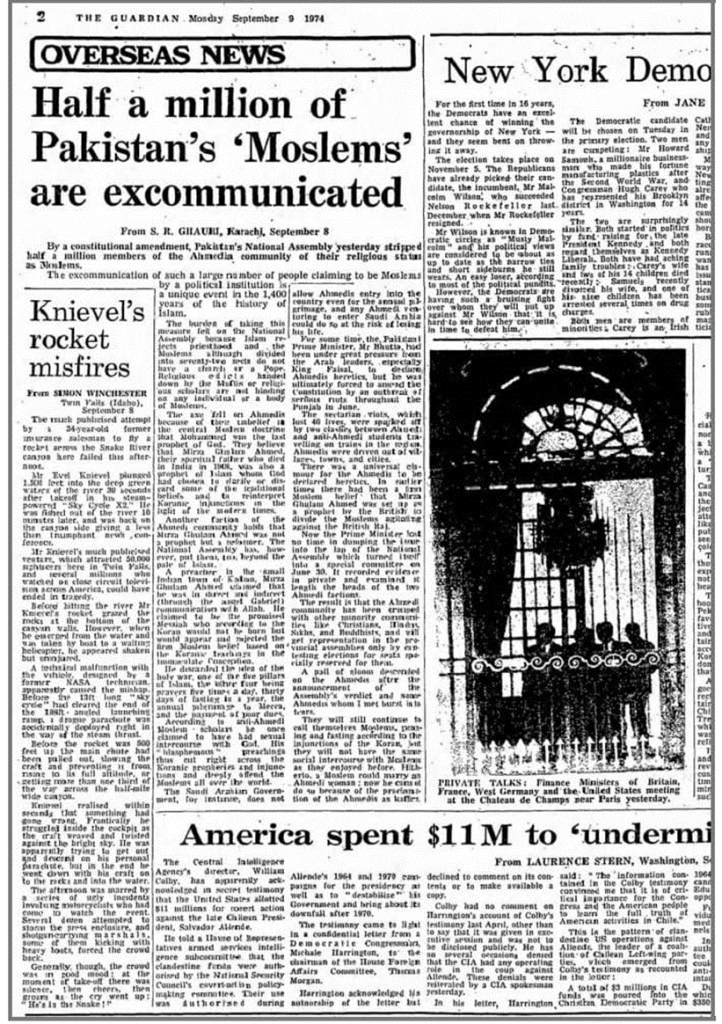
The Second Constitutional Amendment was passed on Saturday 7 September 1974.[3] The news reached Rabwah that evening, on the radio. The details came the next morning in the newspapers, and Abdul Samee Khan remembers it exactly, because his father, Abdul Rasheed Khan Sahib, followed the news closely and the house subscribed to Nawa-e-Waqt along with every Jama’at periodical.
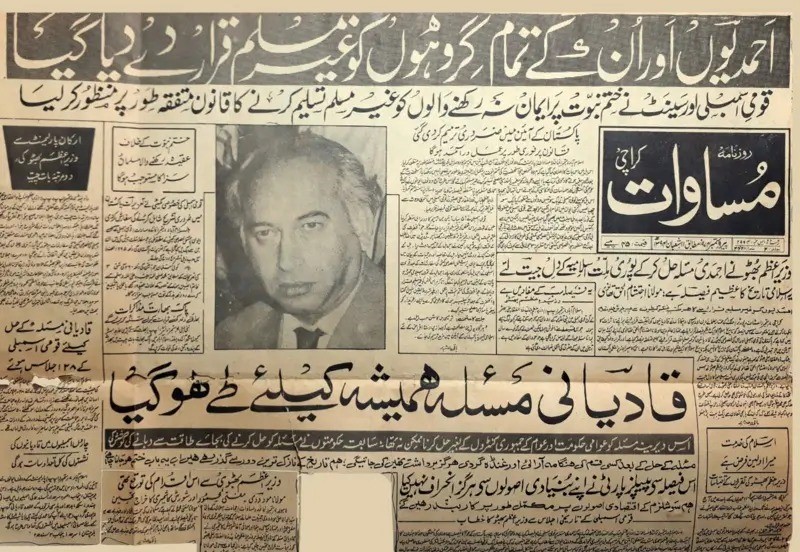
A thousand miles to the south, in Karachi, Dr Aslam Daud saw the same thing on the front pages the next morning, in the largest type the papers had. Qadiani akliyat qarar diye gaye hain. The Qadianis have been declared a minority. There was some excitement in seeing it there in print, and there was also, in a household absorbing what it meant, an assumption that turned out to be wrong. The family took it for something temporary. It would not last long.
He also remembers the school bell. Classes ended on 7 September, and he was coming down the stairs when a group of boys closed in front of him and behind him, shouting kafir, using foul language about the Promised Messiah (as). He had been told, at home and in the Jama’at, never to answer that. He did not answer. Anyone who reasoned with him decently, he answered at length.
Two of his uncles were attacked in those months. One was martyred.
On 7 and 8 September a message from Hazrat Khalifatul-Masih III (rh) went out to every Jama’at in Pakistan. It was short, and it drew a single distinction.
“The Ahmadi who needed the fatwa of an outsider in order to have faith in his own Islam may have cause for worry. But the Ahmadi who understands that he is a Muslim in the sight of Allah, what need has he to worry? May Allah be the Protector and Helper of you all, and may He grant you the strength to remain attached to His hem always. Amin, thumma amin.”[4]
That was the whole of it. Then the community waited for Friday.
No comment
On 13 September, in Masjid Aqsa, Hazrat Khalifatul-Masih III (rh) began by saying that the Jama’at had put two questions to him. What is the comment of the Khalifatul-Masih on the resolution that has been passed? And what should the reaction of the Jama’at be. He noted that the confusion was worse because different newspapers were printing different things and some were leaving things out.[5]
To the first he answered, in English, “no comment.”[6]
Before any comment could be made, he said, there was need of great reflection and deliberation, and need of consultation. After taking counsel and weighing every aspect, he would then tell the Jama’at how many aspects the resolution had contained, what in it was sound and what was not.
A whole country was waiting to hear what he would say, and he declined to be hurried into saying it.
To the second question, his answer was entirely about restraint. He took two prohibitions from the Holy Quran: that God does not love the wrongdoers [Al-Imran, ch.3:v.58] and that God does not love disorder [Al-Baqarah, ch.2:v.206]. Then he explained the meanings of zulm, from putting a thing where it does not belong, to the definition of Imam Raghib, the taking away of a right, noting that the word covers the smallest transgression of a right as well as the largest, and that there is no distinction between them.[7]
The conclusion could not be avoided. The reaction of a true Ahmadi to the resolution of 7 September could not be such that the world would see in it the faintest trace of oppression, nor such that disorder would come of it and the rights of others be taken away, since disorder catches people who are not part of it.[8]
Only at the end did he touch the question everyone had come to hear about, and he began by saying that he had been saying this from the beginning, long before the resolution. A man who bought his Islam from a shop on the Mall Road in Lahore will lose it. As for you and me, whom God Himself says with His own mouth are Muslims, what is there to worry about? Let the world say what it likes. The comments, he said, will come later.[9]
What ordinary Ahmadis were actually afraid of was something larger than themselves. Abdul Samee Khan returns to it three times in an hour. We were a preaching community. That was what we did. And now, if a man in Pakistan accepted Ahmadiyyat, he would understand himself to be stepping out of Islam and putting the title of non-Muslim on himself. Who would do that. It seemed to a boy of fifteen, and to a great many adults, that tabligh in Pakistan was finished.
Keep smiling
The instruction that came back was two words. Muskuratay raho. Keep smiling.
Take no notice of human beings, he said on another occasion, since a man is not able to create even a particle. Fear God alone, and always keep smiling.[10]
Beside it, he said a sentence the community took up and made its own. Kisi maan nay woh bacha nahin jana jo hum say hamari muskurahatain chheen sakay. No mother has given birth to the child who could take our smiles away from us.[11]
Nobody was told to publicise it. People wrote it on the walls of Rabwah themselves, wherever there was space. Chaudhry Hadi Ali Sahib, then eighteen, says he wrote it on walls with his own hand. Years afterwards, when officials came to demand that the writing on the walls of Rabwah be erased, they were told that the Jama’at was not especially fond of it either and that no scheme lay behind it, since people had written it out of their own enthusiasm. The writings were then read out to the officials. The superintendent of police sat through the reading in silence, smoking his hookah, and when that particular line was read, he said that this one at least could be left.[11]
It was not bravado, and the people coming from all over Pakistan were proof of it. Here is an example of a man from Gujranwala.
His family were hakeems, and he kept a herbal medicine shop that his people had run for generations. In the riots, his shops were burned. He reached Rabwah with his children and nothing else and was given a room at Darul-Ziafat. Chaudhry Hadi Ali met him afterwards and had it from him directly. They had all been weeping, he said, and trying not to weep in front of one another, because everything was ash.
The next day he was taken to Hazrat Khalifatul-Masih III (rh), who embraced him. He said it was as though a coolness out of paradise had reached him. Then Huzoor (rh) took a hundred rupee note from his pocket, put it into the hand of the man who had lost everything, and told him to go and look at premises in Gol Bazar in the morning and begin again.
Within a few months, the man told him, his house was full, and his heart was full.
Huzoor (rh) described the same thing from his side of the room at the Jalsa that December. A man came to him whose property, worth lakhs, had been burned and who had lost everything, and his face was so open that a stranger would have thought he had come from his own wedding. So what if there has been a loss, the man said. The treasuries of God cannot be emptied by this sort of conduct.[12]
Our wealth may be looted, Huzoor (rh) told the Jalsa, and our lives may be taken, and to all appearances life may be bitter, and still the smiles cannot be taken from our faces nor the peace from our hearts, because their source is no worldly power or agency.[13]
Widen your dwelling
It was during those months that the promise came.
The responsibility, he said, was a heavy one, and it weighed on him. He did not sleep for a single minute of that night. He went on praying. At the time of the call to Fajr a voice came, and he calls it very beautiful.
Wassi makanaka, inna kafainaka al-mustahzieen. Widen your dwelling. We are sufficient for thee against the mockers. The second half is the assurance given to the Holy Prophet Muhammad (sa) in the Holy Quran [Al-Hijr, ch.15:v.96], given again to a man in a town that could not buy milk.
And he was given the reason. Worry about our guests. They will keep increasing in number. Make room in your houses. They have certainly laid a plan of mockery, but We are sufficient for it.[14]
Consider what that asked of a rational man in the autumn of 1974. Every road out of the town was watched; there was no water, milk, or cleaning facilities. Guests were the one thing Rabwah was guaranteed not to receive.
Build for them anyway.
December
Through that year the newspapers reported repeatedly that the Jama’at was preparing to move its headquarters out of Pakistan. There was reason to believe it. As early as 1973 senior men had urged it on Huzoor (rh) directly, arguing that the communities outside Pakistan needed him and that Pakistan was finished as a base. He refused, and refused again after September.
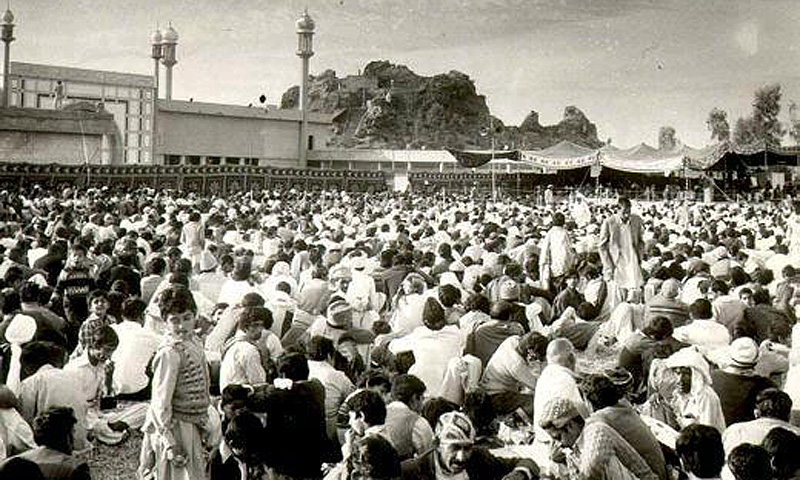
He said so himself in the opening address of the Jalsa Salana on 26 December, in words nobody could misread. Pakistan is our homeland, he said, and God has made the centre of the Jama’at in this country. Of the people who live in it, one per cent, or half a per cent, or a quarter of one per cent, or fewer than that, are without decency. Our centre will not go to another country at their bidding. Let them spread as many rumours as they wish. This is our country. Just as it belongs to the ninety-nine thousand nine hundred and ninety-nine decent Pakistani citizens in every hundred thousand, it belongs to Ahmadis too, and this land will serve us as a mother serves her child.[15]
He was seriously unwell when he said it. He told the Eid congregation the day before that he had been ill for a long time, that the first attack had come on 26 November and a second after that, that the illness was now under control but that he was very weak, partly from the illness and partly from the antibiotics. Some friends had advised him not to attend the Eid gathering at all so that the work of the Jalsa would not suffer.[16]
He came anyway.
Eid-ul-Adha fell on 25 December, the day before the Jalsa. He had instructed that the Jalsa would be held at its proper time, and that those coming should bring their sacrificial animals with them.
They did. Abdul Samee Khan, a boy watching at the station and the bus stand, remembers people getting down from buses leading goats. Others brought them on trucks and in cars and led them off the trains. In a town that had spent the summer unable to buy milk, several hundred goats were sacrificed on 25 December by the hands of the Ahmadis of Pakistan. The Eid sermon was delivered in Masjid Aqsa, with the overflow seated outside in the Jalsa Gah, because the crowd had already arrived from across the country.
The Jalsa opened the next morning. We have gathered here at the centre, Huzoor (rh) said, with smiling faces and contented hearts, rejecting all the rumours, and in greater numbers than last year.[17]
On the second day he told them where some of those numbers had come from. Iron curtains do not stop the angels of God. Two young Ahmadis had come from Yugoslavia, where a scholar had taken bai’at and spread Ahmadiyyat. A letter had arrived from Poland to say that some people there had become Ahmadi.[18]
Abdul Samee Khan remembers walking about the unpaved roads of Rabwah for no reason except to greet the visitors, the Africans, the English, the Indonesians, the Malaysians, and being answered with affection.
Four months earlier, the town had not been able to obtain the essentials of life.
Worry about our guests, said Allah.
Part Four, on 1984, the migration, and how a community that had never left arrived in Canada, follows.
Notes
- Al Fazl (Rabwah), Jalsa Salana Number, 24 December 1980, 10, https://files.alislam.cloud/alfazl/rabwah/A19801224.pdf.
- Al Fazl, Jalsa Salana Number, 24 December 1980, 10.
- Constitution (Second Amendment) Act, 1974. For a summary of its effect, see United States Department of State, Bureau of Democracy, Human Rights and Labor, International Religious Freedom Report 2001: Pakistan, https://2009-2017.state.gov/j/drl/rls/hrrpt/2001/sa/8237.htm.
- Message of Hazrat Khalifatul-Masih III (rh) to the Jama’ats of Pakistan, 7 and 8 September 1974, quoted in Andar ki Kahani Aini Shahid ki Zubani, 395.
- Mirza Nasir Ahmad, Khalifatul-Masih III, Friday Sermon delivered at Masjid Aqsa, Rabwah, 13 September 1974, in Khutbat-e-Nasir, vol. 5 (Rabwah: Nazarat Isha’at, Sadr Anjuman Ahmadiyya Pakistan), 691.
- Khutbat-e-Nasir, vol. 5, 692.
- Khutbat-e-Nasir, vol. 5, 696.
- Khutbat-e-Nasir, vol. 5, 699.
- Khutbat-e-Nasir, vol. 5, 701.
- Mirza Nasir Ahmad, Khalifatul-Masih III, Dora-e-Maghrib 1400 Hijri, 134–135.
- Chaudhry Hameedullah, “Mera Safar-e-Zindagi,” pt. 1, Al Fazl online, 9 December 2021, https://alfazl.com/2021/12/09/38486/.
- Mirza Nasir Ahmad, Khalifatul-Masih III, opening address, Jalsa Salana, 26 December 1974, in Khitabat-e-Nasir, vol. 2, 6.
- Khitabat-e-Nasir, vol. 2, 9.
- Al Fazl, Jalsa Salana Number, 24 December 1980, 10.
- Khitabat-e-Nasir, vol. 2, 2.
- Mirza Nasir Ahmad, Khalifatul-Masih III, Eid-ul-Adha Sermon delivered at Masjid Aqsa, Rabwah, 25 December 1974, in Khutbat-e-Nasir, vol. 10, 179.
- Khitabat-e-Nasir, vol. 2, 10.
- Mirza Nasir Ahmad, Khalifatul-Masih III, address of the second day, Jalsa Salana, 27 December 1974, in Khitabat-e-Nasir, vol. 2, 33.
Testimony from Abdul Samee Khan, Chaudhry Hadi Ali, Mirza Muhammad Afzal, Lal Khan Malik, Dr Aslam Daud and Abdul Wahab Butt is drawn from interviews recorded by the authors in August and September 2026 and is not separately cited.