Islamabad, Tilford, UK – 29 March 2026
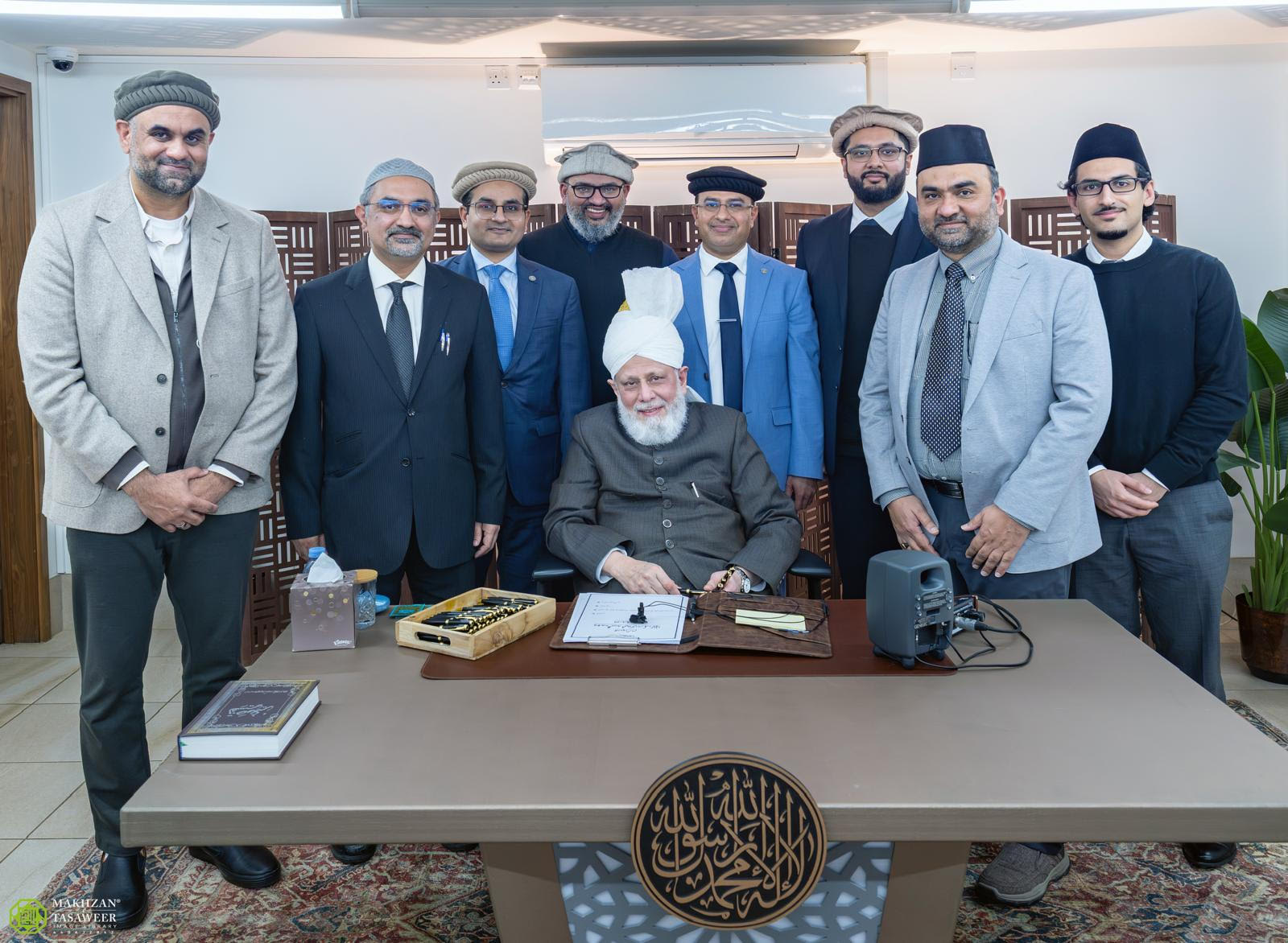
By the grace of Allah, a distinguished delegation of 34 Ahmadi doctors and medical professionals from North America was granted the honour of a mulaqat with Hazrat Mirza Masroor Ahmad (aba). Among them were 20 Ahmadi medical professionals from Canada, who travelled to the United Kingdom with the intention of presenting themselves for service as Waqf-e-Arzi (temporary devotion) and seeking spiritual and professional guidance.
This blessed gathering was marked by humility, reflection, and a deep sense of purpose, as each participant introduced themselves before engaging in a meaningful question-and-answer session with Huzoor (aba). The discussion spanned a wide range of topics, including medical ethics, patient care, mental health, balancing professional and Jama’at responsibilities, and the true essence of waqf.
The Call to Waqf-e-Arzi
A central theme of the mulaqat was the importance of Waqf-e-Arzi. Huzoor (aba) strongly encouraged all doctors and medical professionals to actively participate in this noble form of service and to motivate others—especially specialists—to do the same.
While acknowledging the practical challenges faced by those travelling abroad, such as adapting to local systems and resource limitations, Huzoor (aba) emphasized that the primary objective is participation itself. The act of offering one’s time and expertise for the sake of Allah carries immense spiritual value, regardless of external constraints.
For Canadian readers, this guidance is particularly significant. In a healthcare system that is structured, resource-rich, and protocol-driven, stepping into environments with different realities can be challenging. However, Huzoor (aba) reminded us that Waqf-e-Arzi is not about perfection of systems—it is about sincerity of service. The willingness to serve, learn, and adapt is itself a form of عبادت (worship).
“The True Healer is Allah”
Huzoor (aba) reiterated a profound principle rooted in Islamic teaching: Allah alone is the true Healer. Referring to a narration of the Holy Prophet Muhammad (sa), Huzoor (aba) reminded the delegation that physicians are merely means of comfort and support, while healing ultimately comes from Allah.
He advised doctors to:
- Begin patient encounters with silent prayer
- Maintain humility in their role
- Remember Allah continuously during clinical practice
He further encouraged writing “Huwa ash-Shafi” (“He is the Healer”) as a spiritual reminder, reinforcing the connection between faith and medicine.
For physicians in Canada—where clinical excellence is often emphasized—this guidance reframes medicine as both a scientific and spiritual responsibility.
Practicing Medicine with Wisdom and Cultural Sensitivity
Huzoor (aba) also highlighted the importance of understanding local patient populations. He explained that patients in countries such as Pakistan may differ significantly from those in North America in terms of expectations, communication styles, and cultural norms.
Doctors were advised to:
- Exercise patience and forbearance
- Adapt communication to local contexts
- Respect the experience of local practitioners
- Work collaboratively rather than comparatively
This guidance reflects a broader principle: effective care requires not only knowledge, but wisdom and humility.
Building Trust in Mental Health Care
In response to concerns about stigma in mental health, Huzoor (aba) emphasized that trust and confidentiality are foundational. Many individuals hesitate to seek help due to fear that their personal matters may not remain private—especially within close-knit communities.
Huzoor (aba) advised that:
- Psychiatrists and clinicians must strictly uphold confidentiality
- Patients should be reassured with clarity and compassion
- Treatment must remain within moral and ethical boundaries
This guidance is particularly relevant for Canadian Ahmadi professionals working to improve mental health awareness within the community.
Balancing Profession and Jama’at Service
Addressing the challenge of balancing professional duties with Jama’at responsibilities, Huzoor (aba) offered a practical and reassuring approach:
- Prioritize professional responsibilities
- Contribute to Jama’at work within one’s capacity
- Avoid overburdening oneself with unrealistic expectations
- Work with ease and rely on prayer
He reminded attendees that perfection is not required in worldly tasks, and that striving with sincerity is what matters most.
Conveying Islam Through Character
Huzoor (aba) beautifully articulated that the most effective way to convey Islam is not through words alone, but through exemplary character. Kindness, compassion, and professionalism naturally attract people and reflect the true teachings of Islam.
He noted that:
- A patient’s trust can itself become a means of healing
- Good conduct enhances both treatment outcomes and reputation
- Prayer remains an essential part of patient care
The True Spirit of Waqf
In defining the essence of Waqf-e-Arzi, Huzoor (aba) explained that it begins with a living relationship with Allah. He emphasized the role of daily prayers in structuring life, creating discipline, and maintaining spiritual focus.
He advised:
- Consistency in five daily prayers
- Regular recitation and study of the Holy Qur’an
- Humility and reliance on Allah
- Continuous self-improvement
For Canadian professionals balancing demanding schedules, this framework offers a powerful model for integrating faith into daily life.
A Lasting Impression
The mulaqat concluded with heartfelt prayers and reflections, leaving attendees spiritually uplifted and deeply motivated. The example of past Waqf-e-Zindagi doctors—who served with extraordinary sacrifice in places like Ghana—served as a reminder of what can be achieved through sincerity and trust in Allah.
This blessed opportunity reflects the remarkable growth and increasing impact of the Ahmadiyya Muslim Medical Association of Canada.
Over recent years, AMMAC has evolved into a vibrant national platform bringing together Ahmadi healthcare professionals across disciplines. Its work includes:
- National mental health initiatives, including monthly webinars addressing stigma, emotional well-being, and community education
- Collaborative programs with educators and allied health professionals to promote holistic care
- Medical assessments and community service initiatives, supporting Jama’at institutions and future generations
- Wellness and prevention efforts, integrating physical, mental, and spiritual health
Through these efforts, AMMAC is not only strengthening professional collaboration but also shaping a faith-informed, trauma-aware, and service-oriented healthcare culture within the Jama’at. Health care professionals are encouraged to join AMMAC by registering on AMMAC.ORG.