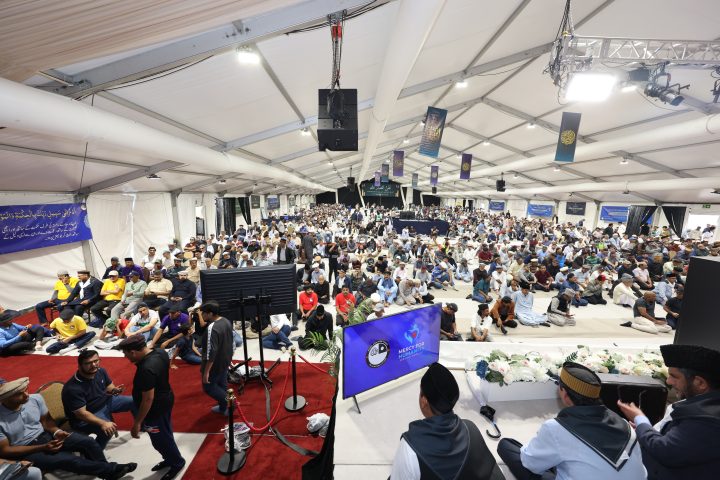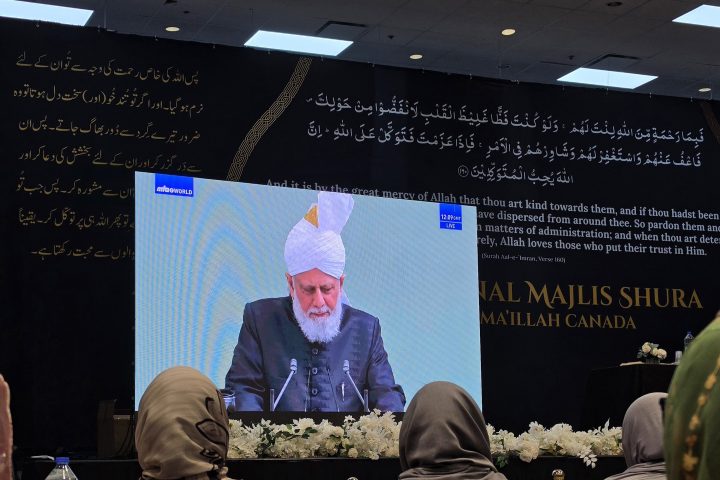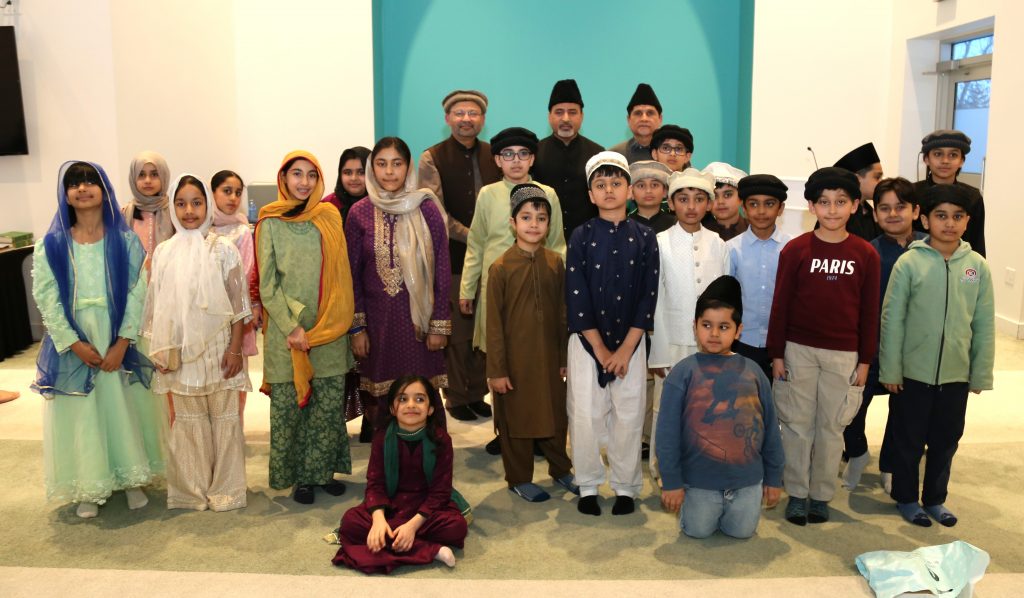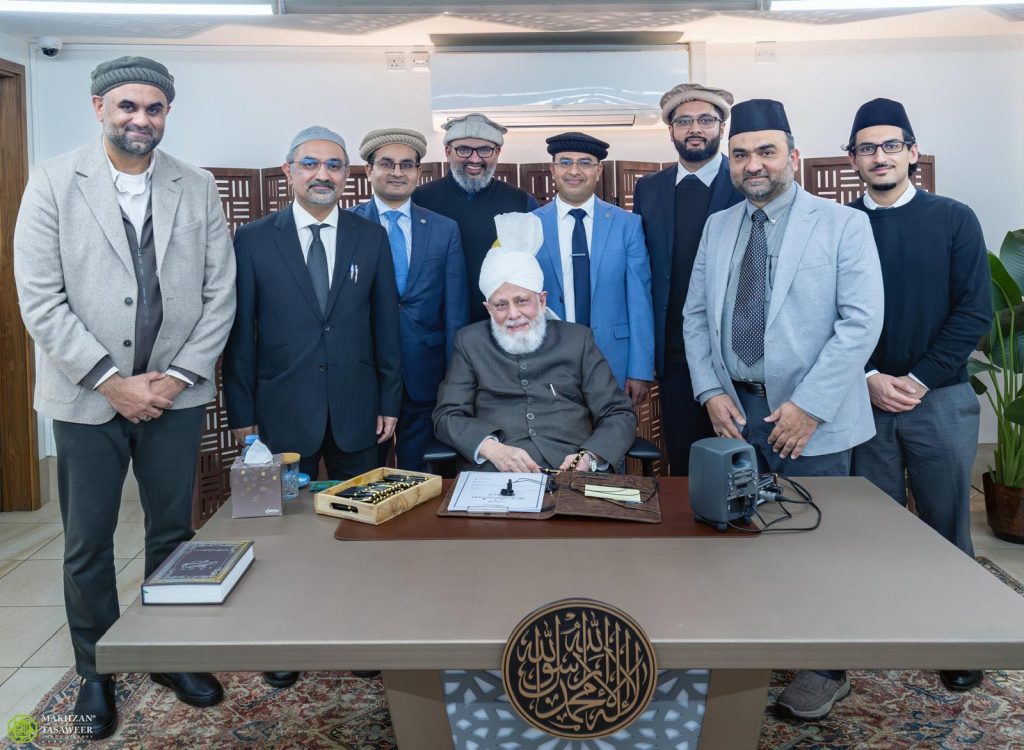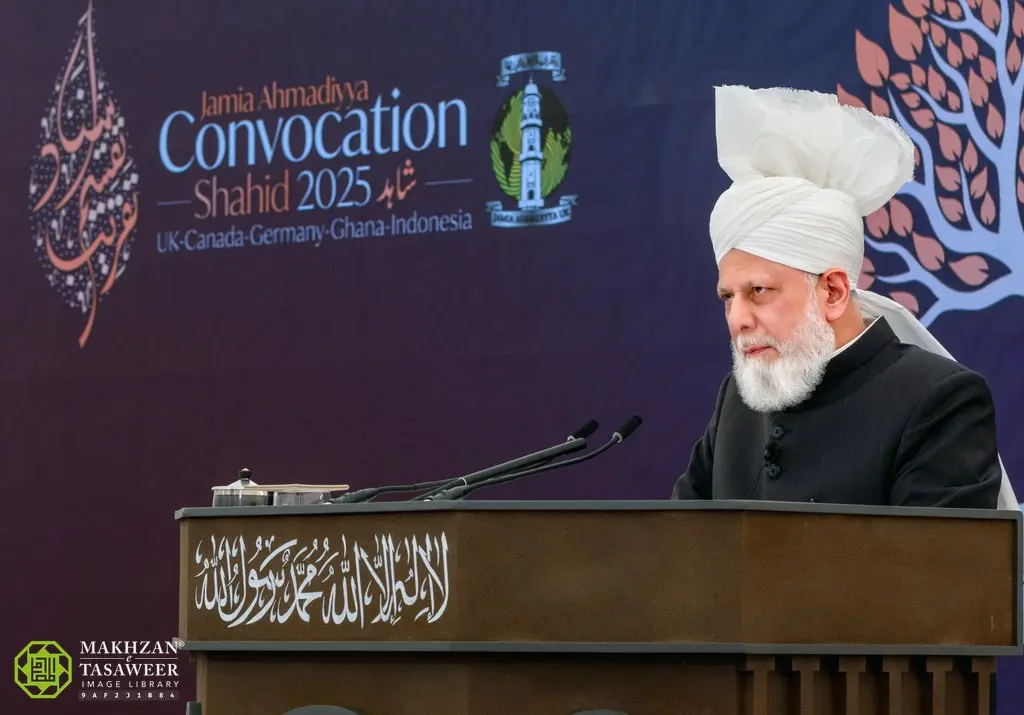
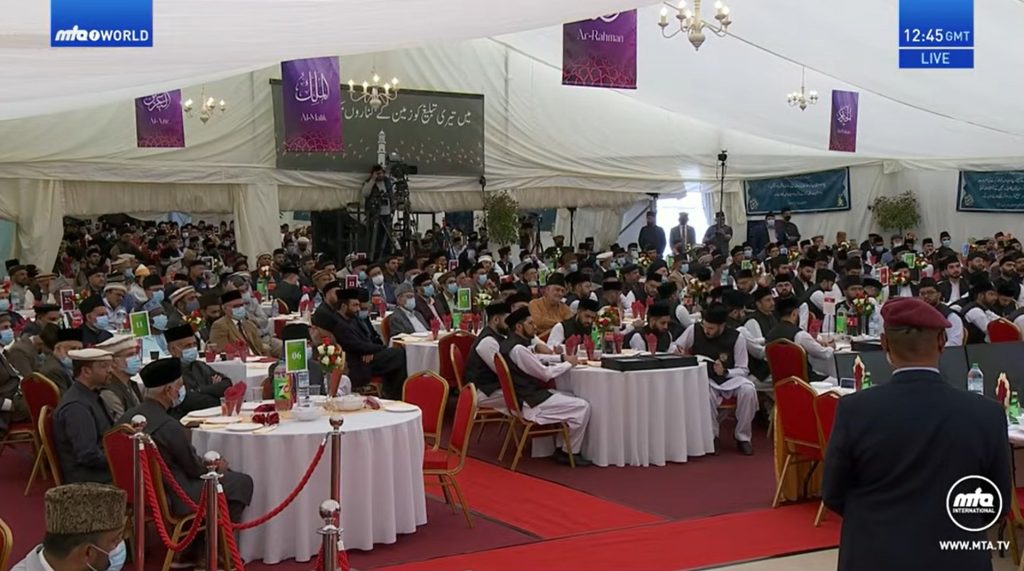
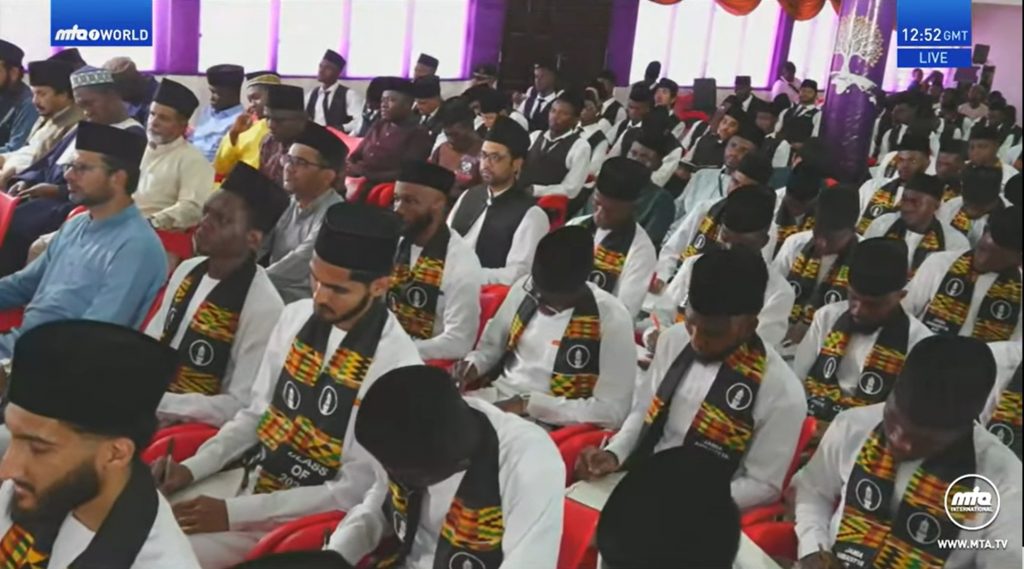
On Saturday, 2 May 2026, Hazrat Mirza Masroor Ahmad, Khalifatul Masih V (may Allah be his Helper) graced the Jamia Ahmadiyya convocation ceremony at the Jamia Ahmadiyya UK campus in Haslemere, where graduates of five Jamias received their Shahid degrees. Graduates from the UK, Canada, and Germany were present in person, while those from Ghana and Indonesia joined the session virtually.
This year marked a particularly substantial cohort. Eighteen graduates from Jamia Ahmadiyya Canada, eighteen from Jamia Ahmadiyya Germany, and sixteen from Jamia Ahmadiyya UK received their degrees directly from Huzur (aba). The eight graduates of Jamia Ahmadiyya Indonesia and the forty-five graduates of Jamia Ahmadiyya Ghana, joining via video link, were presented their degrees with Huzur’s (aba) permission by the Amir of Indonesia and the acting Amir of Ghana, respectively. In total, 105 newly trained Murabbiyan now enter the field of action.
Following the distribution of degrees, Huzur (aba) delivered an address that opened on a note of joyful gratitude. According to the published English summary in Al Hakam, Huzur (aba) reminded the graduates that having completed seven years at Jamia Ahmadiyya, they now stand prepared to enter the field as Murabbiyan, dedicated lifelong to the service of the Jama’at and remaining available, around the clock, for that service.
Setting out the standard expected of the new cohort, Huzur (aba) framed it as the standard hoped for by the Jama’at, by the Khalifa-e-Waqt, and in fulfilment of the solemn pledge they have made with Allah the Almighty. He cautioned that “nations which progress are those that remain conscious of their weaknesses,” and counselled the graduates against assuming that praise from their Principals signified completion of the task.
On the spiritual foundations of a Murabbi’s life, Huzur (aba) urged regular self-assessment in matters of love for Allah, the establishment of His Tawhid, and focus on worship. He invited the graduates to examine the standard of their obligatory prayers, their nawafil, and their remembrance of Allah, noting that only when these standards improve will their work be blessed and leave a lasting impression on others.

Particular emphasis was placed upon the five daily Salat. Huzur (aba) reminded the graduates that the doors of every centre or mosque should be opened for all five prayers, and that the Murabbi himself should give the adhan and be present in the mosque. Those engaged in office work, he observed, sometimes assume that offering prayers in the office suffices, but this approach is not correct. The Tahajjud prayer was described as of utmost importance, given that a Murabbi’s success depends entirely upon Allah.
Huzur (aba) also drew attention to the regularity of sending durood upon the Holy Prophet (sa) and of istighfar, observing that consistency in both has often been lacking among students and among those already serving in the field. The graduates were invited to pledge steadfastness in these practices before leaving the gathering.
On engagement with the Holy Qur’an, Huzur (aba) reminded the cohort that for a Murabbi, reading merely a small portion is insufficient. The Promised Messiah’s (as) warning against abandoning the Holy Qur’an like something forsaken, and his teaching that within it lies our very life, was cited by Huzur (aba) as a continuing call to daily engagement with the Book of Allah, accompanied by reflection and study of its commentaries.
Huzur (aba) also urged the graduates to study the writings of the Promised Messiah (as) in their entirety, recounting an incident in which a serving Murabbi mentioned having read sixty of his books. The figure was commendable, Huzur (aba) noted, but a Murabbi ought to study them all. Insufficient familiarity with the corpus, he observed, is why some Murabbiyan struggle when asked to provide accurate references.
On the indispensable place of taqwa, Huzur (aba) reminded the graduates of the Promised Messiah’s (as) teaching that it is only through righteousness that one may enter the fortified sanctuary of Allah. Once within that refuge, every action aligns with Divine pleasure and yields beneficial outcomes both in tarbiyat and in tabligh. Huzur (aba) cautioned the graduates against absorption in inappropriate online or televised content, noting that such indulgence removes blessings from a Murabbi’s work and invites complaint from the family and the Jama’at.
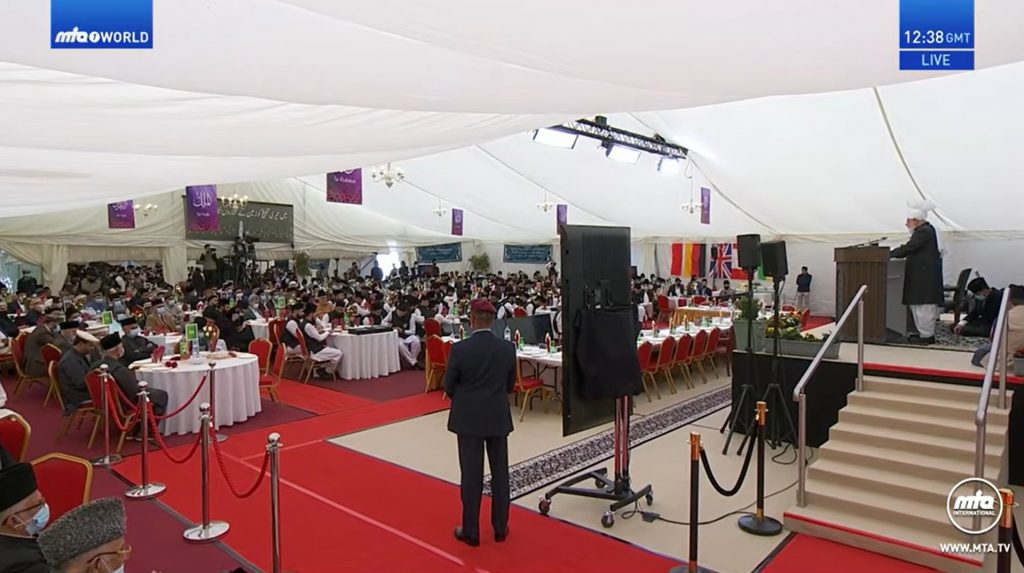
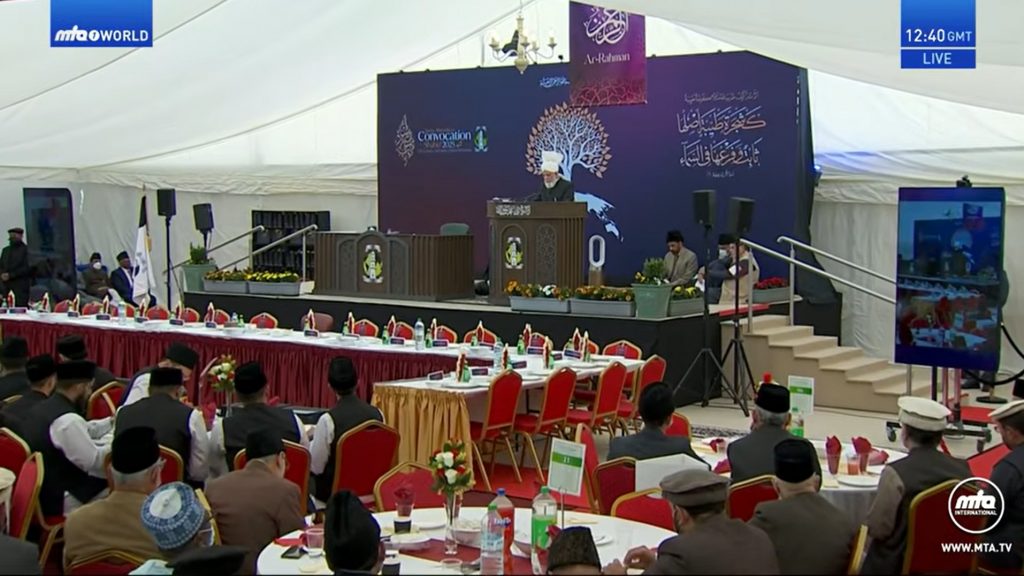
Among the most uplifting passages of the address was Huzur’s (aba) reminder that the prophecies of the Holy Prophet (sa) and the glad tidings given to the Promised Messiah (as) are certain to be fulfilled, Insha’Allah, and that the Jama’at is destined to prevail. With this conviction firmly held, the targets the new Murabbiyan set for themselves will be lofty and high. By refining both their intellectual and practical abilities, they will become participants in those very successes.
Huzur (aba) was equally encouraging on the question of moral excellence. Many Murabbiyan, he acknowledged, possess a strong scholarly foundation and are capable of silencing opponents through reasoned argument. The further step, he counselled, is to pair that strength with gentleness and high morals, in keeping with the consistent teaching of the Holy Qur’an, the Holy Prophet (sa), and the Promised Messiah (as), who together emphasise that harsh or offensive language reflects only a deficiency of knowledge.
The graduates were reminded that as representatives of the Khalifa-e-Waqt, it is their duty to listen attentively to each Friday Sermon, to extract its key points, and to communicate them onward. Many Murabbiyan, Huzur (aba) noted with appreciation, already practise this, and the Jama’at benefits considerably as a result.
Closing the address, Huzur (aba) urged the graduates to prepare strategically for tabligh among Muslims, atheists, Christians, Jews, and staunch opponents alike, and to foster love and unity within the Jama’at so that no individual might wrongfully usurp the rights of another. With these qualities firmly established, Huzur (aba) said, the graduates of Jamia Ahmadiyya will have emerged as Murabbiyan who are valuable assets to the Jama’at and beneficial members of society.
Hazrat Amirul Momineen (aba) then led everyone in silent prayer.