The Holy Qur’an repeatedly invites humanity to reflect upon the signs of Allah Almighty. Every aspect of creation can offer lessons that deepen our understanding of faith, morality, and the world around us. The spider, the jellyfish, and the Qur’anic account of Gog and Magog may seem unrelated at first, yet each is closely related upon reflection. The thoughts shared below are offered as personal reflections of this relationship, rather than definitive interpretations of the Qur’an and Hadith.
Allah Almighty states:
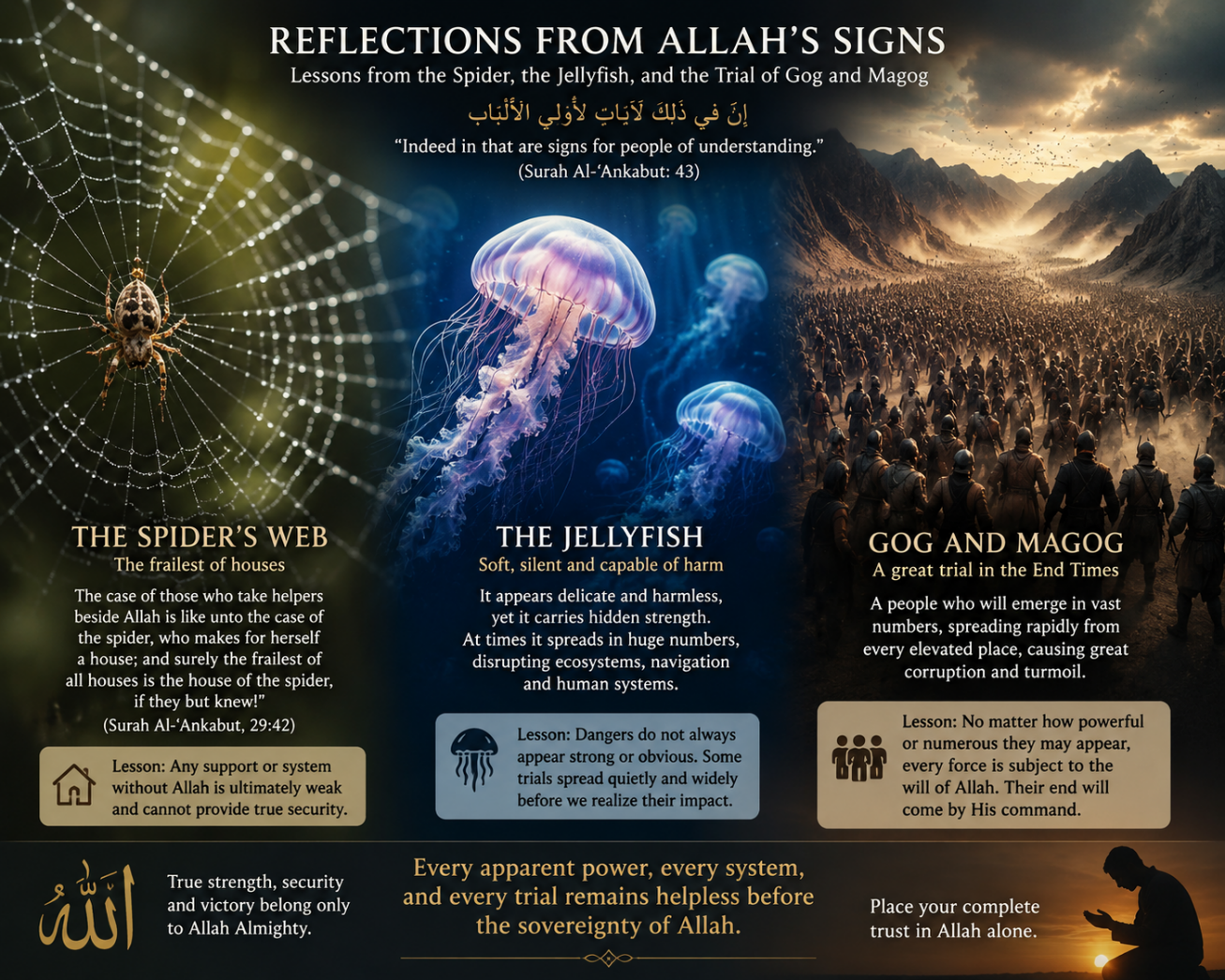
“The case of those who take helpers beside Allah is like unto the case of the spider, who makes for herself a house; and surely the frailest of all houses is the house of the spider, if they but knew!” [Al-‘Ankabut, ch.29:v.42]
This verse reminds us that any support, system, or source of security disconnected from Allah is ultimately fragile, however strong it may appear. True strength and permanence belong to Allah Almighty alone.
The Holy Qur’an also mentions Gog and Magog (Ya’juj and Ma’juj), describing them as creating disorder in the earth [Al-Kahf, ch.18:v.95] and as hastening forth from every height [Al-Anbiya, ch.21:v.97]. These are not a people whose appearance is still awaited. The Promised Messiah (peace be upon him) connected the name with ajij, meaning fire, and explained that Gog and Magog would be a people who make greater use of fire than any other, reigning supreme on earth and dominating every height. He identified them with the technologically dominant nations of the modern age, and held that their emergence is itself among the signs of his advent. Their overwhelming presence is a reminder that human beings should never place absolute trust in material power alone.
The jellyfish offers a modern example from nature. It appears delicate, transparent, and harmless, yet it carries stinging cells capable of affecting creatures far larger than itself. Its populations can also increase dramatically, disrupting marine ecosystems, fisheries, and industrial operations. Dangers do not always arrive in obvious forms. Some spread quietly and gradually, long before their impact becomes apparent.
The spider’s web offers a further lesson. The silk itself may be remarkably strong, yet the Qur’an directs our attention to the weakness of the spider’s house as a structure. The distinction is important. A system may possess impressive elements, sound organisation, and outward strength, and still lack true stability if it is not founded upon truth, justice, and righteousness. Building a just society requires patience, wisdom, and adherence to moral principles.
The account of Gog and Magog carries a similar reminder that even the greatest worldly forces remain subject to the will of Allah. According to the traditions, their end will come through divine decree rather than human strength. No earthly power stands independently of Allah’s command.
Today, information, ideas, technologies, and global influences cross continents within moments. It would be incorrect to identify such developments as Gog and Magog themselves, yet one may observe certain parallels in the speed and scale with which events now affect humanity. Reflections of this kind help us appreciate the wisdom behind the Qur’anic warnings about large-scale trials, and the importance of spiritual preparedness.
Viewed together, the spider’s web teaches us the weakness of false supports, the jellyfish reminds us that some dangers are subtle and unexpected, and the account of Gog and Magog points to the reality of the trials that test humanity. Each encourages believers to remain vigilant, thoughtful, and firmly connected to Allah.
The purpose of such reflection is not speculation but the strengthening of faith. The Qur’an encourages believers to observe, contemplate, and seek wisdom from the signs of Allah in creation. Through it, we are reminded that every apparent power, every worldly system, and every trial remains subject to the sovereignty of Allah Almighty.
True security lies in placing our trust in Allah the Exalted alone.