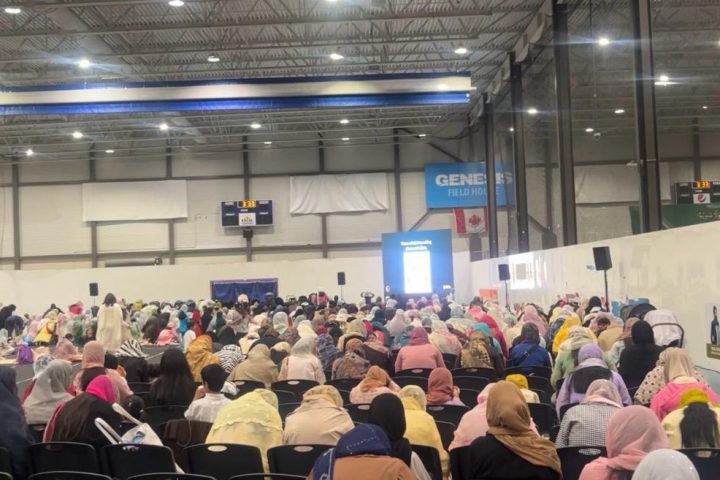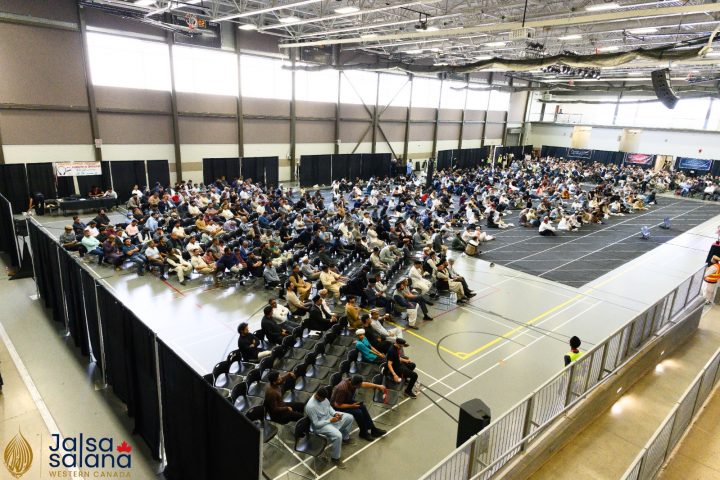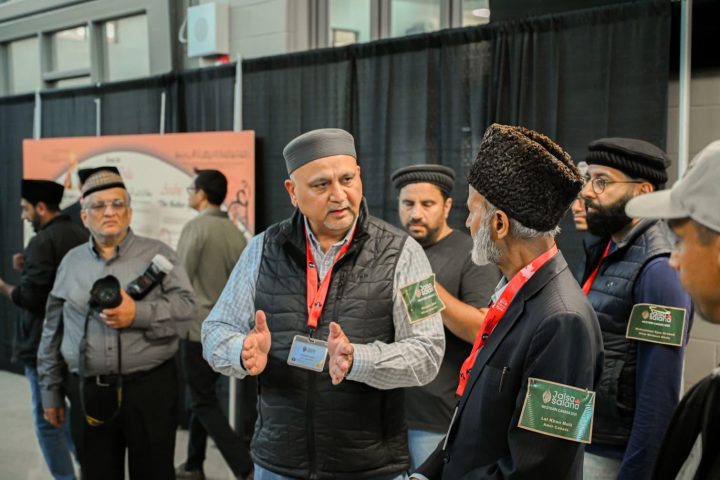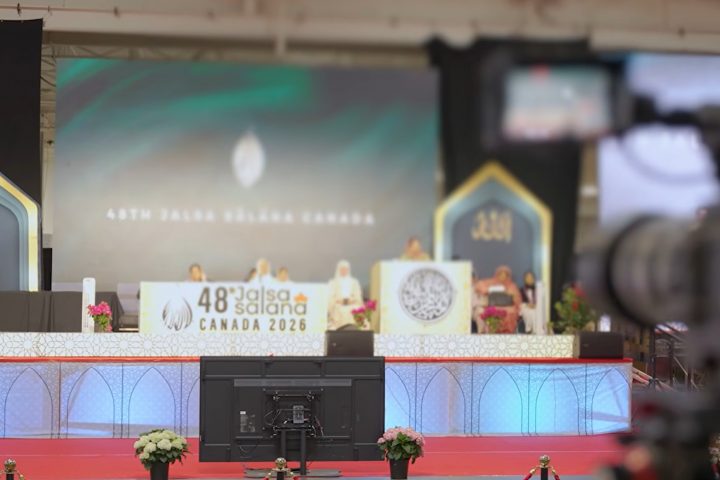
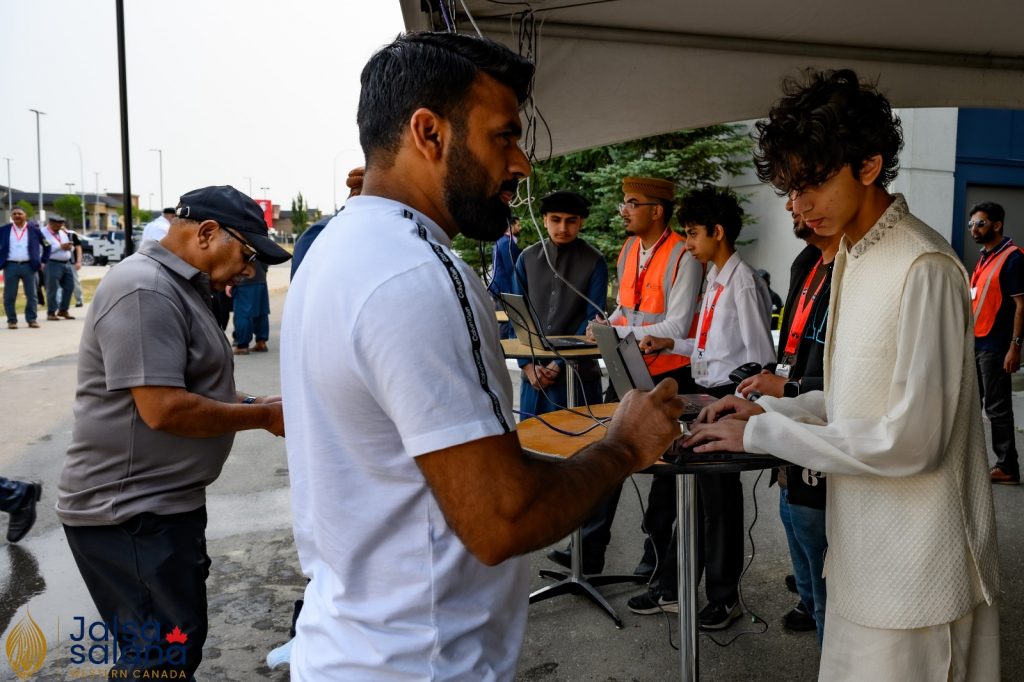
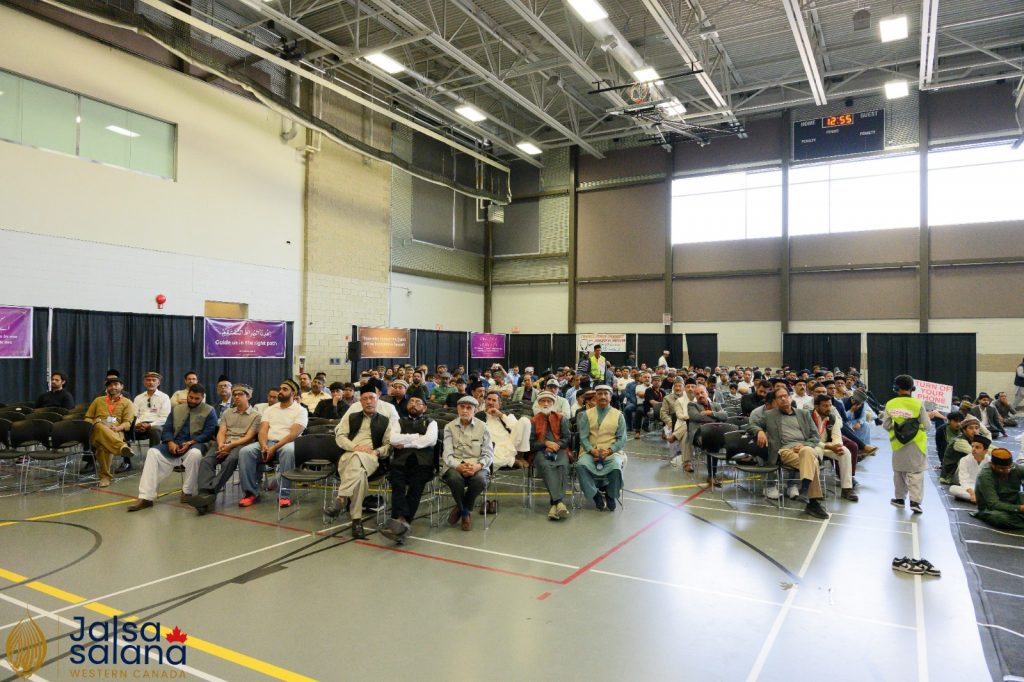
Alhamdulillah, the 42nd Jalsa Salana Western Canada opened on Saturday, 8 August 2026 at the Genesis Centre in northeast Calgary, drawing members from British Columbia, Alberta, Saskatchewan, Manitoba and Northwest Territories. Attendance was reported at around 5,500, up from roughly 5,100 the previous year. The growth was visible in the arrangements, which included two separate Langar Khana operations running in parallel, more than forty-five departments on duty, and a volunteer workforce that had been on site since well before the first guests arrived. Muzaffar Ahmed Sahib, Officer, Jalsa Salana, oversaw the move to the Genesis Centre and the logistics that accompanied it.
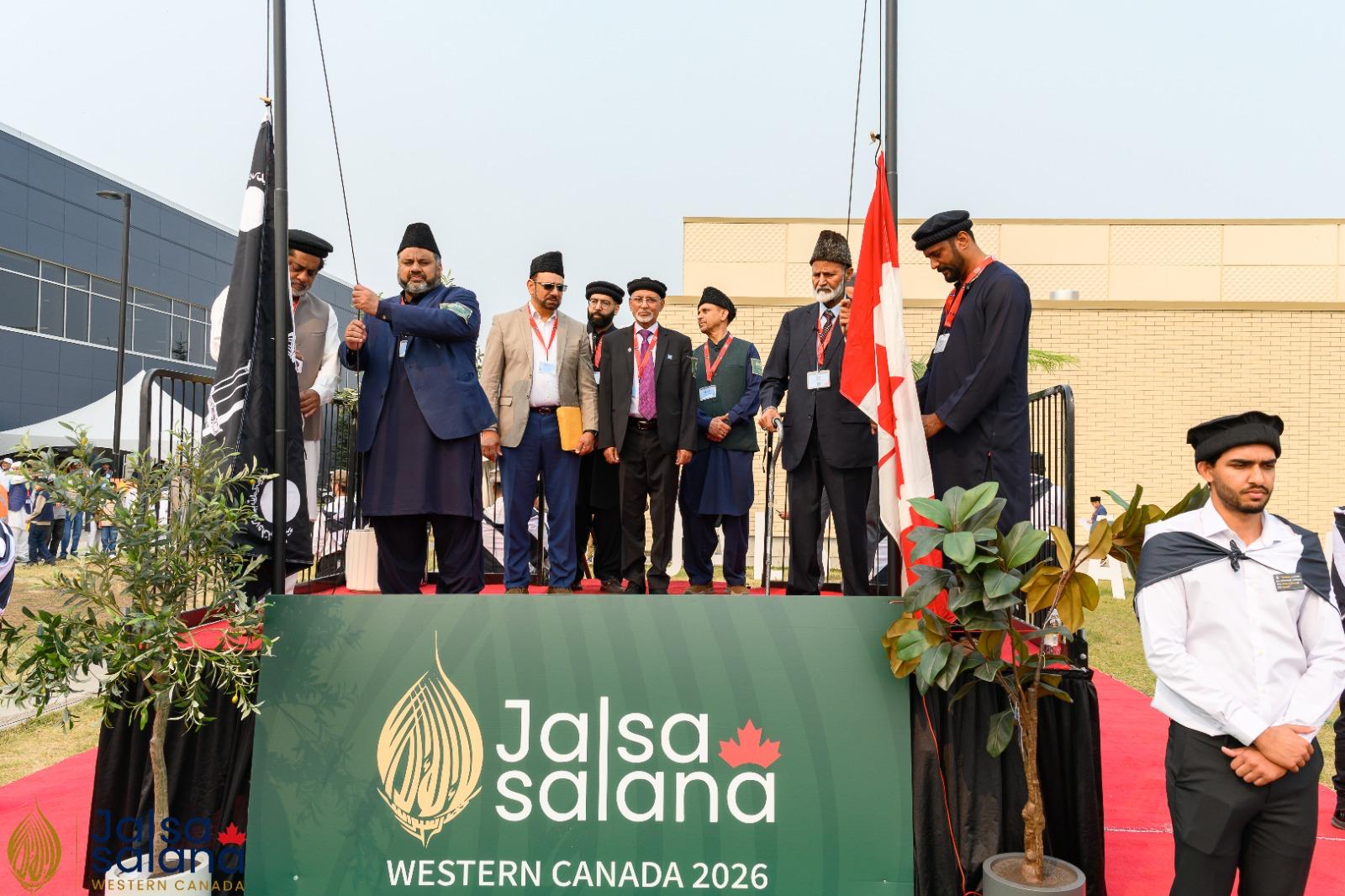
On the first day of Jalsa, breakfast was served in the Jalsa Gah from half past nine. At a quarter to eleven, the Liwa-e-Ahmadiyyat was hoisted by Lal Khan Malik Sahib, National Amir of Jama’at Ahmadiyya Canada, together with Sohail Mubarak Ahmad Sharma Sahib, Missionary In-Charge, followed by silent prayer. The first session then opened under the chairmanship of Sohail Mubarak Ahmad Sharma Sahib.
First session
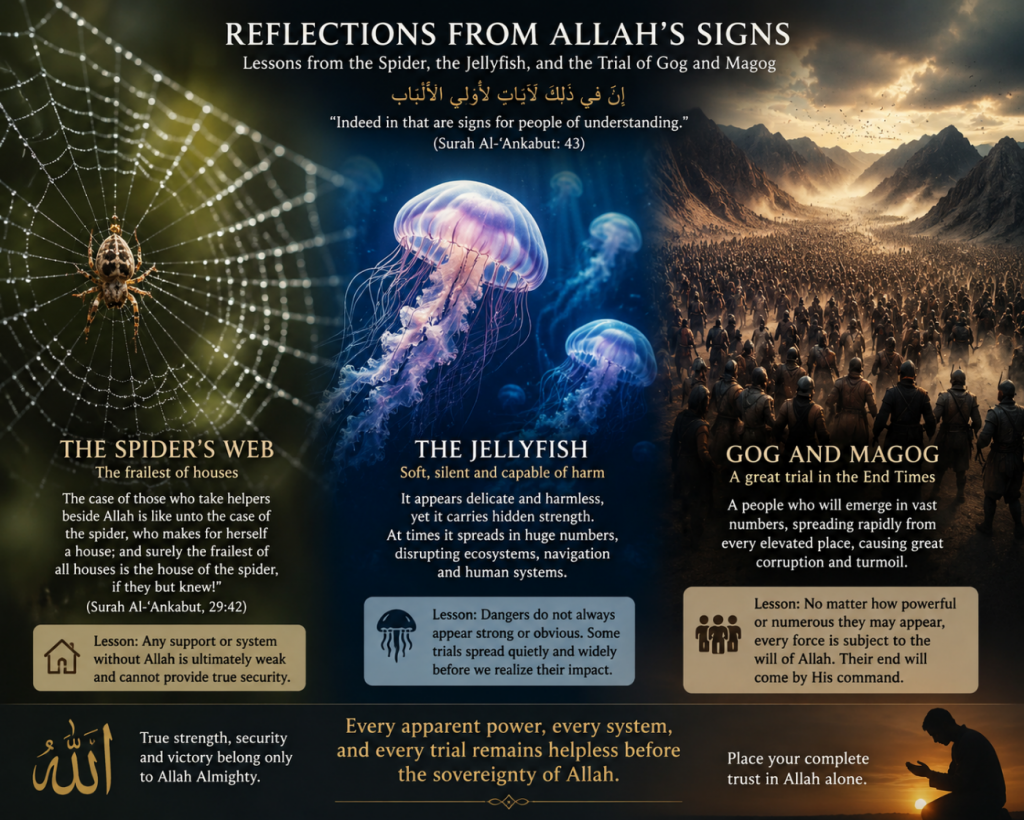
Proceedings began with recitation from the Holy Qur’an, the portion taken from Surah al-Zumar [Al-Zumar, ch.39:v.63-67], in which Allah the Exalted is named the sole Guardian and Trustee over the heavens and the earth. This was followed by a poem of the Promised Messiah, Hazrat Mirza Ghulam Ahmad (as), from Durr-e-Sameen. The verses and the poem set the tone for much of what followed.
Sohail Mubarak Ahmad Sharma Sahib delivered the opening address on how a believer is to protect themself in a time of global crisis. He argued that the physical conflicts now unsettling much of the world are not the whole of the matter, and that the spread of atheism and the erosion of restraint in international affairs are symptoms of humanity having placed distance between itself and its Creator. Drawing on the histories of Hazrat Nuh (as) and Hazrat Lut (as), he traced a consistent divine pattern by which the sincere are gathered into safety before a judgement falls. He then located the equivalent shelter of the present age in the community of the Promised Messiah (as), citing the well-known verse of the Promised Messiah (as) that he is “the impregnable fortress of this age”, the man who enters it having his life guarded while the one who chooses to live beyond its walls stands exposed on every side. The protection promised, he was careful to say, is not a guarantee attaching to brick and mortar or to the body, and entry into that fortress is not a matter of registration but of conduct, requiring obedience to Khilafat, the abandonment of crookedness and a sustained programme of self-reform.
He closed his speech by returning the attention of the audience to the three prayers which Hazrat Mirza Masroor Ahmad, Khalifatul Masih V (aba), drew the attention of the Jama’at towards in his Friday Sermon of 23 August 2024, delivered from Jalsa Salana Germany. Huzoor (aba) recalled there a vision of Hazrat Khalifatul Masih III (rh), in which an elderly gentleman told him that every member of the Community should recite the durood Subhan Allahi wa bi hamdihi, Subhan Allahil Azim, Allahumma salli ala Muhammadin wa ali Muhammad two hundred times daily, those between fifteen and twenty-five at least one hundred times, children at least thirty-three times, and younger children three or four times after their parents; and thereafter Astaghfirullaha Rabbi min kulli dhanbin wa atubu ilaih one hundred times. To these Huzoor (aba) added the prayer Rabbi kullu shai’in khadimuka, Rabbi fahfazni wansurni warhamni.
Naeem Lakhan Sahib, Local Amir of Vancouver, spoke next on gratitude in the light of the life of the Holy Prophet Muhammad (sa). He began with the observation that human beings have learned to count stars and to process quantities of information that would have been unimaginable a century ago, yet remain unable to number the ordinary mercies of a single morning. Gratitude, he said, does not end by the prayer, Alhamdulillah, said after a meal; it is owed by the heart, the tongue and the limbs together. He recalled the nights on which the Holy Prophet (sa) stood so long in prayer that his feet swelled, and the answer he gave when asked why he prayed so hard, when his sins of the past and future had been forgiven, was that “should he not be a grateful servant”.
The true measure of gratitude is taken in adversity. At Taif, stoned out of the city and bleeding, the Holy Prophet (sa) had the praise of God on his tongue and a prayer for his persecutors. A believer’s life therefore moves between Shukr in comfort and Sabr in hardship, with neither state left barren. He ended his speech on the entry into Mecca, where the Holy Prophet (sa) rode with his head lowered almost to the saddle, offering it as the pattern for how success ought to be carried.
After an Arabic Qaseedah with English and Urdu translations, Aizaz Khan Sahib, Murabbi Silsila, spoke on the significance of reading the books of the Promised Messiah (as). He described the writings collected in the volumes of Ruhani Khazain as living arguments rather than historical documents, and gave several accounts of men and women in Germany, the United States and Egypt whose lives were overturned by a single reading. The Promised Messiah (as) has been called Sultan-ul-Qalam, he noted, and the title carries a claim about method as much as about achievement, since the victory promised to Islam in this age was to be won by argument and pen rather than by force. He was candid about the obstacle. A generation used to short-form videos does not read easily, and the discipline these books ask for has become genuinely difficult to summon. To neglect them altogether, he suggested, is not merely to miss an opportunity but to assume that one does not need them. For those uncertain where to begin, and particularly for the youth, he recommended Noah’s Ark, Jesus in India, The Philosophy of the Teachings of Islam, Essence of Islam, and the third volume of Malfuzat.
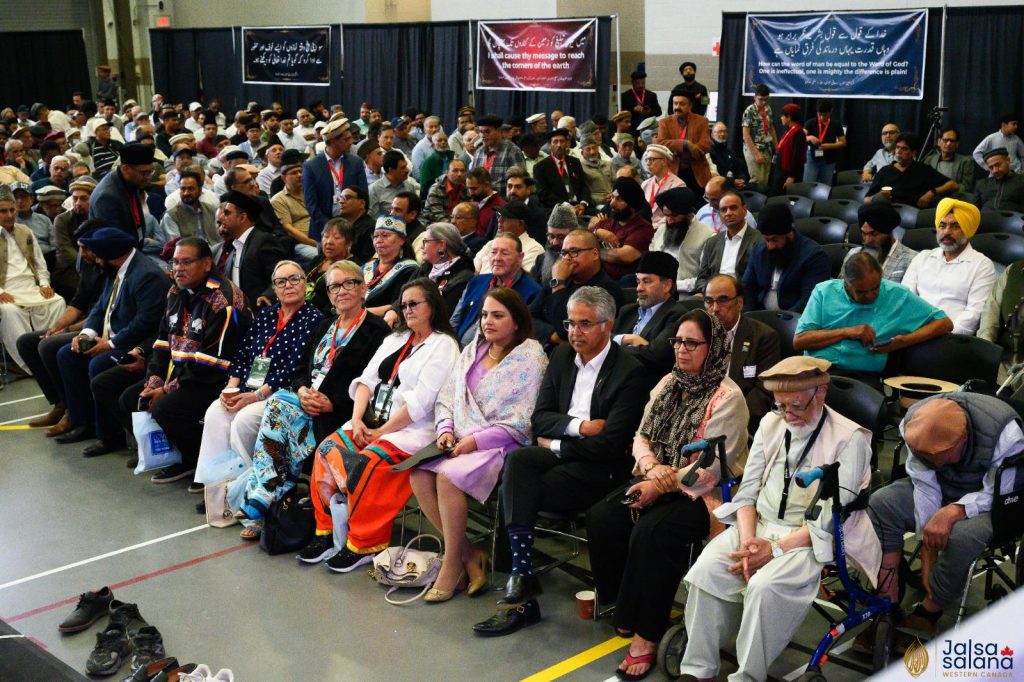
The session closed with an Urdu address by Abdus Sami Khan Sahib, Teacher of Jamia Ahmadiyya Canada , on the bond of love between the Khulafa of Ahmadiyyat and the members of the Jama’at. He spoke of the way this relationship holds the community together, which is spread across more than two hundred countries.
Announcements and lunch followed, with Zuhr and Asr prayers offered in congregation at half past three.
Second session
The afternoon session opened under the chairmanship of Abdul Bari Sahib, Naib Amir of Jama’at Ahmadiyya Canada, again with recitation from the Holy Qur’an, a poem and translations.
Dr Mirza Mohyuddin Sahib spoke on the instructions of the Holy Qur’an concerning cleanliness, treating the subject with a seriousness it is not usually granted. Cleanliness, he argued, is an order imposed on one’s surroundings that answers to an order sought within, and physical cleanliness is the precondition rather than the substitute for spiritual cleanliness. Completing a small task, such as putting things in order, releases dopamine and makes sustained attention easier, which bears directly on the quality of prayer; shared clean space raises oxytocin and reduces the friction of living close together; disorder raises cortisol and pushes out the acceptance that reflection requires.
He then turned to the history. The requirement of wudu and ritual purity, he said, was not an arbitrary imposition. It answered a real danger. While people lived as nomads, waste was dispersed behind them as they moved on. Settled farming changed that. Communities now stayed in one place and lived alongside their own refuse, and those without firm habits of cleanliness ended up dying by disease. Those that made hygiene a rule survived. This point is not only historical, with infections now returning that do not respond to treatment. Cleanliness has become a clinical matter again, after a long absence.
The awards of academic excellence followed, with 109 awards presented across high school, undergraduate, graduate and doctoral levels.
Mansoor Anjum Sahib, Western Canada Coordinator for Humanity First, then presented the work of the organisation. He began with the ninth condition of Bai’at. In it, a member undertakes to serve God’s creatures. This is a condition of entry rather than a virtue recommended to those who feel inclined towards it. Relief work is therefore not something an Ahmadi does alongside his faith. It is part of what they have already promised.
Over its first thirty years Humanity First has assisted more than seventeen million people, responded to 284 disaster relief events across 111 countries, built over one hundred schools and 56 training centres, and installed close to 6,200 water pumps now serving over six million people, alongside hospitals including Nasir Hospital in Guatemala and Masroor Hospital in Ivory Coast, the latter of particular consequence for maternal and infant health in the region it serves. Much of this is carried out by volunteers, and the organisation’s low overhead is a deliberate feature. He described a shift in emphasis over those decades from emergency response towards permanent provision, on the reasoning that a well or a school prevents the crisis that relief would otherwise have to answer, and stressed throughout that assistance is given without regard to the faith or origin of those who receive it.
Guests and the afternoon addresses
The acknowledgement of guests brought several visitors to the stage. Rajan Sawhney, Alberta’s Minister of Indigenous Relations and MLA for Calgary-North West, and Jasraj Singh Hallan, Member of Parliament for Calgary East, both spoke to the community’s place in the life of the city and the province. An Indigenous welcome was offered by Rev John Snow Jr of the Stoney Nakoda First Nation, accompanied by elders including Chief Lee Crowchild, who drew a parallel between the undertakings made under Treaty 7 and the commitments the Jama’at makes about peace, treating both as promises about how a shared land is to be inhabited rather than as documents to be filed.
Sa’ad Hayat Bajwa Sahib, Murabbi Silsila, spoke on faith, simplicity, and purity as they appear in the life of the Holy Prophet (sa). He began by explaining the tiredness that comes from always wanting more. People work longer in order to buy more, he said, and when they achieve their goals, they want more. Against this he gave the example of the Holy Prophet (sa), who owned almost nothing and desired for nothing.
In the Cave of Thaur, with pursuers close enough to be heard, the Holy Prophet (sa) told Hazrat Abu Bakr (ra) not to grieve, since Allah was with them, and Bajwa Sahib offered this statement of what trust in God looks like under pressure. He described the household possessions of the Holy Prophet (sa) which consisted of a mat that left marks on his side and a pillow stuffed with palm fibre, and set beside them, at the height of his authority in Mecca, dried bread and vinegar. Simplicity of this kind is not deprivation but freedom from wanting what others hold. He recalled too the incident of Zahir bin Haram (ra), whom the Holy Prophet (sa) embraced from behind in the market and called and declared him to be of great worth in the sight of Allah.
The final address of the day was given by Shahrukh Rizwan Abid Sahib, Sadr Majlis Khuddamul Ahmadiyya Canada, on love of one’s country as part of faith. Canadian citizenship, he argued, is properly understood as a covenant, and dishonesty in its terms is a religious failure and not simply a legal one. He was specific about this, naming evasion of tax and the withholding of wages as breaches of the Bai’at rather than as ordinary infractions. The reason behind it is that a citizen holds a trust of the nation and that a trust is either honored or broken. He drew the model from Medina, where the Muhajirin did not settle as a separate population but became indispensable to the city that had received them, and he applied it directly to Ahmadi Muslims who have arrived in Canada from places where the freedoms they now enjoy were denied to them. Gratitude of that kind carries obligations rather than discharging them.
He was equally clear that patriotism is not owed unconditionally, since the Holy Qur’an forbids injustice even towards a people one has cause to resent, and that a vote is a trust to be exercised for the good of the country rather than for private or communal advantage, which requires holding those elected to account after they are elected.
Announcements followed the presentations, and dinner was served from 7:00 PM onwards, with proceedings due to resume on Sunday morning. Insha’Allah, the second day’s report will follow.