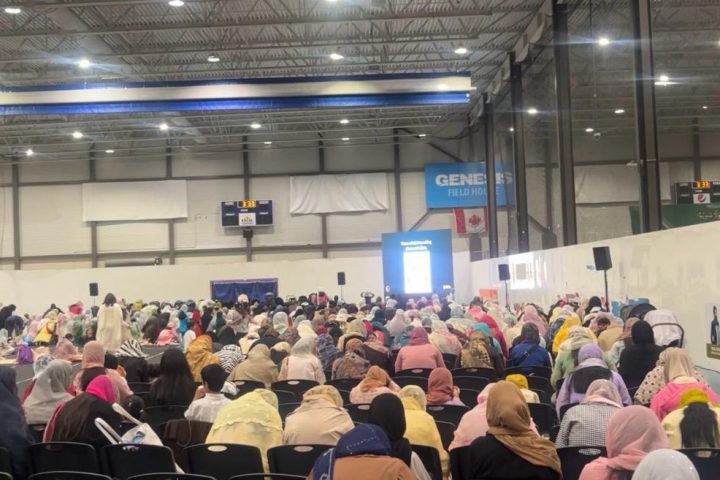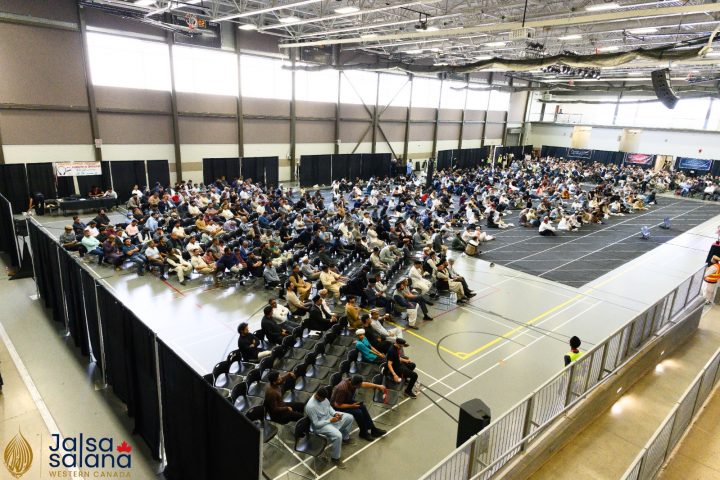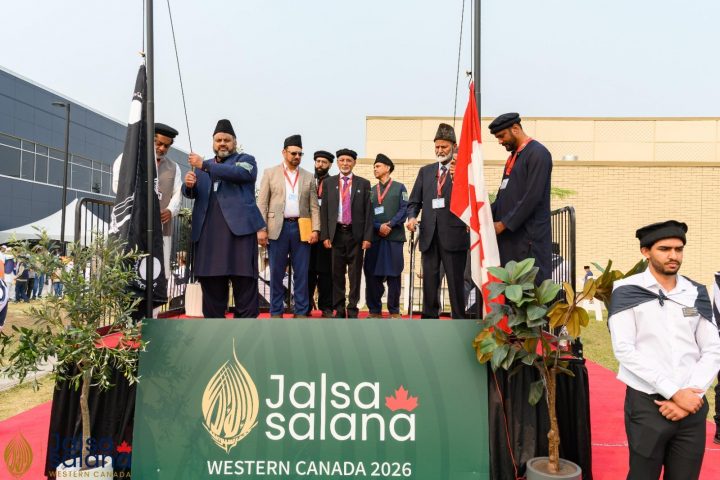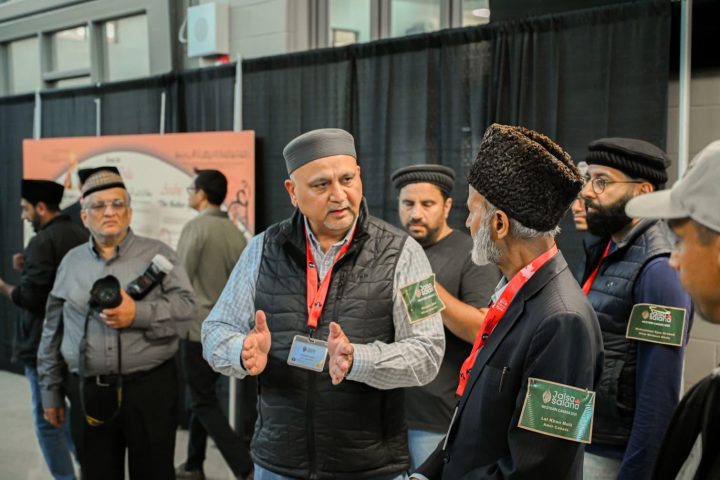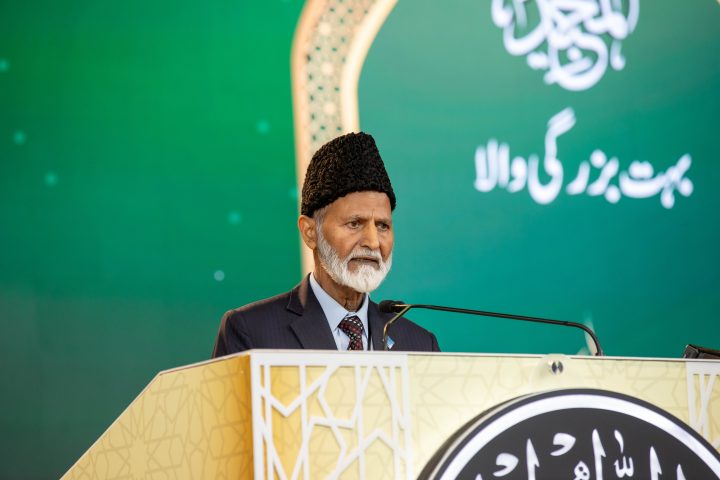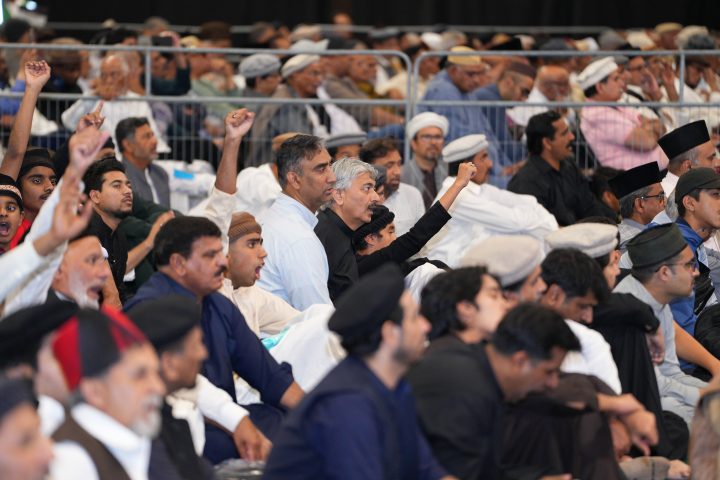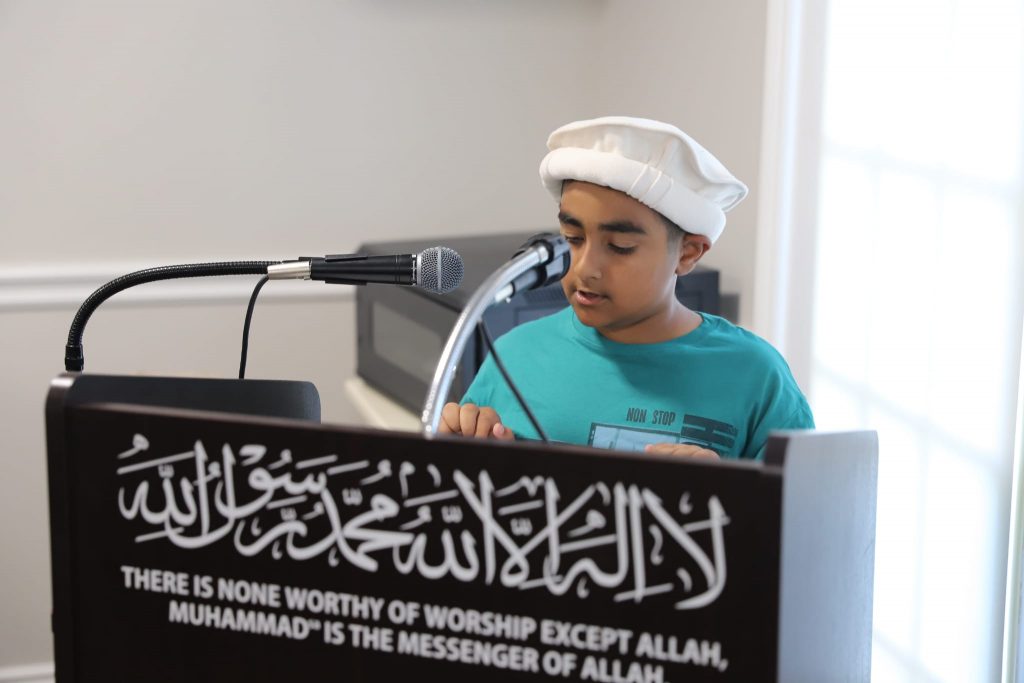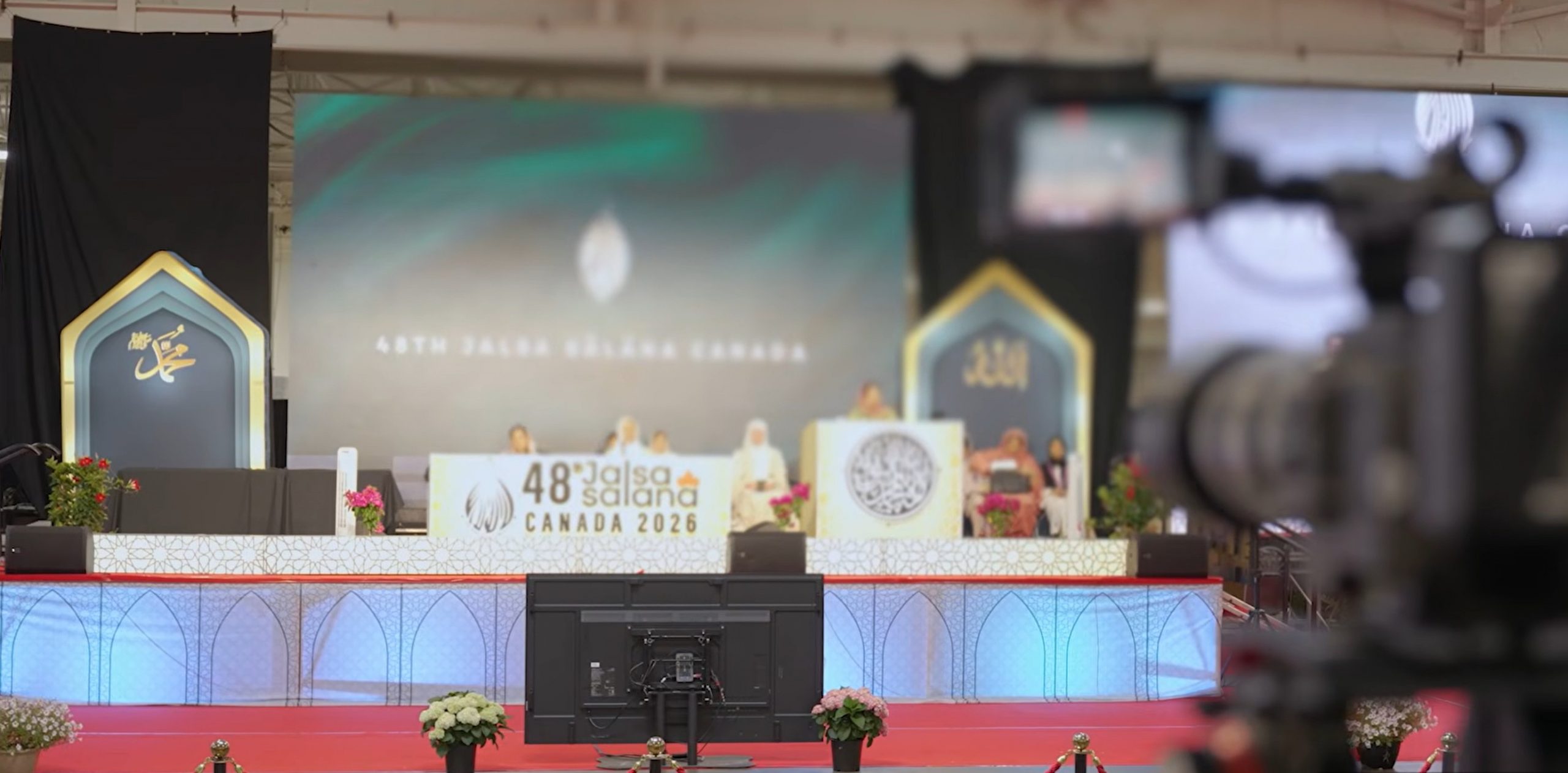
Alhamdulillah, on the afternoon of Saturday, 11 July 2026, the second day of the 48th Jalsa Salana Canada, the Lajna Jalsa Gah at the International Centre in Mississauga, Ontario hosted a session arranged by Lajna Ima’illah Canada. Proceedings opened at 4:00 pm with the Zuhr and ‘Asr prayers offered in congregation, followed by a recitation from the Holy Qur’an with its translation, and a poem presented with its translation. The gathering then turned to a happy piece of business: the academic awards ceremony, in which members were honoured for their educational achievements.

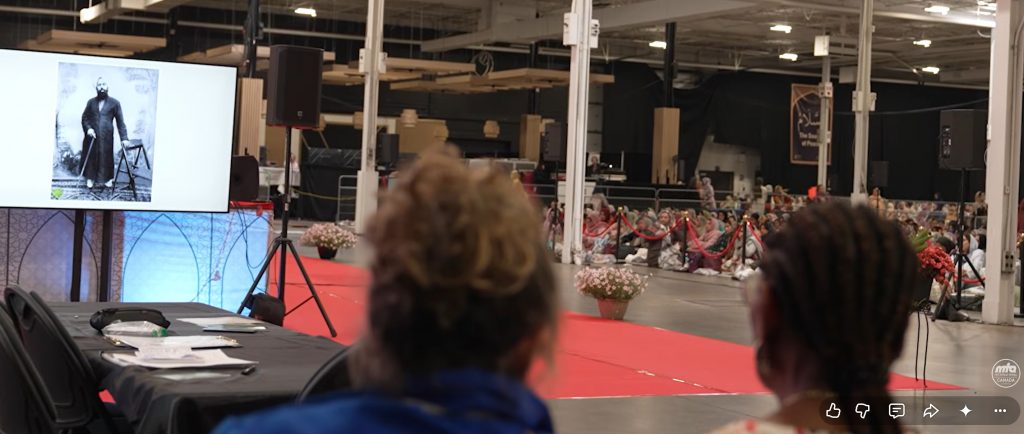
The first address of the afternoon was delivered in English by Daniyah Yaqoob Sahiba, National Sadr of the Ahmadiyya Muslim Women Students’ Association (AMWSA), under the title “Why Islam Ahmadiyyat?” She began with the condition of the modern world, where loneliness, corruption and a loss of purpose have spread, and traced this unease to a lost belief in a saviour. An age such as ours, she argued, stands in need of a divinely appointed guide to distinguish right from wrong, and Muslims have in fact been asking for exactly this for over fourteen centuries, pleading in every prayer, “Guide us on the straight path.”
Turning to the fulfilment of prophecy, she recalled that Muslim scholars of earlier centuries had anticipated the advent of the Promised Messiah at the head of the fourteenth Islamic century, and it was in 1889, corresponding to 1306 and 1307 AH, that Hazrat Mirza Ghulam Ahmad of Qadian, the Promised Messiah (as), accepted the first Bai’at and laid the foundation of the Ahmadiyya Muslim Jama’at. The narrations describing his advent extended even to his dress, picturing a man clothed in two light-coloured garments. The most decisive sign, however, appeared in the heavens. The Holy Prophet Muhammad (sa) foretold, in a narration recorded in Sunan al-Daraqutni, that for the Mahdi the moon would be eclipsed on the first of its appointed nights and the sun on the middle of its appointed days, both within a single Ramadan. Since a lunar eclipse can only fall on the 13th, 14th or 15th of a lunar month, and a solar eclipse only on the 27th, 28th or 29th, the prophecy pointed to the 13th and the 28th of Ramadan. This is precisely what came to pass in 1894, when a lunar eclipse occurred on 13 Ramadan (21 March) and a solar eclipse on 28 Ramadan (6 April), witnessed across the East, including Qadian itself; the following year, the same pair of eclipses appeared over the Western hemisphere, again on the 13th and 28th of Ramadan. The speaker noted that these events are preserved in modern astronomical records, including NASA’s catalogues, where anyone today may confirm their fulfilment.
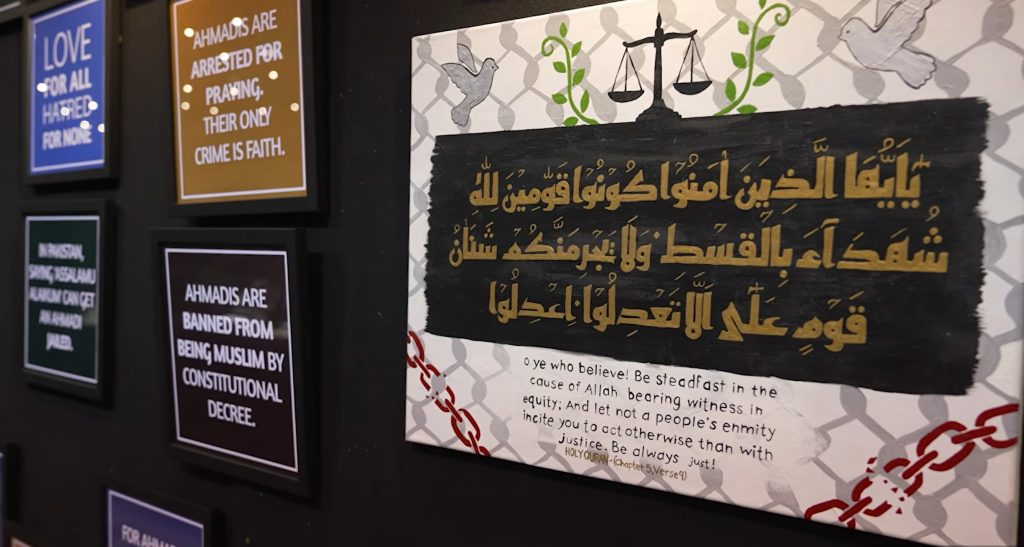
The Arabic qaseedah written by the Promised Messiah (as) was then presented along with its translation.
Kayla Andersen Read Sahiba followed with an account, delivered in English, of her spiritual journey towards Islam Ahmadiyyat. Born in Denver and raised in Canada from the age of four, she grew up in a culturally Christian home with Danish heritage on her father’s side. Attending church in Toronto, she found herself more attached to her Danish culture than to God, and she often wondered why prayers were offered to Jesus rather than directly to the Creator. At thirteen, having never before heard of Islam, she began to notice it in the people around her: a friend whose modest dress spoke of quiet conviction, and a classmate named Omar, whose self-discipline through Ramadan showed her what a genuine commitment to self-improvement could look like. Curiosity led her to research the faith online, and in time she resolved to wear the hijab. Her parents did not fully understand, she recalled, but they supported her quietly, through presence and patience; when she joined her school’s robotics club in 2017, her father stood behind her decision to wear a hijab matching the team colours. For three years she tried to learn Islam on her own before she found the Ahmadiyya Muslim Jama’at, a community she likened to a living ecosystem and a spiritual safety net, where a mentor gave her the guidance she had been missing and taught her to read the Holy Qur’an in Arabic. Faith, she concluded, is not merely a set of beliefs but a way of living, one that has brought her purpose, peace and fulfilment.
Amatul Salam Malik Sahiba, National Mu’awina Sadr and In-charge Wasaya, Lajna Ima’illah Canada, then spoke in Urdu on the theme “Follow in the Footsteps of the Female Companions (ra)”. She recalled that Hazrat Khadija (ra) and Hazrat Abu Bakr (ra) were among the very first to accept Islam, devoting their lives and their wealth to its cause at a time when opposition pressed in from every side; Hazrat Khadija (ra) placed all she owned at the service of the faith. Hazrat Ayesha (ra) was remembered for her profound truthfulness, and for bearing witness to the physical hardships the Holy Prophet (sa) endured. The speaker related the Holy Prophet’s (sa) teaching that charity does not diminish wealth, but rather draws down blessings and protection, and she reminded the audience that the compassion of Islam reaches even to animals and birds, kindness towards whom is itself a sign of faith. She closed with the legacy of sacrifice at Karbala, where even the young of the Holy Prophet’s (sa) family gave their lives for the faith.
Following another poem, the concluding address of the session was delivered in English by Nadia Mahmood Sahiba, National Sadr of Lajna Ima’illah Canada, on “Lajna Ima’illah as Ambassadors of Khilafat”. She took as her starting point 19 October 2025, when 107 students of the Ahmadiyya Muslim Women Students’ Association (AMWSA) Canada, travelling as part of a larger Lajna Ima’illah Canada delegation, were received by Hazrat Mirza Masroor Ahmad, Khalifatul Masih V (may Allah be his Helper), at Masroor Hall in Islamabad, Tilford, UK. In that audience, Huzoor (aba) set before the students three duties: to strengthen their relationship with Allah through the consistent observance of Salat, to establish a distinct and noble identity as Muslim women in Western society, and to convey the message of Islam to the world.
The key to fulfilling this role, the speaker said, is complete and practical obedience to the Khalifa. She reminded the audience that the Holy Qur’an describes the response of true believers in the words “We hear, and we obey” (Surah an-Nur, Ch. 24: V. 52), and that Allah’s promise of Khilafat rests upon such obedience. Obedience, she continued, is lived in ordinary decisions: keeping at least three months of food and water at home, guidance whose wisdom became plain during the pandemic; choosing a spouse on the basis of Taqwa rather than under cultural pressure; celebrating weddings within the guidance the Jama’at has given, free of mixed gatherings, dancing and music; honesty in one’s taxes and one’s Zakat, and care that one’s earnings remain pure; turning to one’s phone for the study of the Holy Qur’an rather than for aimless scrolling; and heeding the instruction, given some twenty years ago, to refrain from posting personal photographs online, an instruction whose foresight is unmistakable in an age of AI deepfakes and misinformation. She also urged members to guard their tongues, keeping their speech free of foul and careless language.
In a world she described as increasingly anxious and drifting from God, Ahmadi Muslim women enjoy a peace and unity found under divinely guided leadership, and it is theirs to share. An ambassador of Khilafat, she concluded, is a woman whose high moral character and living connection with Allah make her a living testament to her faith.
The session drew to a close in the early afternoon with announcements, after which dinner was served to the attendees. May Allah the Almighty enable every member of Lajna Ima’illah Canada to carry this guidance into her daily life, Insha’Allah.