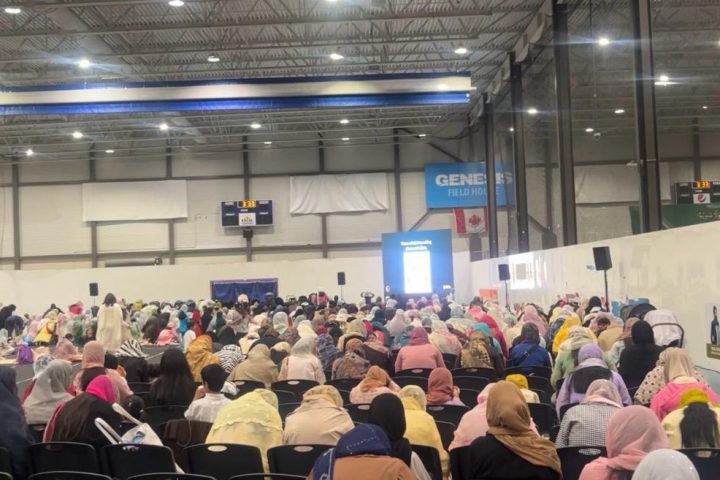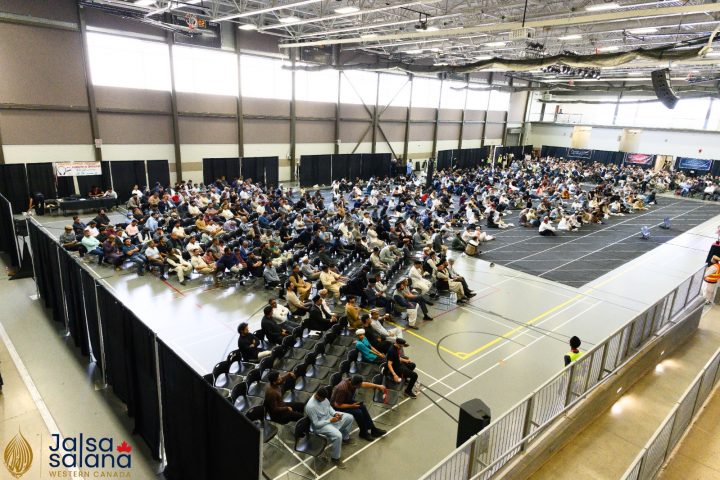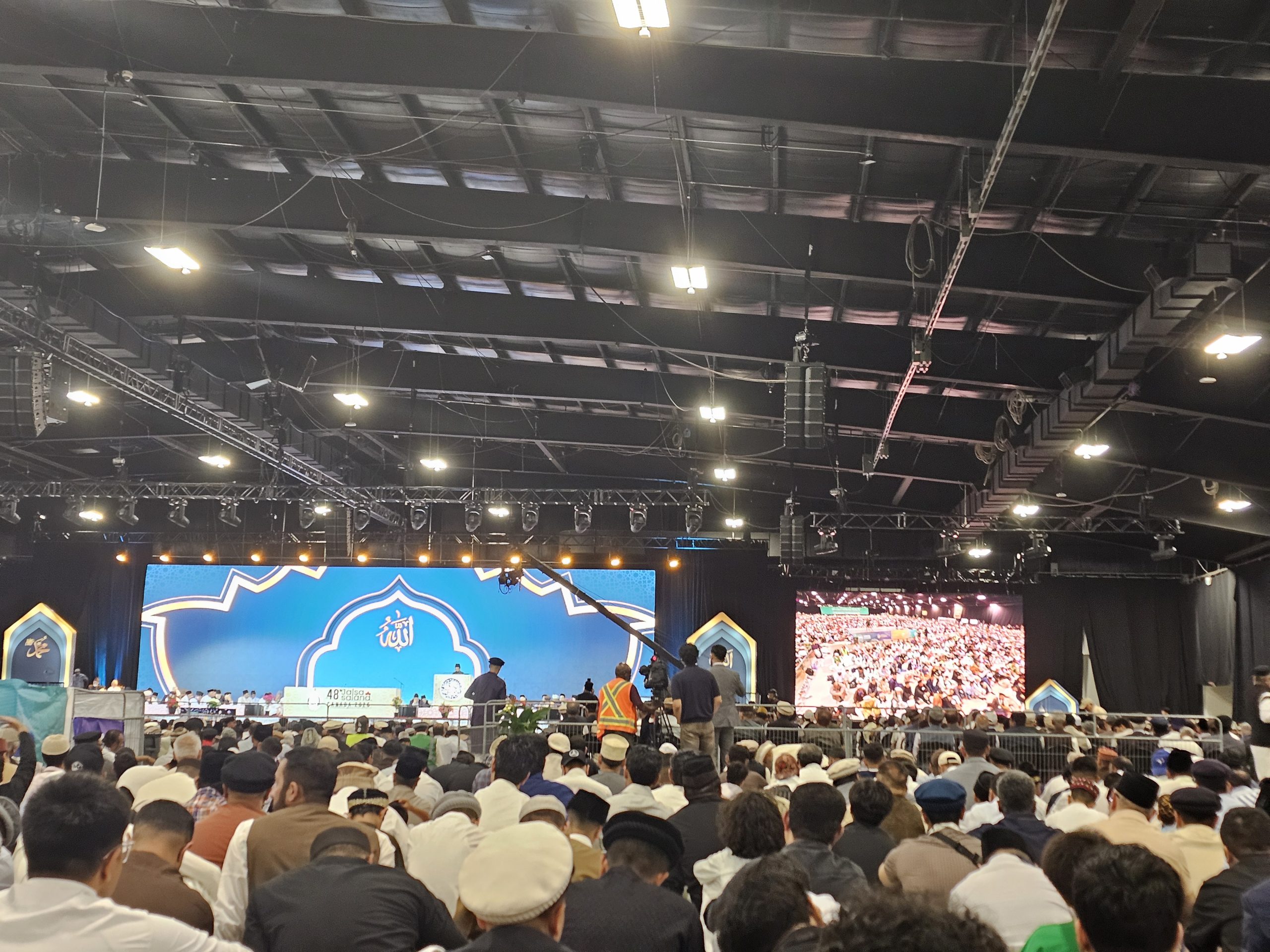
Alhamdulillah, the 48th Jalsa Salana Canada, the annual convention of the Ahmadiyya Muslim Jama’at Canada, opened on 10 July 2026 at The International Centre in Mississauga, Ontario.
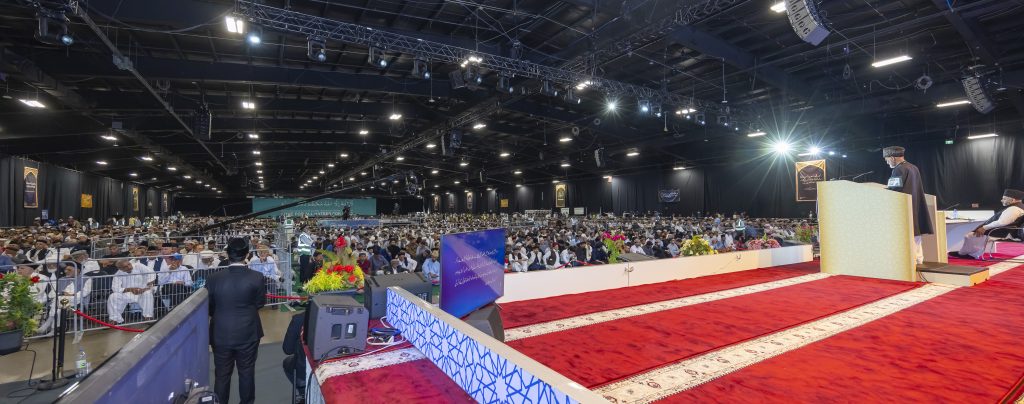
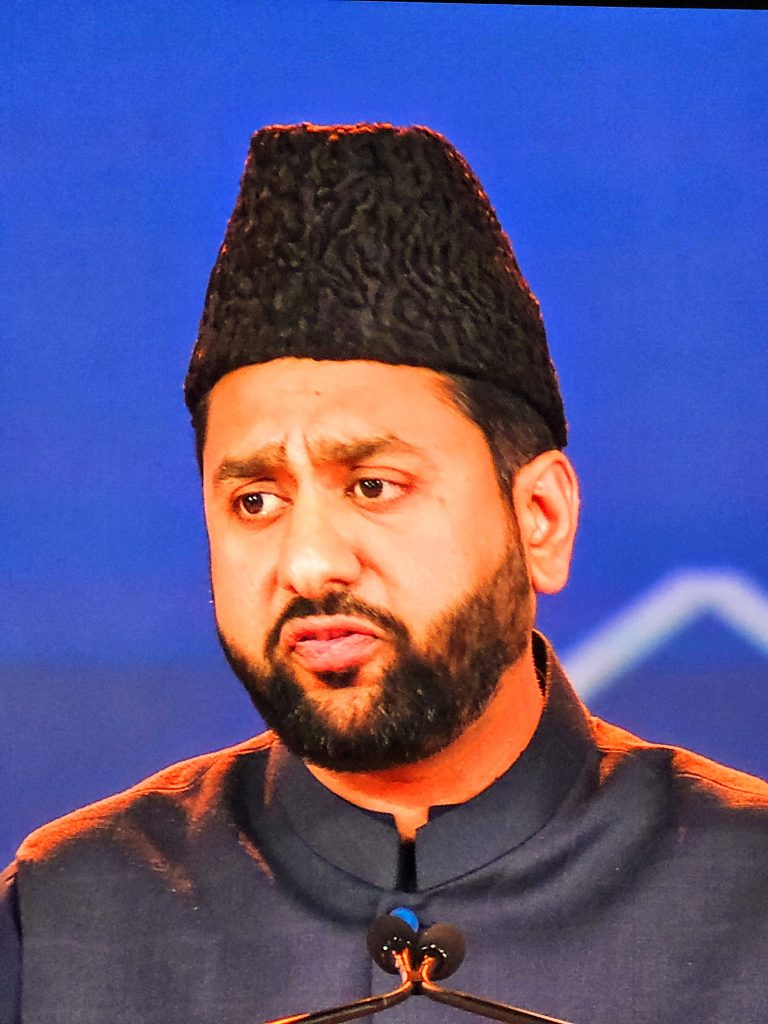
The day began with a repeat broadcast of the Friday Sermon of Hazrat Khalifatul Masih V (aa). Abdul Rashid Anwar Sahib then delivered a local sermon on the true purpose of the Jalsa. He explained that the gathering is not a worldly festival or a formal convention but an occasion for spiritual revival, one in which a heavenly light descends upon those who attend with sincerity. He reminded the congregation that the Jalsa exists to help attendees renew the covenant they took at bay’at. He cautioned in the words of Khalifatul Masih V (aa) that a Jalsa attended by tens of thousands means nothing if it does not advance the taqwa of the attendees. He closed by pointing to the Jama’at’s global responsibility to carry Islam’s teachings of love and peace to the world, urging attendees to treasure what they would hear over the coming days and to carry it home to their families. This was followed by Jumu’ah and Asr prayers and a lunch service for early arrivals.
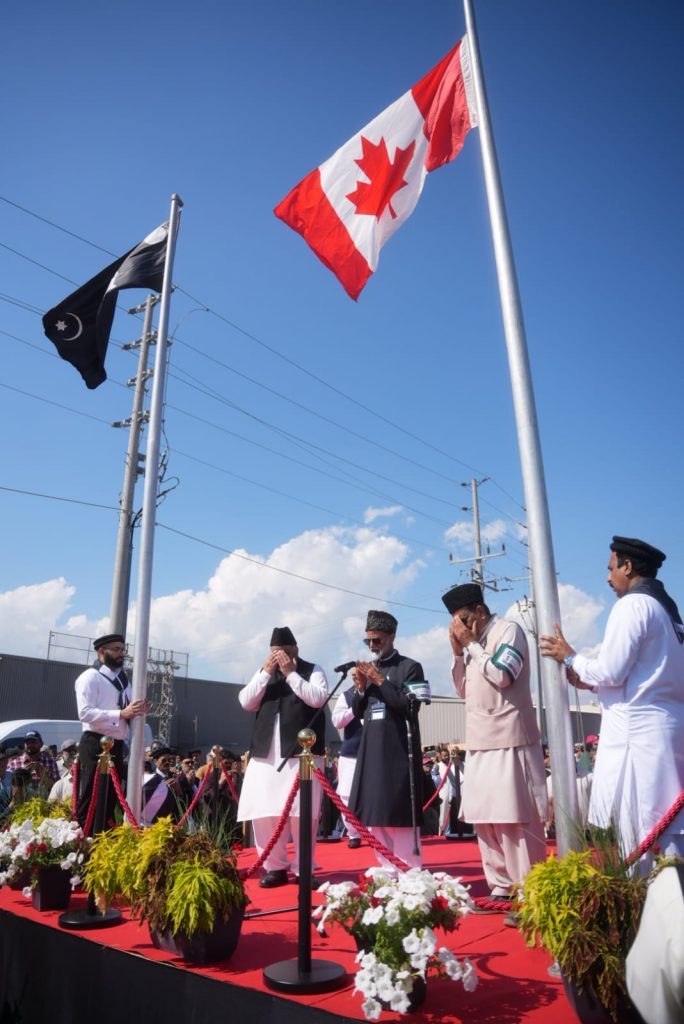
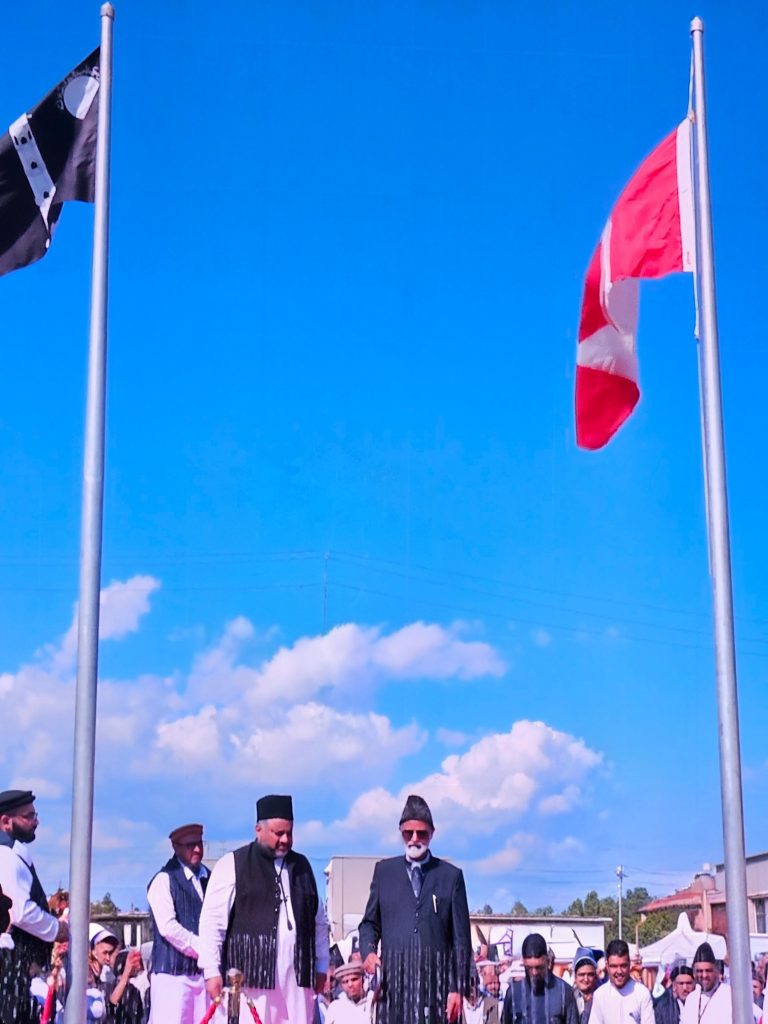
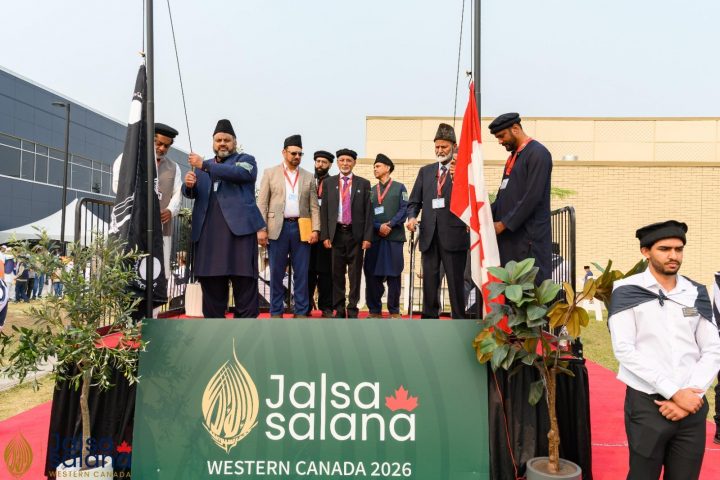
The Liwa-e-Ahmadiyyat was then hoisted, formally inaugurating the convention. The flag is raised at the commencement of every Jalsa Salana to consecrate the gathering for its spiritual purpose and to symbolise the unity of the worldwide Ahmadiyya Muslim Community under Khilafat. The practice traces back to the Promised Messiah’s (as) own words, that “the refuge of my flag will be acquired by every blessed person,” and each hoisting reaffirms both the Jama’at’s religious mission and its loyalty to the country in which the Jalsa is held.
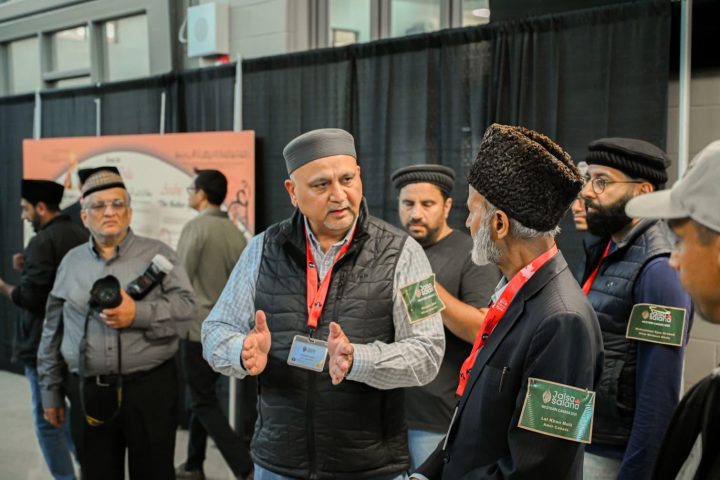
Before the programme began, Respected Amir Sahib, Jama’at Canada Lal Khan Malik, read a special message to the audience from Hazrat Khalifatul Masih V (aba). Huzoor (aba) reminded members that the Jama’at’s purpose is to revive a true comprehension of God and to re-establish a righteousness and purity that has largely vanished from the modern world. He urged every Ahmadi to build a personal relationship with Allah through regular, sincere prayer and constant remembrance, and to pursue Taqwa as a lived discipline. Huzoor (aba) closed by reaffirming that absolute obedience and loyalty to Khilafat remain the essential keys to the Jama’at’s continued progress and everlasting success.
The First Session opened with a recitation from the Holy Qur’an by Hafiz Mazhar Ahmad Sahib, from Surah Al-Ahzab, Chapter 33, verses 70 to 74, followed by Tahir Ahmed Sahib’s English translation. The verses opened with a caution against slandering the prophets, recalling how Allah cleared Moses (as) of the false accusations levelled against him, before turning to command believers to fear Allah and to speak only what is right, promising that truthful speech would see one’s works set right and one’s sins forgiven. The recitation moved into the verse describing the Trust that the heavens, the earth, and the mountains were offered and refused to bear, a Trust that man alone accepted, and closed on Allah’s mercy extended to believing men and women, fitting words to open three days set aside for spiritual renewal.
Man should search for the spiritual water
Abdul Noor Abid Sahib, Missionary and Professor at Jamia Ahmadiyya Canada, followed with an Urdu address titled “Acceptance of Prayer as a Powerful Argument for the Existence of God.” He pointed to documented instances during the Promised Messiah’s (as) own lifetime, in Sri Lanka and in parts of Africa, where prayers offered in his name were said to have been accepted as living signs of God’s power. “Man should search for the spiritual water, he will certainly find it; he should search for spiritual bread, it will certainly be granted,” he said. “As there is a law of nature for physical needs, there is also a law of nature for spiritual needs; but seeking is the prerequisite.”
Aizaz Ahmad Khan Sahib, Missionary of the Ahmadiyya Muslim Jama’at Canada, followed with an English address on “The Holy Prophet Muhammad (sa): The Liberator of Mankind.” He traced how the Prophet (sa) dismantled the social hierarchies of pre-Islamic Arabia, recalling how he honoured Hazrat Bilal (ra), a formerly enslaved man, over the tribal chiefs of Mecca, and how he rebuked companions who used derogatory racial language, citing the Farewell Sermon’s declaration: “All of mankind is from Adam and Eve. No Arab has any superiority over a non-Arab, nor does a non-Arab have any superiority over an Arab; a white does not have any superiority over a black, nor does a black have any superiority over a white except through piety and good actions.”
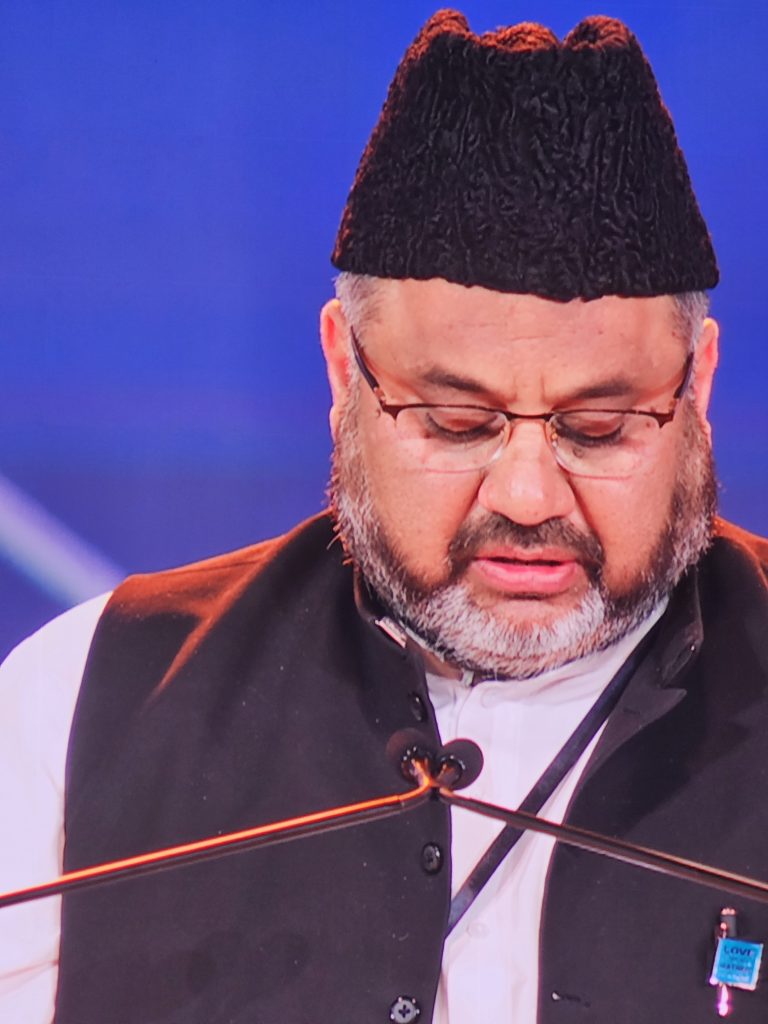
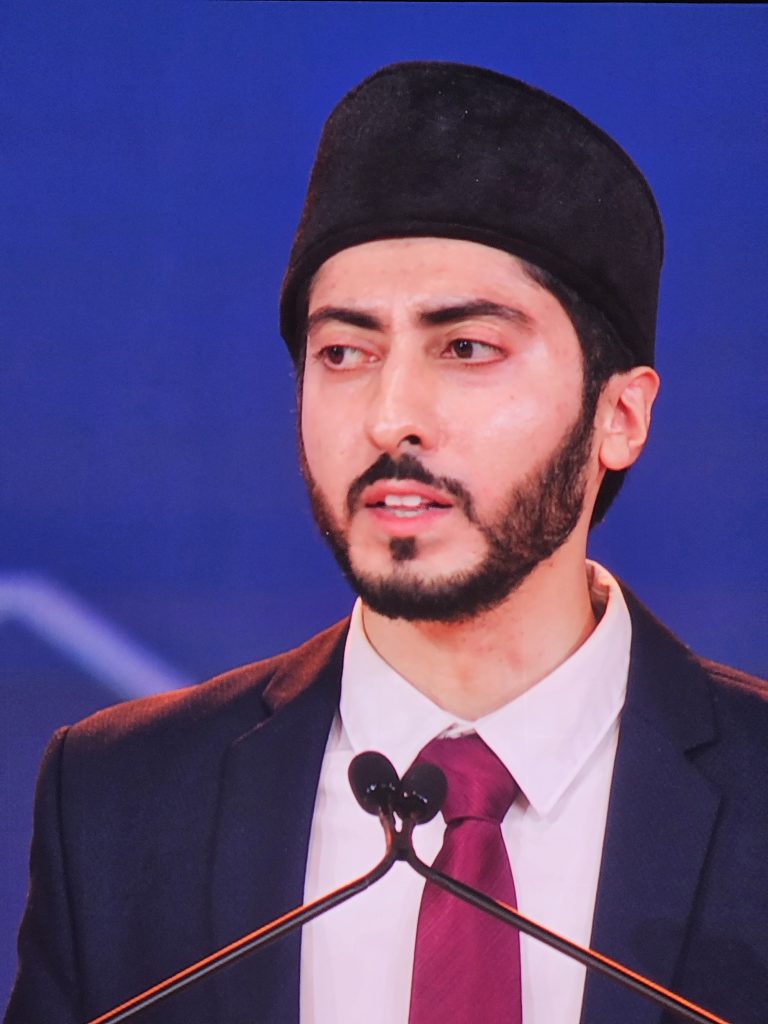
Turning to the prohibition of alcohol, he noted that Medina saw a near-immediate, voluntary abandonment of drinking once it was forbidden, a contrast he drew against the World Health Organization’s estimate of 2.6 million alcohol-related deaths worldwide each year, arguing that lasting change comes from a transformed heart rather than legal enforcement alone. On the status of women, he said: “The greatest contribution of the Holy Prophet (sa) towards the liberation of women was recognizing the full humanity and the spiritual and social equality of a woman.” He closed by connecting the Prophet’s example to the Promised Messiah’s own devotion to him, noting that this liberation came not through a single decree but through small, repeated changes in how people treated one another.
All of mankind is from Adam and Eve.
Maulana Sohail Mubarak Ahmad Sharma Sahib, Na’ib Amir and Missionary-in-Charge, closed the session with an English address on “Truthfulness: The Foundation of Peace in Society.” He defined truthfulness as harmony between what a person shows outwardly and what they hold within, telling the congregation: “If truthfulness is the foundation of peace, then lying is the root of chaos and corruption.” He recounted the 1897 case in which Dr. Henry Martyn Clark accused the Promised Messiah (as) of attempted murder, a charge carrying the possibility of a death sentence, and how his lawyers urged him to give an ambiguous answer rather than risk the truth. Quoting the Promised Messiah’s (as) own reply, he said: “I have come to establish truthfulness. I will never tell a lie even if I am hanged… God has sent me to set an example for mankind; I cannot present a false example merely to save my life.” He pointed to the Prophet’s (sa) reputation among friend and foe alike as Al-Sadiq and Al-Amin, the Truthful and the Trustworthy, and linked the erosion of truthful speech in the home to the erosion of peace between nations, pointing to the justifications offered for the Iraq War as an example.
I have come to establish truthfulness.
It is important to note that he reached for an example of war to make a point about honesty at home. For this Jama’at of the Promised Messiah (as), peace does not start with treaties or policy. It starts with whether people can trust what is said around their own dinner table.
The session closed with announcements, silent prayer, and dinner service. Maghrib and Isha’a prayers were offered at local mosques.
Insha’Allah, coverage of the Second, Third and Fourth Sessions, together with the Ladies’ session, will follow in subsequent reports.