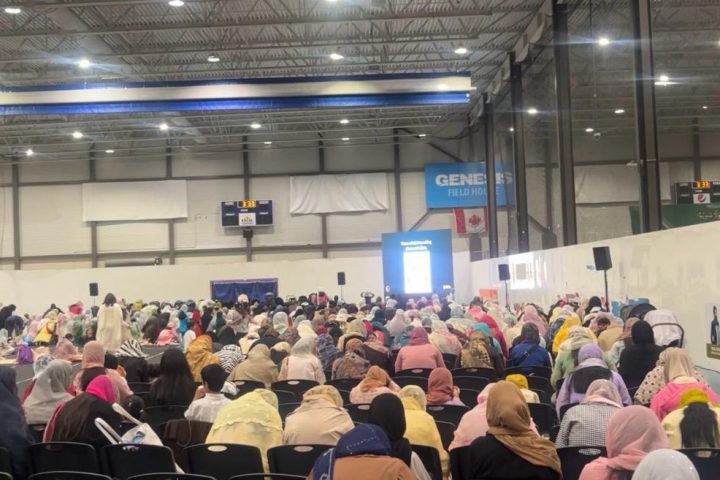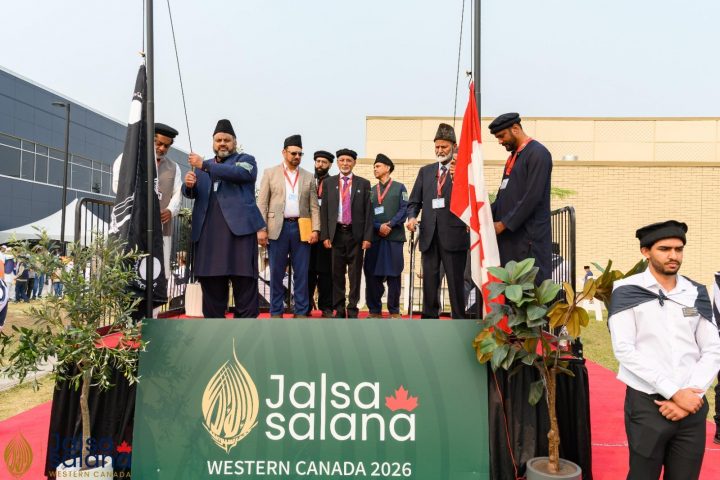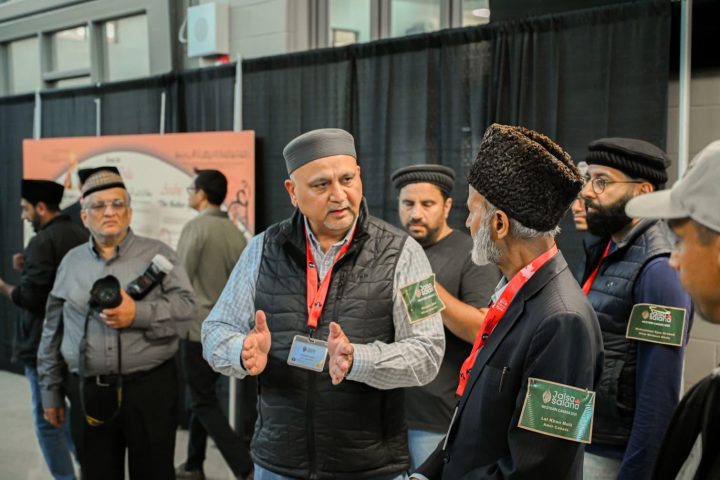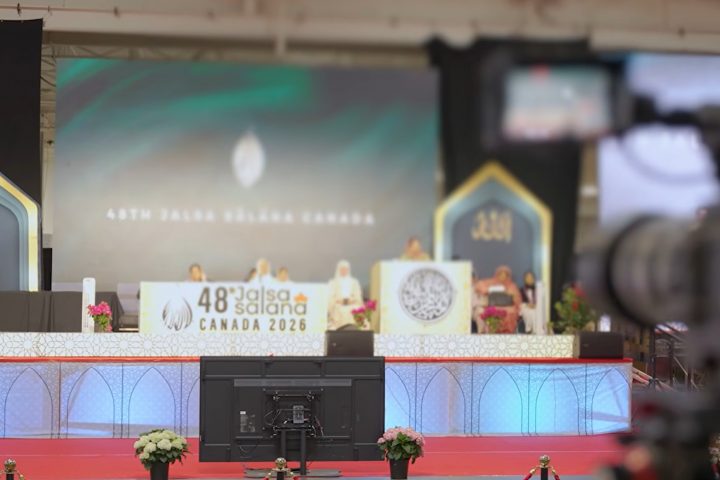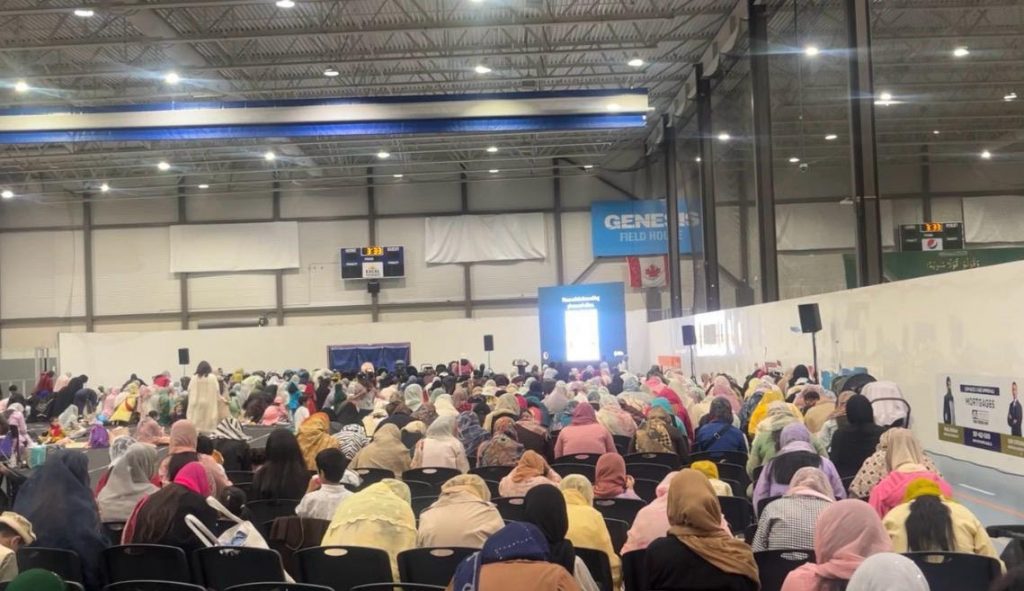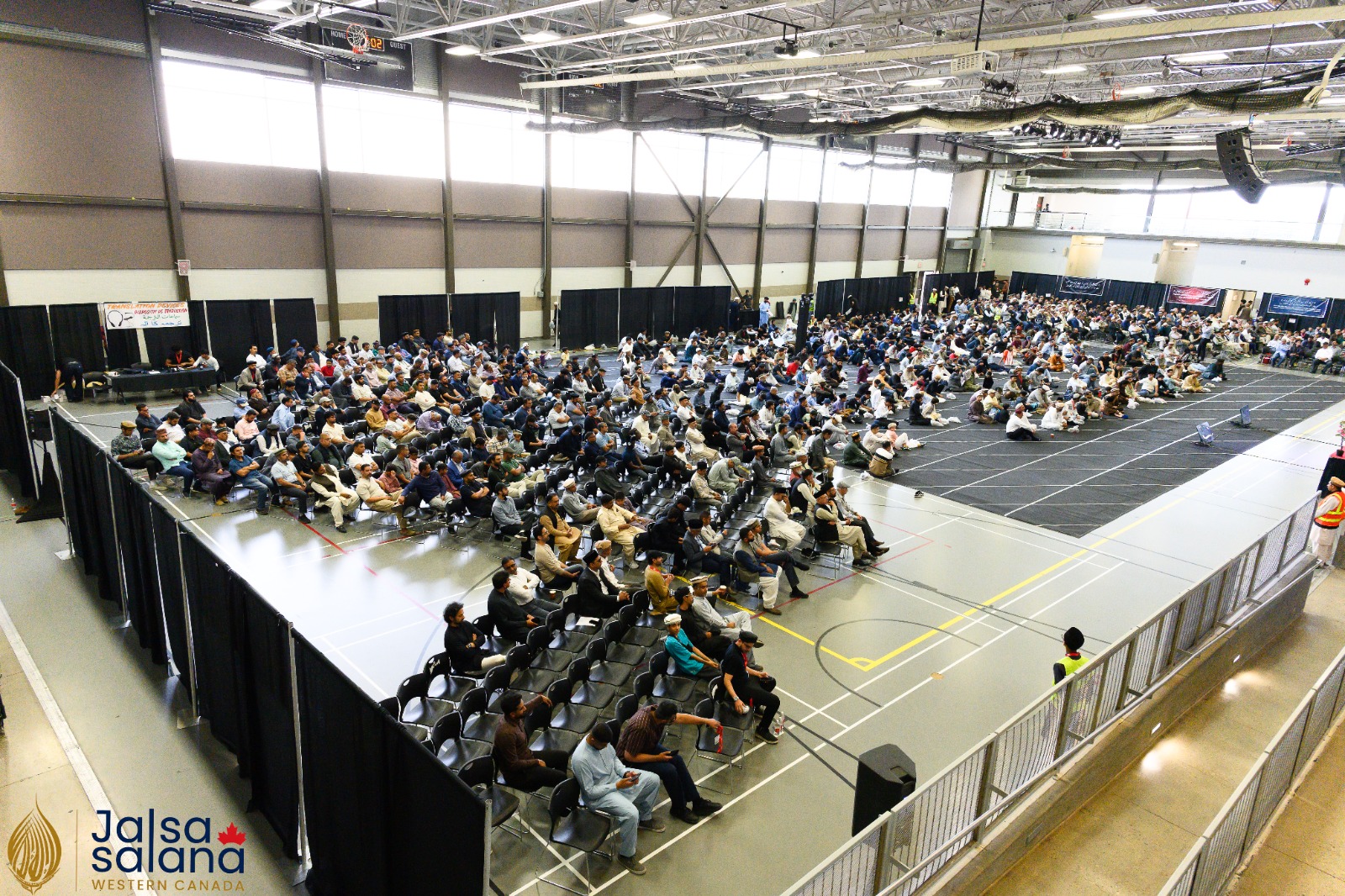
Alhamdulillah, the second and concluding day of the 42nd Jalsa Salana Western Canada, held on 9 August 2026 at the Genesis Centre in Calgary, comprised two sessions and six addresses. The morning session took up the obligations that Islam places on the individual in the home and in speech, in dealing with parents, in the handling of news and rumour, in the choice of a spouse, and in the remembrance of God. The concluding session turned to the community’s relationship with Khilafat and to the purpose for which Ahmadi Muslims have been settled in Canada.
Third Session
The morning session was presided over by Respected Maulana Azhar Hanif Sahib, Missionary in Charge and Na’ib Amir of the Ahmadiyya Muslim Jama’at USA, who travelled to Calgary on the special invitation from the Jalsa Salana Administration. It opened with a recitation of verses 14 to 17 of Surah Al-Ahqaf [Al-Ahqaf, ch.46:v.14-17]. The verses speak of those who declare Allah to be their Lord and then remain steadfast, and enjoin kindness on parents. They close with the prayer of the servant who, on reaching the age of forty, asks for the power to be grateful for the favours shown to him and to his parents. A poem of the Promised Messiah (as) was read in Urdu with an English translation.
Abdul Bari Sahib, Na’ib Amir of the Jama’at in Canada, delivered the first address in Urdu on the Quranic command to show kindness to parents [Bani Isra’il, ch.17:v.24]. He explained that the word used in the verses is ihsaan, which asks for more than duty or civility, and that the command is directed particularly at the years when parents grow old and become dependent. Drawing on the Quranic account of the mother who carries and bears her child in hardship and whose bearing and weaning extend over thirty months, he said the obligation rests on a debt that cannot be calculated and therefore cannot be paid. Children are forbidden even a word of irritation towards their parents, and are instructed instead to pray for them, in the terms the Holy Qur’an itself supplies, that God may have mercy on them as they nurtured their children in childhood. Abdul Bari Sahib added that this prayer is not suspended by death, and that continuing to pray for parents who have passed away keeps a family’s faith connected across generations.
Usman Jamil Sahib of Ahmadiyya Muslim School Calgary, spoke next on truthfulness in narration, taking as his basis the saying of the Holy Prophet (sa) that it is enough to make a person a liar that he narrates everything he hears. He began with the killing of a young software engineer by a mob in Bidar district in Karnataka in July 2018, after rumours of child abductors had circulated on WhatsApp, and used it to argue that an unverified message is not a harmless thing passed on but a link in a chain that ends in real injury. He cited the Quranic instruction that when news is brought by one whose reliability is not established, it must be fully investigated before it is acted upon [Al-Hujurat, ch.49:v.7], and observed that the standard applies as much to what is forwarded from a keyboard as to what is spoken aloud. The Incident of Ifk, in which a false accusation was raised against Hazrat Aisha (ra) and was met by the Holy Prophet (sa) with patience and inquiry until her innocence was declared in Surah Al-Nur, was presented as the model for how slander is to be answered. Usman Jamil Sahib closed by reminding the audience that in the fourth condition of Bai’at, an Ahmadi Muslim undertakes to abstain from causing harm by their tongue.
Mir Majeed Ahmad Tariq Sahib, Additional Secretary Rishta Nata Canada, addressed the path to a blessed marriage. He described marriage as an act of worship and the foundation on which families and, through them, the community rest, rather than a private arrangement or a stage in life. Citing research associating pre-marital cohabitation with higher rates of marital breakdown, he argued that the arrangements presented as normal in the wider culture do not in fact deliver what they promise. Religious character, he said, is the one criterion that continues to hold a marriage together once wealth, status and physical attraction have ceased to be decisive. He also placed the matter in terms of the next generation, noting that the rights of a child begin before birth, with the parents’ choice of a righteous spouse.
The session’s final address was delivered by Maulana Azhar Hanif Sahib on reviving the soul through the remembrance of Allah. He likened the heart to iron, which rusts unless it is polished, and identified Zikr as the polish. Remembrance, he cautioned, is not a numbers game and is not discharged by counting; it is a relationship, and where there is love for God, the remembrance of Him follows as naturally as fragrance from a flower. He pointed to the practice of the Holy Prophet (sa), who remembered God sitting, standing and lying down, and to his counsel to Hazrat Fatima (ra) to recite the tasbih before sleeping when she asked for relief from the labour of her household. Azhar Hanif Sahib concluded with the comparison drawn by the Holy Prophet (sa) between one who remembers his Lord and one who does not, which is the comparison between the living and the dead, and urged the audience to keep God first in a setting crowded with material distraction.
Fourth Session
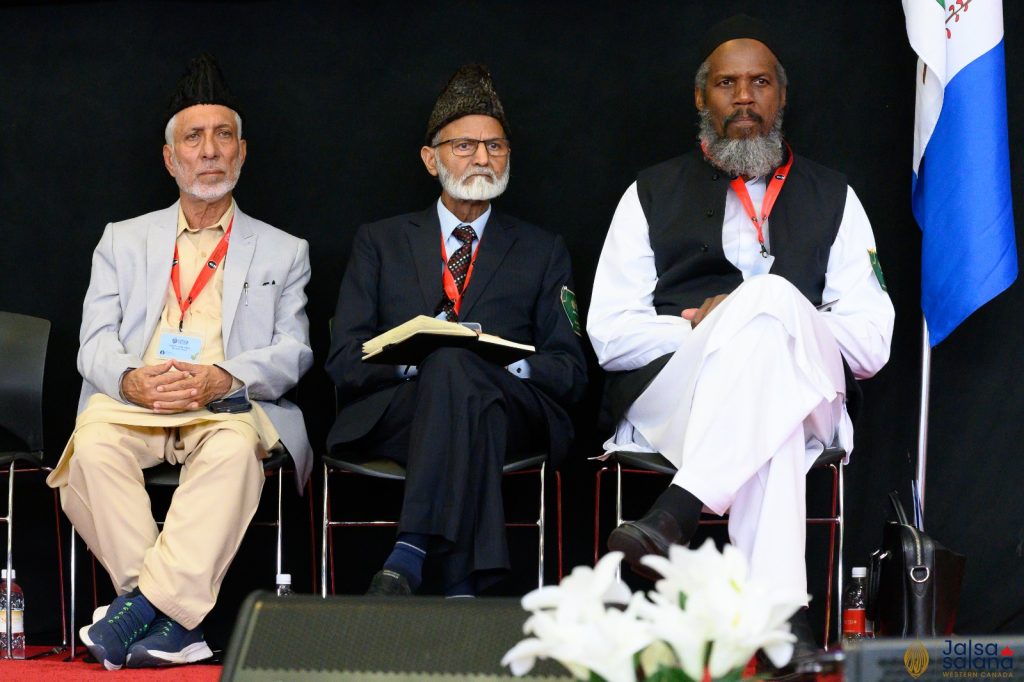
The concluding session was presided over by Lal Khan Malik Sahib, National Amir of the Ahmadiyya Muslim Jama’at Canada. It opened with a recitation from Surah Al-Anfal [ch.8:v.25], on the command to respond to Allah and to His Messenger when they call towards that which gives life. After recitation of a poem, a prayer was offered for members of the Western Canada Jama’at who had passed away during the year.
Hafiz Attaul Wahab Sahib, Murabbi Silsila, spoke on the sermons of Hazrat Khalifatul Masih V (aba) as a path to spiritual advancement. He drew his central image from an everyday example, stating that a branch cut from a tree does not recover on its own, but the same branch, grafted back onto a living tree of the same kind, takes root and bears fruit again. Khilafat, he said, is that living tree, and the Khalifa carries out the prophetic tasks of purifying hearts and teaching the Book and wisdom. He contrasted the Friday sermon with the abundance of material available online, observing that reach and influence are not the same thing as truth, and that a following measured in millions guarantees nothing about what is being transmitted. Members who find spiritual discipline effortful at first, he added, should persist, since the taste for it is acquired rather than immediate. He also reminded the audience that the Khalifa spends his nights in prayer for members of the Jama’at, and asked that the obligation be met from the other side by listening to his sermons with attention.
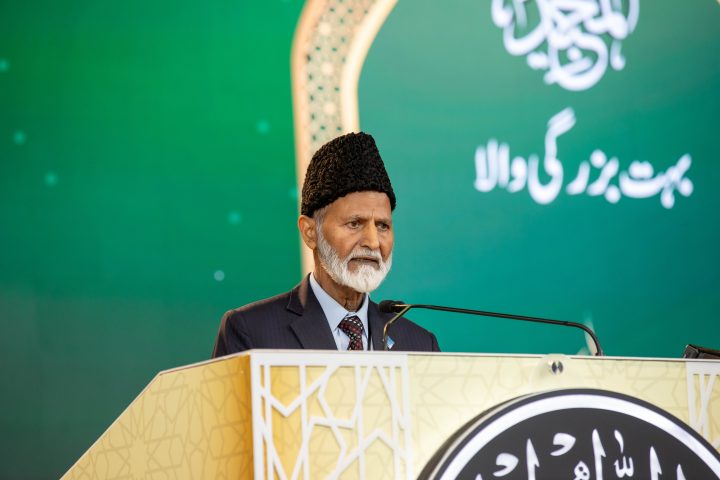
National Amir Sahib delivered the concluding address in English and Urdu, on identity and legacy. Speaking to a hall containing many who had come to Canada as migrants, he said they should not think of themselves as people who had merely been displaced. They had been planted. The circumstances that drove Ahmadi Muslims out of the countries of their birth had distributed them across the world for a purpose, and they were the seed of Islam Ahmadiyyat sown in Canadian soil. He warned that a seed which does not know what it is will not grow into what it could be, and illustrated the point with the account of an orphaned lion cub raised among sheep, which lived as a sheep because it had never been shown its own reflection. The young people of the Jama’at, he said, are ambassadors of Islam, and their careers, their conduct as parents and their financial honesty, including the accurate declaration of income, are themselves a form of preaching in a secular state.
Amir Sahib cautioned against the complacency that follows material security, recalling the generation of Moses (as) who settled where they were and lost the inheritance that had been promised to them. He recited the words of the Promised Messiah (as): “And the third century, from this day, will not be completed when those who wait for Jesus (as), both Muslims and Christians, will become deeply despaired and disillusioned, and will abandon this false belief. And there will be only one religion in the world, and only one Leader. I have come only to sow a seed, so that seed has been sown by my hand. And now it will grow and flourish, and none can stop it.” (Tadhkirat-ul-Shahadatain, Ruhani Khazain, Vol. 20, p. 67.)
The revival of Islam, he said, has a ransom attached to it, and the ransom is to die in this path, in the sense of giving up personal comfort, time, and preference for the sake of the work. A legacy is not what is left behind at death but what continues to live afterwards.
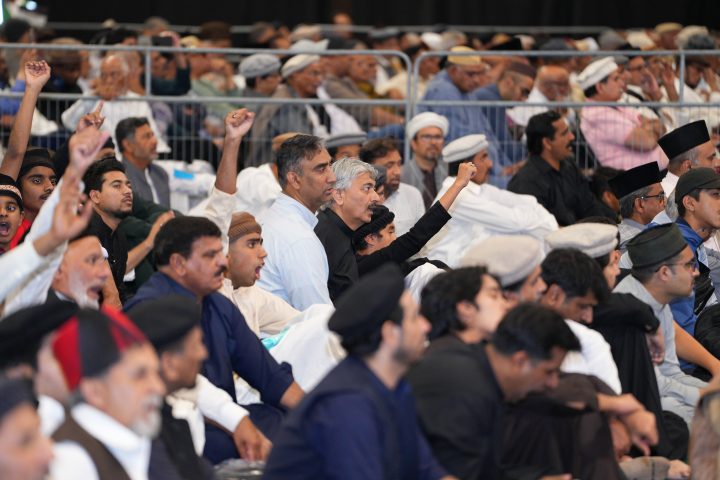
Announcements followed the address. Total attendance at the 42nd Jalsa Salana Western Canada was 5,364, including 559 guests. Coverage of the convention was viewed more than 280,000 times across social media platforms. By the grace of Allah, eleven people took Bai’at during the Jalsa, among them two Canadian families of Afghan origin.
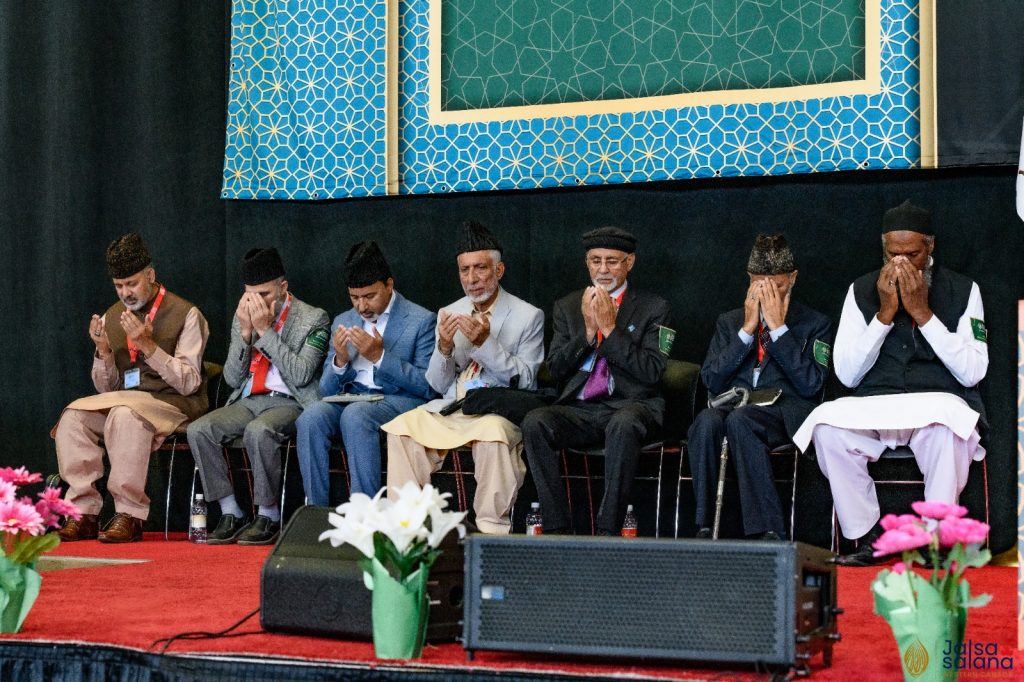
The Jalsa concluded with silent prayer led by the National Amir Sahib, offered for the volunteers, for those who had attended, and for all those affected by the wildfires burning across British Columbia, where a provincial state of emergency had been declared the previous day and some twenty-two thousand people were under evacuation orders.
May Allah accept the prayers offered at this Jalsa and grant its attendees the fulfilment of the promise made to the Promised Messiah (as) regarding those who travel for its sake, Insha’Allah. Ameen.